What Is Fabric Protocol (ROBO)? A Robotic AI with Its Own Crypto Wallet
2026-03-06
Fabric Protocol (ROBO) is one of the most ambitious crypto projects born at the intersection of artificial intelligence and physical robotics — a decentralized infrastructure that allows robots to have their own cryptographic identities, conduct transactions autonomously, and coordinate with each other without human intervention.
The ROBO token was officially listed on major exchanges on March 4, 2026, with trading volume surpassing $142 million on its first day. ROBO's current price is $0.0411 (Rp695), having reached an all-time high of $0.0607 (Rp1,026) post-listing — a reasonable correction for a new token with a revolutionary narrative.
Key Takeaways
Fabric Protocol is the “nervous system” for the global robotics industry — enabling robots from different manufacturers like UBTech, AgiBot, and Fourier to share intelligence, make on-chain payments, and verify their real-world work without relying on a centralized platform.
ROBO is backed by a $20 million funding round led by Pantera Capital, with a total supply of 10 billion tokens and 2.2 billion (22%) already in circulation — insiders (team and investors) face a 12-month cliffhanger meaning no tokens will be unlocked for them in the first year.
Fabric Protocol operates on top of Base (Coinbase's Layer-2 network) today and is in preparation for migration to a dedicated Layer-1 blockchain called Fabric L1 — an infrastructure designed to capture direct economic value from robotic activity on a global scale.
Register at Bittime now and start trading crypto with a fast, safe, and easy process in the app.
Problem to be Solved: "Isolation Problem" in the Robotics Industry
To understand why the Fabric Protocol is important, we need to understand the current state of the robotics industry. Imagine a factory that uses robots from three different manufacturers—for example, a robotic arm from UBTech, a delivery robot from AgiBot, and an inspection robot from Fourier.
These three robots cannot communicate with each other, cannot share data securely, and cannot perform automated transactions such as, for example, ordering raw materials when stocks are low.
This is what Fabric Protocol calls the “Isolation Problem” — each brand of robot operates in its own closed ecosystem, like unconnected islands.
As a result, inter-robot coordination requires expensive custom integration, complex maintenance, and is always dependent on a single vendor platform that can change policies at any time.
Fabric Protocol exists as a neutral layer that unites all these robots in one open standard.
By integrating OpenMind's OM1 operating system with blockchain infrastructure, each robot can obtain its own unique cryptographic identity — like a "digital ID card" recognized by the entire network, regardless of who manufactured it.
Read also:What is CZAGENT? A Complete Guide and Discussion
How Can a Robot Have a Crypto Wallet?
This is the most exciting and revolutionary concept of the Fabric Protocol. In this ecosystem, every robot is more than just a tool—it's an independent economic actor that can autonomously own, store, and transfer value.
Technically, it works through three interconnected components.
First, robot identity layer: each robot gets a cryptographic key pair (like a wallet address) recorded on the blockchain, making it transparently identifiable, verifiable, and auditable.
Second, machine-to-machine payment: robots can pay for the services they need — for example, charging fees, sensor data access fees, or coordination fees with other robots — using ROBO as the settlement currency, without the need for humans to authorize each transaction.
Third, Proof-of-Robotic-Work (PoRW): a unique consensus mechanism that verifies that robots have actually done real work in the physical world before being rewarded.
Unlike regular Proof-of-Stake, which simply locks tokens passively, PoRW requires verified proof of work — making reward distribution much fairer and based on real contributions.
To illustrate: a delivery robot can automatically pay for parking, recharge its battery at a Fabric-enabled charging station, and receive payment from clients — all in one work session without a single human needing to press a confirmation button.
Read also:What Is Definitive (EDGE)? A Platform for Master Traders
Fabric Protocol Product Ecosystem
Fabric Protocol is built as a layered technology stack that covers the entire lifecycle of a robot in the modern economy:
OM1 Universal Operating System: An operating system for robotics developed by OpenMind, enabling robots from different manufacturers to run the same artificial intelligence and communicate in a universally understood "language." OM1 is a software layer that bridges the gap between machine intelligence and the Fabric blockchain infrastructure.
Decentralized Coordination Pools: A mechanism that allows individuals or institutions to collectively fund the deployment of a fleet of robots for specific tasks—for example, funding 50 delivery robots for a remote area where a single operator is unprofitable. This opens up new business models that wouldn't be possible with centralized infrastructure.
Robot Skill App Store (coming soon): An open marketplace for developers worldwide who want to sell or distribute new skills for robots. A developer in Jakarta could write a "forest fire detection" skill and sell it to firefighting robots around the world through this platform.
Fabric L1 (in development): A specialized Layer-1 blockchain designed from the ground up for the needs of the machine economy—the high-volume, low-latency transactions required for real-time robot coordination. The migration from Base to Fabric L1 will be a key milestone in the project's roadmap.
Adaptive Emission EngineA dynamic token issuance system that adjusts ROBO emissions based on network utilization and verified work quality—rather than a rigid, fixed schedule. This means that when more robots are working and the network is more active, more ROBOs are issued as rewards. Conversely, when activity is low, emissions automatically slow down to maintain supply-demand balance.
Read also:What Is Dvision Network (DVI)? The NFT Metaverse That's Still Going
ROBO Tokenomics: Designed for the Long Term
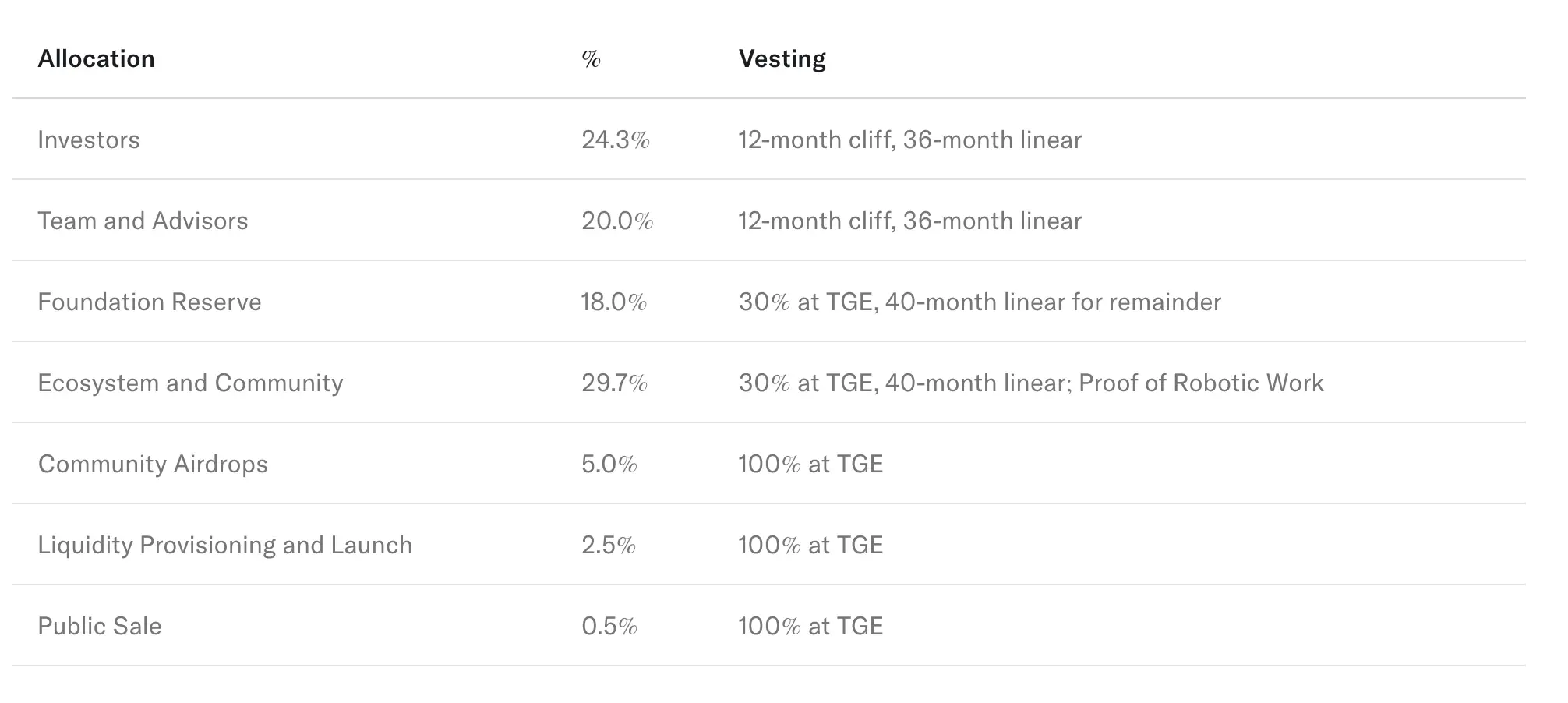
One of the most compelling aspects of Fabric Protocol is its highly pro-community and anti-dumping tokenomics design for insiders. Here's the complete distribution of the 10 billion ROBO tokens:
Ecosystem and Community (29.7%): 30% unlock at TGE, the remainder 40-month linear vesting plus Proof-of-Robotic-Work emission — the largest allocation and directly flowing to active network participants.
Investor (24,3%): Full 12-month cliff, then 36-month linear vesting — no investor can sell a single token in the first year.
Team and Advisors (20%): 12 month cliff, then 36 month linear vesting — just as tight as investors.
Foundation Reserve (18%): 30% unlock at TGE, the remainder 40 months linear vesting for long-term stewardship and research purposes.
Community Airdrop (5%): 100% available in TGE for distribution by the Foundation — already distributed through the Binance Alpha airdrop program (888 ROBO per eligible participant).
Liquidity Provisioning dan Launch (2,5%): 100% in TGE to maintain initial liquidity.
Public Sale (0,5%): 100% in TGE.
The key principle to underline: insiders (team + investors) face a 12-month cliffhanger with no exceptions — not a single token can be sold within the first year.
The largest allocation (29.7%) actually went to the ecosystem and community, not to insiders. This represents a much healthier tokenomics structure than the average new crypto project.
Currently, 2.2 billion ROBOs (22% of the total supply of 10 billion) are in circulation, with an FDV of $414 million (Rp7 trillion) and an active market cap of $92.5 million (Rp1.56 trillion) at a price of $0.0411 (Rp695).
ROBO Price Today and Market Context
ROBO hit an ATH of $0.0607 (Rp1,026) after listing and is currently trading at $0.0411 (Rp695) — down 32% from its peak but still 82% above its initial listing price of $0.0225 on February 27, 2026.
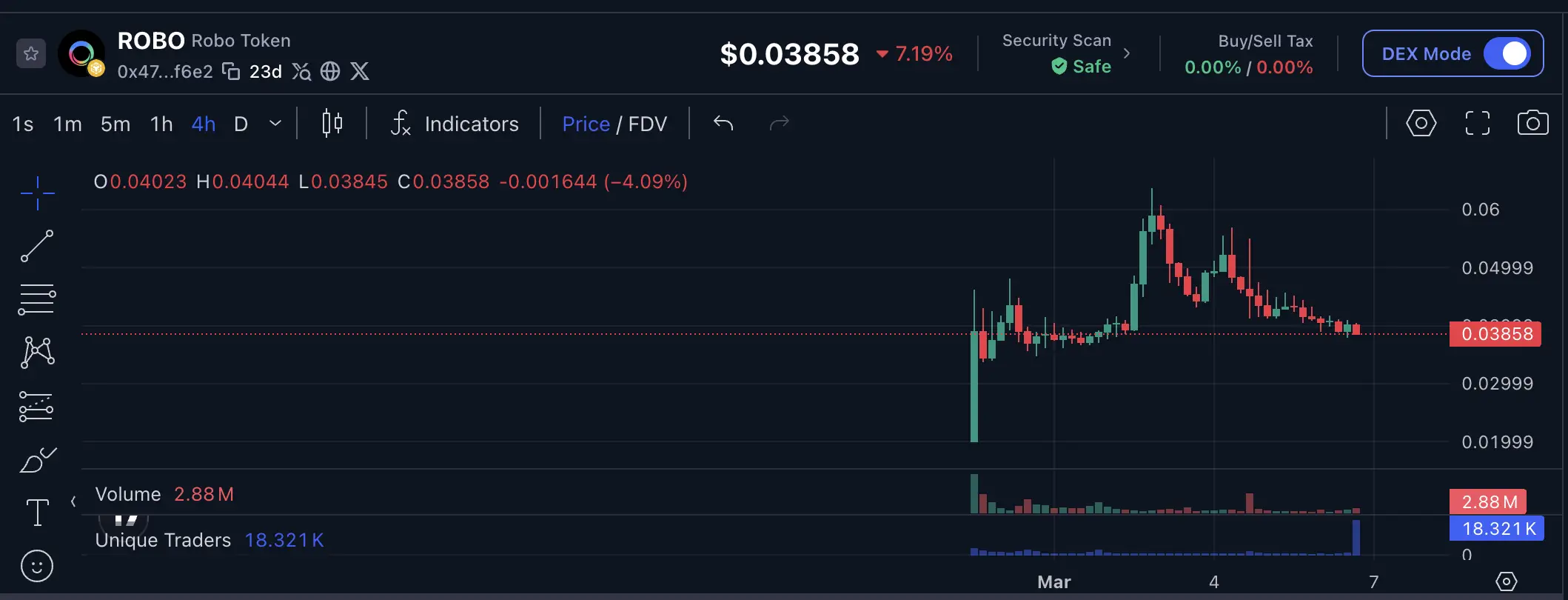
24-hour trading volume was recorded at $101 million across 63 active trading pairs on 24 exchanges.
Compared to similar projects in the AI-DePIN segment, ROBO competes directly with Bittensor (TAO) And Fetch.ai (FET)— both are AI coordination networks that use token incentives.
What sets ROBO apart is its focus on physical, real-world hardware: Proof-of-Contribution requires verified physical work, not just passive staking, and the robot identity infrastructure addresses gaps that purely computational AI networks don't address.
Who is Behind Fabric Protocol?
The Fabric Protocol was developed by the Fabric Foundation, a team of experts in distributed systems and machine learning founded with the vision of building a safe, open, and globally beneficial future for AI and robotics.
The project operates under the principle that “future intelligence should not be controlled by a handful of companies or nations” — a philosophy that aligns with the broader open-source and decentralization movements.
Behind the Fabric Foundation stands OpenMind as the primary builder of the OM1 operating system, with onboard robot partners including UBTech (a leading Chinese humanoid robot manufacturer), AgiBot (an industrial robot), and Fourier (a medical rehabilitation robot).
A $20 million funding round led by Pantera Capital — one of the world's most influential crypto venture capital firms — confirms that Fabric Protocol is more than just a concept on paper.
Conclusion: Is Fabric Protocol Worth Paying Attention To?
Fabric Protocol represents one of the most compelling investment theses in crypto today: the foundational infrastructure for a global robotics industry that is entering a phase of exponential growth.
The global industrial robot market is expected to reach $218 billion by 2030 according to a BNEF report, and Fabric Protocol is positioning itself as the settlement and coordination layer that the entire industry needs.
But like all early infrastructure projects, ROBO's value will ultimately be determined by real-world adoption — how many robots are actually operating on the network, how many PoRW transactions are verified daily, and how quickly Fabric L1 can be rolled out and adopted.
Monitor these metrics as the most honest indicators of project health, far more honest than the daily token price.
How to Buy Crypto on Bittime?

Want to trade sell buy Bitcoins and crypto investment easily? Bittime is here to help! As an Indonesian crypto exchange officially registered with Bappebti, Bittime ensures every transaction is safe and fast.
Start with registration and identity verification, then make a minimum deposit of IDR 10,000. After that, you can immediately buy your favorite digital assets!
Check the exchange rate BTC to IDR, ETH to IDR, SOL to IDR and other crypto assets to find out today's crypto market trends in real-time on Bittime.
Also, visit the Bittime Blog for interesting updates and educational information about the crypto world. Find reliable articles about Web3, blockchain technology, and digital asset investment tips designed to enrich your crypto knowledge.
FAQ
What is Fabric Protocol (ROBO)?
Fabric Protocol is a blockchain infrastructure that gives robots unique cryptographic identities and the ability to transact autonomously without human intervention.
How much does ROBO cost now?
ROBO is trading at $0.0411 (Rp695), down from its ATH of $0.0607 after listing on Binance on March 4, 2026, with an active market cap of $92.5 million.
Apa itu Proof-of-Robotic-Work?
A unique consensus mechanism that requires proof of actual physical work from robots before earning rewards — unlike regular passive staking.
Can insiders directly sell ROBO tokens?
No. The team and investors face a full 12-month cliffhanger — they cannot sell a single token within the first year of the TGE.
On which blockchains is ROBO available?
ROBO is available on BNB Smart Chain (0x475c...6e2) and Ethereum (0x32b4...36e), with plans to migrate to Fabric L1 — a robotics-specific blockchain currently under development.
Disclaimer: The views expressed belong exclusively to the author and do not reflect the views of this platform. This platform and its affiliates disclaim any responsibility for the accuracy or suitability of the information provided. It is for informational purposes only and not intended as financial or investment advice.

.png)