AI Agentic Shoppers Rise 393% in Q1 2026: They Shop More Than Humans!
2026-04-20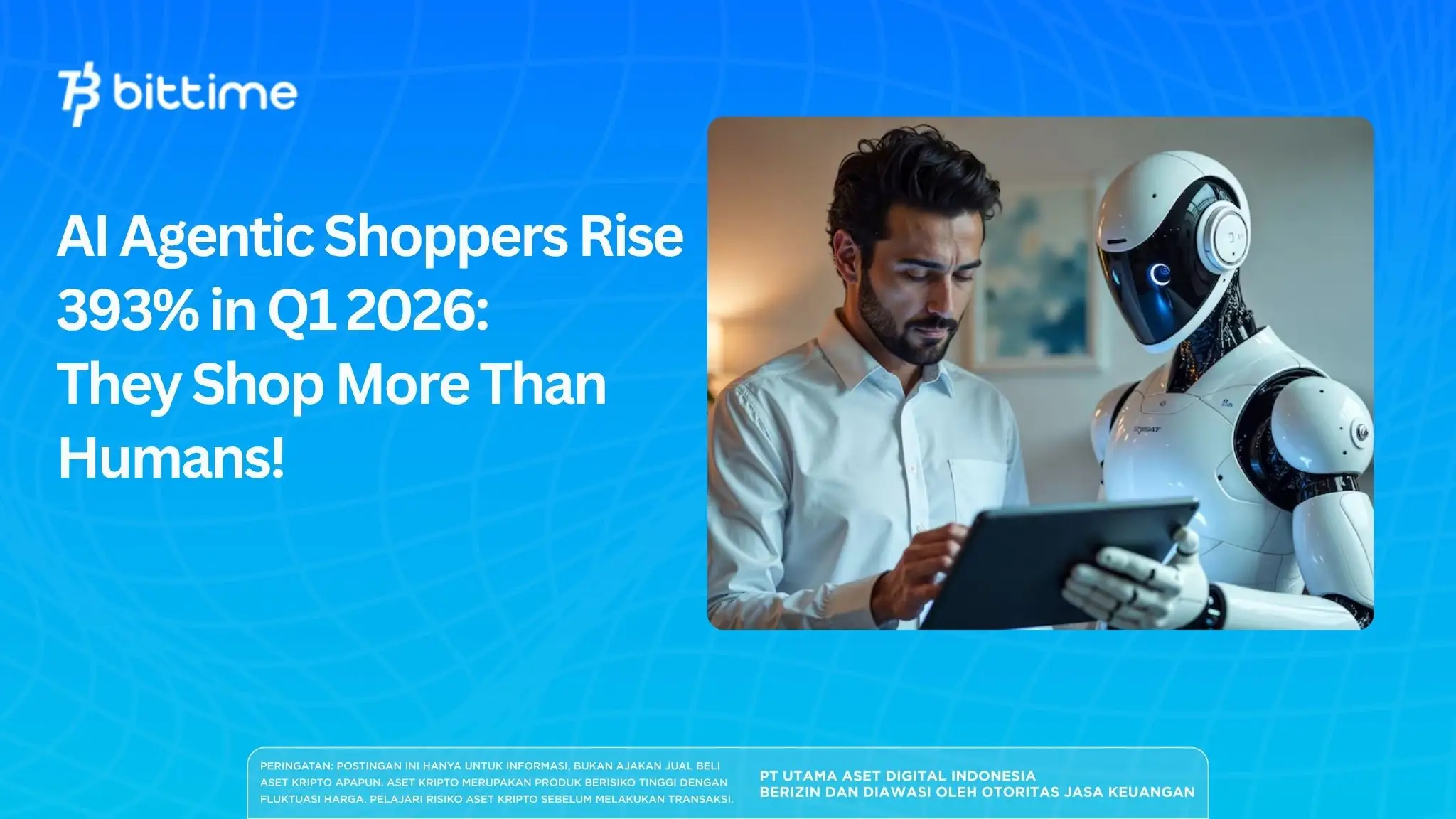
Bittime - Imagine a shopper who never tires, never hesitates, and goes straight to the product that best suits your needs.
These are AI agentic shoppers — automated programs that now shop on behalf of humans. And surprisingly, they shop more than real humans.
According to data from Adobe Commerce Analytics, traffic from AI agents to US retail sites surged 393% in the first quarter of 2026.
What's more interesting: March alone recorded a growth of 269% compared to the previous year.
Key Takeaways
AI traffic to US retail surged 393% in Q1 2026, with March up 269% year-over-year — this isn't a small trend, it's an explosion.
AI shoppers have higher conversion rates and higher revenue per session than humans. AI agents are designed for transactions, not just browsing.
Retailers have 6-12 months to optimize: structured data, APIs, and AI-friendly checkouts. Those who are slow will lose market share, just like in the mobile commerce era of 2013.
Register at Bittime now and start trading crypto with a fast, safe, and easy process in the app.

This isn't just a small trend — it's the inflection point where automated shopping (agentic commerce) goes from an experiment to a major revenue channel.
What Are AI Agentic Shoppers?

AI agentic shoppers are artificial intelligence programs tasked with shopping on behalf of humans. These agents come from platforms like ChatGPT, Perplexity, and other shopping assistants. They work by:
Search for products based on specific criteria (price, specifications, reviews)
Compare offers from different stores
Complete transactions automatically
Report the results to humans for final approval
What distinguishes these agents from mere “bots” is their autonomy — they can make decisions within user-defined constraints.
Shocking Data: AI Spends More Than Humans
Data from Adobe Commerce Analytics for Q1 2026 shows a dramatic surge. Traffic from AI agents to US retail sites increased by +393% overall.
If viewed per month, March alone recorded an increase of +269% compared to the same period the previous year (year-over-year).
Most surprising: the conversion rate of AI shoppers is higher than that of humans, and the revenue per session generated by AI agents is also greater.
These aren't just bots aimlessly "scrolling" — they're actually buying and making money.
Read also:How to Create AI Agents and Their Functions
Why Can AI Be Better at Shopping?
There are several reasons why AI shopping in 2026 could beat humans:
1. AI Without Friction and Doubt
Humans often hesitate, compare too much, or abandon their carts due to distraction. AI agents move directly from search to purchase without any psychological barriers.
2. Execute Shopping with the Right Intent
When someone tells the AI to "find the best noise-canceling headphones under $200," the agent won't be tempted by discounts on other products or irrelevant ads. It immediately executes the intent.
3. Browsing vs Executing
Humans tend to "browse" — browse without a clear purpose. AI comes with a specific mission: find the best products, compare them, and buy. This results in significantly higher conversions.
4. Shopping with AI = Shopping by Learning from Behavior
AI agents can learn from user preferences over time. The more they're used, the more accurate their recommendations and decisions become.
Read also:Trust Wallet Releases TWAK AI Agent Development Kit for 220 Million Global Users
Impact on E-commerce: Can No Longer Be Ignored
The impact of AI on e-commerce is now very real. Adobe data shows that agentic commerce has reached a "revenue inflection" — the point where revenue from this channel becomes significant and cannot be ignored by retailers.
Opportunities for Fast-Moving Retailers
Conversely, retailers who move quickly now will reap three major benefits:
Optimization in Q2 2026Retailers who begin optimizing their products and websites for AI in the second quarter of 2026 will lead the market when AI traffic explodes in Q3 and Q4.
Structured data as the main weaponProducts with clear specifications, real-time pricing, and accurate stock information will be easier for AI agents to read, process, and recommend.
AI-optimized checkoutA checkout process that can be completed entirely by agents without manual human intervention will drastically increase conversion rates — because there are no psychological or technical barriers in the way.
Risks for Unprepared Retailers
Retailers who ignore this trend face three main risks:
Loss of high-value trafficAI shoppers are high-converting buyers. If your site isn't accessible or readable by AI agents, they'll quickly move on to a more prepared competitor.
Inability to compete in the next 6-12 monthsRetailers who don't optimize their data structures for AI will be left far behind when AI traffic explodes later this year.
Product not found by AI agentIf your product catalog doesn't have structured data (such as schema markup or an open API), AI agents won't be able to read, process, or recommend your products—it's as if they weren't on the digital shelf.
Comparison to the Past: Mobile Commerce 2013
Analysts compare this phenomenon to the transition to mobile commerce in 2013-2014. At that time:
Early mobile traffic had poor conversion rates.
Retailers view mobile as a “supplement,” not a priority.
Suddenly, mobile visitors started converting just as well as desktop.
In 18 months, mobile-first design became a necessity.
Fast-moving companies achieve massive growth; slow-moving ones lose market share forever.
Agentic commerce follows a faster path. The difference: AI shoppers arrive with excellent conversion rates from the start.
There's no such thing as "AI traffic is junk traffic." These agents are designed to transact.
Read also:4 Crypto AI Agents Backed by Major Companies: Here's the Top One!
What Should Retailers Do Now?
Based on Adobe data and industry analysis, here are the steps e-commerce businesses should take:
1. Make sure your product is "AI-Readable"
Use schema markup (structured data) on every product page. AI agents need to accurately read specifications, prices, stock levels, and shipping costs.
2. Build a Robust API
Provide APIs that allow AI agents to access product catalogs, real-time pricing, and inventory status.
3. Optimize Checkout for AI
The checkout process must be able to be completed by an agent without human intervention — while maintaining security and payment authorization.
4. Monitor AI Traffic
Use analytics tools that can differentiate human traffic from AI agents. Track conversion rates and average order value (AOV) from each source.
5. Establish Relationships with AI Platforms
Communicate with ChatGPT developers, Perplexity, and other shopping assistants to ensure your products appear in their searches.
Future Predictions: When Will AI Traffic Surpass 10%?
While Adobe doesn't release absolute percentages of total e-commerce, the 393% quarterly growth rate paints a pretty clear picture. Assuming Q1 2026 as the baseline (100%), then:
Q2 2026is expected to record additional growth of 200-300% if current trends continue.
Q3 2026, AI traffic is expected to start touching 5-10% of total e-commerce volume.
Q4 2026, this figure has the potential to jump to 10-20%, especially during the holiday shopping season where transaction volumes increase sharply and AI agents are utilized to their full potential to find the best deals.
At that point, retailers who are not prepared will lose a very significant portion of their revenue.
Data from Adobe shows that AI shoppers aren't just coming — they're buying.
In fact, they convert better (higher purchase rates) and generate more revenue per session than traditional human visitors.
This is a fundamental shift. Previously, traffic from bots was often considered "junk" because it didn't generate sales. Now, AI agents are the most efficient buyers.
Conclusion
AI agentic shoppers increased 393% in Q1 2026, and they spend more than humans. Data from Adobe Commerce confirms that AI agents have higher conversion rates and higher revenue per session than human visitors.
This phenomenon is transforming agentic commerce from a mere experiment into a major revenue channel that cannot be ignored.
Retailers have a 6-12 month window to optimize their sites to be “AI-readable” — using structured data, robust APIs, and agent-optimized checkout.
Those who move quickly in Q2 2026 will capture this high-value traffic. Those who lag behind will lose market share, as happened in the mobile commerce era.
How to Buy Crypto on Bittime?

Want to trade sell buy Bitcoins and crypto investment easily? Bittime is here to help! As an Indonesian crypto exchange officially registered with OJK, Bittime ensures every transaction is safe and fast.
Start with registration and identity verification, then make a minimum deposit of IDR 10,000. After that, you can immediately buy your favorite digital assets!
Check the exchange rate BTC to IDR, ETH to IDR, SOL to IDR and other crypto assets to find out today's crypto market trends in real-time on Bittime.
Also, visit the Bittime Blog for interesting updates and educational information about the crypto world. Find reliable articles about Web3, blockchain technology, and digital asset investment tips designed to enrich your crypto knowledge.
FAQ
What are AI agentic shoppers?
AI agentic shoppers are artificial intelligence programs tasked with shopping on behalf of humans. They search, compare, and purchase products automatically.
How much will AI traffic to US retail increase in Q1 2026?
A 393% surge according to Adobe Commerce Analytics data.
Are AI shoppers really better than humans?
Yes. Data shows that AI shoppers' conversion rates and revenue per session are higher than those of human visitors.
What should retailers do to keep up?
Optimize products with structured data (schema markup), build robust APIs, and provide AI-agent-accessible checkout.
When will AI traffic reach 10-20% of total e-commerce?
Estimated in Q3-Q4 2026 if current growth rate continues.
Disclaimer: The views expressed belong exclusively to the author and do not reflect the views of this platform. This platform and its affiliates disclaim any responsibility for the accuracy or suitability of the information provided. It is for informational purposes only and not intended as financial or investment advice.

.png)