Learning AI for a Career: The Right Time to Upskill with AI in 2025!
2025-09-25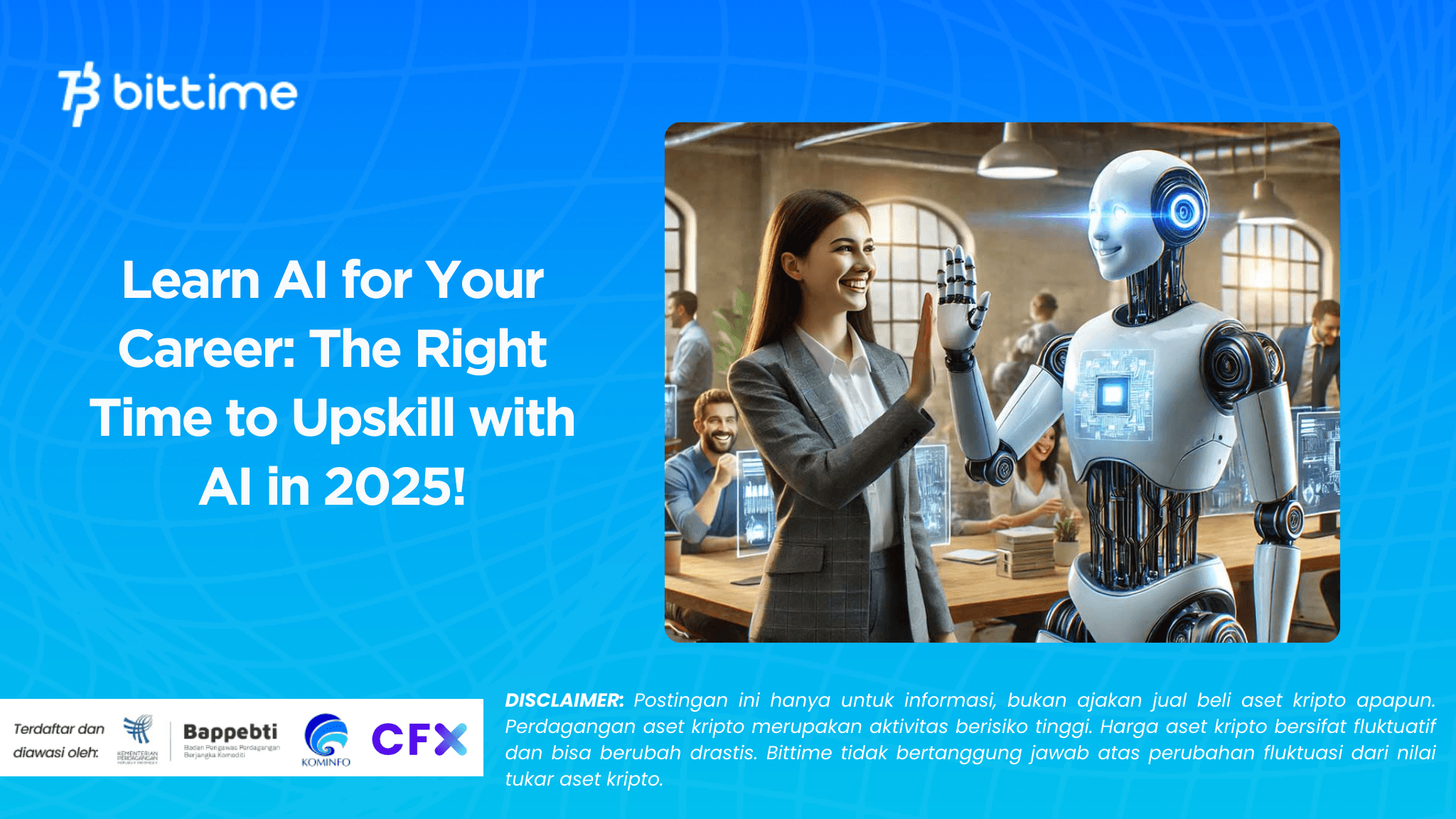
Bittime - Millennials and Gen Z are already accustomed to exploring AI tools—from content creation and creative entertainment to small social media experiments.
But by 2025, the ability to use AI will no longer be just a hobby, but a career skill increasingly sought after by industry.
Recent data shows a dramatic surge in workers' interest in learning AI: AI courses across platforms are growing by thousands of percent.
This article discusses how young people can capitalize on this opportunity: how to learn AI strategically, effective tools & approaches, challenges, and practical first steps.

AI Upskilling Trends 2025: What's Happening?
TAI topics are among the fastest-growing skills on online learning platforms.
Many workers now see learning AI not as an add-on, but as a primary need to stay relevant in an era of technological disruption.
Some interesting facts:
- Microsoft Copilot courses on Udemy grew ~3,400% year-over-year.
- The topics of generative AI, AI agents, and how to apply AI in everyday workflows are becoming very popular among professionals and creators.
- However, AI learning sessions were also perceived as “extra work” by some participants due to the large volume of content and the expectation of quick mastery.
This trend confirms that AI capabilities in 2025 will no longer be “value added”—but “basic standards” in many fields.
Read Also: Will AI Replace Human Jobs? Answers Amid AI Takeover Fears
Why Gen Z & Millennials Should Focus on Learning AI
There are several compelling reasons why the younger generation should take AI capabilities seriously:
- High Market Demand
Many organizations now prioritize candidates who are familiar with AI, especially in productivity, research, marketing, data analytics, and content roles.
- Competitive Advantage
If you can apply AI in your daily work—for example, producing content, analyzing data, automating simple tasks—you will be more valued than those who haven't.
- Reducing Routine Workload
AI can automate tedious tasks like formatting, initial research, and initial editing, allowing you to focus on creativity, strategy, and human value-add.
- Preparing for the Future of Work
Amid the potential for automation and job shifts, AI skills can protect against the risk of job obsolescence. However, maintaining non-technical skills (soft skills) remains crucial.
AI Tools Recommendations for Upskilling in 2025
- ChatGPT (OpenAI)
- Perfect for learning AI concepts, quick research, content ideas, evenpractice interview.
- Can be used asstudy partner to understand technical or non-technical material.
- Perfect for learning AI concepts, quick research, content ideas, evenpractice interview.
- Microsoft Copilot
- Integrated with Word, Excel, PowerPoint, Outlook, and Teams.
- Helps workers automate reports, data analysis, presentations, and business communications.
- Integrated with Word, Excel, PowerPoint, Outlook, and Teams.
- Claude AI (Anthropic)
- An AI chatbot alternative with a focus on security, ethics, andlong-context understanding.
- Useful for reading long documents, analyzing data, and drafting neater content.
- An AI chatbot alternative with a focus on security, ethics, andlong-context understanding.
- AI concept
- Used by students, freelancers, and creative workers to create smart notes, summaries, andtask automation.
- Perfect for organizing AI learning projects or daily work.
- Used by students, freelancers, and creative workers to create smart notes, summaries, andtask automation.
- Perplexity AI
- An AI-based search engine that focuses on answers with source references.
- Great for quick research without having to open multiple tabs.
- An AI-based search engine that focuses on answers with source references.
- Hugging Face Spaces
- An open source platform for trying out various AI models (NLP, Computer Vision, Audio).
- Useful for those who want to learn more technically and experiment directly with models.
- An open source platform for trying out various AI models (NLP, Computer Vision, Audio).
- Runway ML
- Suitable for visual content creators, because it can produce videos, visual effects, or automatic editing with AI.
- Used by many Gen Zs forcreative portfolio.
- Suitable for visual content creators, because it can produce videos, visual effects, or automatic editing with AI.
- Khan Academy (AI Tutor)
- An AI-based tutor that can help with math, science, and coding lessons.
- Helping young people who want to learn while getting interactive guidance.
- An AI-based tutor that can help with math, science, and coding lessons.
Read Also: AI for Side Hustle & Productivity 2025: Maximize Time & Income
Efficient First Steps to Learning AI
Here are some strategies you can implement to keep the AI learning process productive and not overwhelming:
1. Start with AI Basics & Literacy
Learn basic concepts like language models, machine learning, neural networks, what-if scenarios, and AI bias. Understand ethical and privacy issues.
2. Take an Applied Focus Course
Look for practical courses that teach you how to use AI in real life, not just theory. For example, Microsoft Copilot courses (Word, Excel, Teams, etc.) are now widely available on Udemy.
3. Learn Prompt Engineering & AI Agents
Learn how to give specific prompts to AI models to produce more relevant output. Also, explore agentic AI, which can perform tasks automatically.
4. Combine AI + Your Custom Domain
If you're a content creator, marketer, or developer, use AI in contexts you understand—rather than trying everything new at once. This will speed up adaptation.
5. AI Mini Projects & Portfolios
Create small projects using AI: for example, blog post automation, small data analysis, or a simple chatbot. These projects can serve as a portfolio that showcases your skills to potential clients or companies.
6. Combine Soft Skills & Ethics
Real-world conditions: AI can help, but you still need critical thinking, decision-making, communication, empathy, and an understanding of the ethics of AI use.
Read Also: The Phenomenon of Indonesian AI Influencers and the Increasing Popularity of TikTok AI Characters
Challenges to be Faced
- Volume of Information & Curriculum Changes Rapidly: the AI field is very dynamic, material quickly becomes outdated.
- Limited Access to Technology: not everyone has the hardware or powerful connections to run local AI models.
- Burnout & Study Burden: many people feel that learning AI is like extra work.
- AI Output Bias & Error Risks: AI can “hallucinate” or produce inaccurate content—you should double-check.
- Inequality & Digital Divide: access to courses, devices, mentors may be easier in big cities than in remote areas.
How to Buy Crypto on Bittime

Want to trade sell buy Bitcoins and crypto investment easily? Bittime is here to help! As an Indonesian crypto exchange officially registered with Bappebti, Bittime ensures every transaction is safe and fast.
Start with registration and identity verification, then make a minimum deposit of IDR 10,000. After that, you can immediately buy your favorite digital assets!
Check the exchange rate BTC to IDR, ETH to IDR, SOL to IDR and other crypto assets to find out today's crypto market trends in real-time on Bittime.
Also, visit the Bittime Blog for interesting updates and educational information about the crypto world. Find reliable articles about Web3, blockchain technology, and digital asset investment tips designed to enrich your crypto knowledge.
FAQ
Is learning AI suitable for non-technical graduates?
Yes. Many generative AI tools (such as chatbots and analytics tools) can be used without a programming background. Focus on the prompts, basic concepts, and applications in your field.
How long does it take to become “confident” using AI?
It depends on the intensity of your learning. If you study regularly (for example, 1 hour a day) and practice directly, you should feel comfortable using AI in your work within 1–3 months.
Do I have to learn coding first before learning AI?
Not always. For basic AI/genAI applications, you can get started without coding. However, if you want to build your own AI models or custom systems, learning Python and ML concepts is very helpful.
What is a good AI course for beginners?
Microsoft Copilot courses and hands-on generative AI courses on platforms like Udemy are very popular right now.
How do I make sure my AI results are not "confused" or biased?
Always perform human verification—check facts, adapt the style, and don't accept AI output at face value. Also, understand the model's limitations and the context in which it's used
Disclaimer: The views expressed belong exclusively to the author and do not reflect the views of this platform. This platform and its affiliates disclaim any responsibility for the accuracy or suitability of the information provided. It is for informational purposes only and not intended as financial or investment advice.

.png)