50 Futures Trading Terms Every Beginner Must Understand
2026-07-30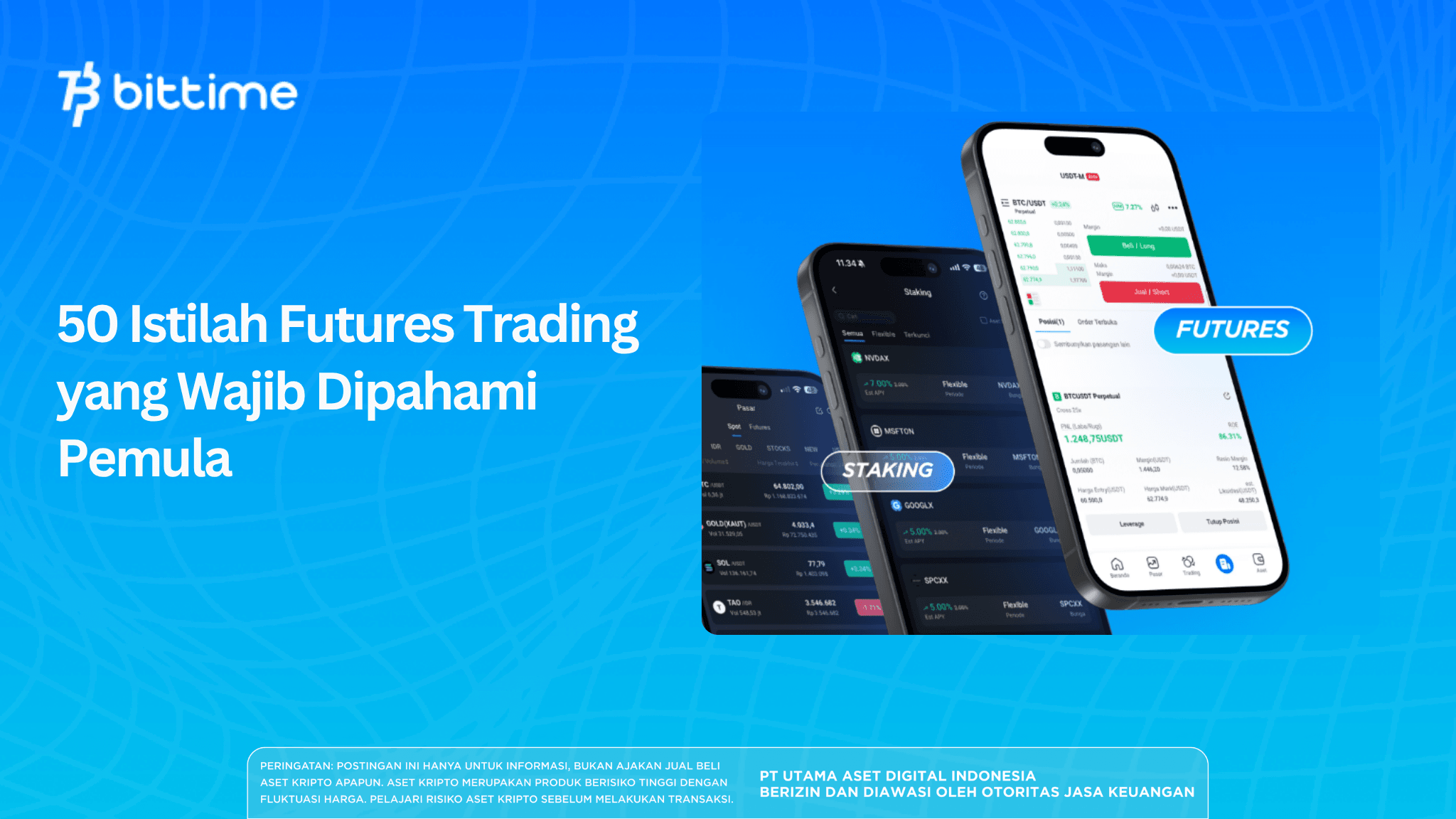
The Indonesian crypto futures market has changed dramatically since several local exchanges obtained Digital Financial Asset Trader (PAKD) licenses based on derivatives from the OJK, paving the way for retail traders to access leverage without having to go through overseas platforms.
Unfortunately, this surge in interest has not necessarily been accompanied by readiness. Many beginner futures traders are still confused about the difference between leverage and margin in futures trading, eventually miscalculating when their position approaches liquidation.
This article summarizes the most important futures trading terms that you must master first, so that every trading decision has a clear and measurable foundation.
Key Takeaways
- 50 futures trading terms are grouped from basic contracts, leverage and margin, position orders, to liquidation risk.
- Leverage amplifies trading exposure, margin is the collateral that holds it, and funding rate keeps futures prices close to spot prices.
- Understanding the difference between long and short in futures as well as the meaning of liquidation in futures trading helps beginners make more measured decisions.
What Is Futures Trading and Why Are the Terms Important?
Futures trading is the activity of buying and selling contracts that lock in the price of an asset in the future, allowing traders to profit whether the price rises or falls without needing to own the asset directly.
The difference from spot trading lies in the settlement time: spot transactions are completed immediately, while futures bind both parties to a previously agreed price and time.
If you are interested, you can register at Bittime with a fast, secure, and easy process so you can start trading futures!
Because the mechanism involves leverage and margin, a single mistake in reading a term can lead to losses far greater than the initial capital. Here is a list of futures trading terms for beginners that has been grouped so it is easier to learn step by step.
Read Also: Bittime Futures: Complete Guide to Crypto Derivatives Trading in Indonesia
Basic Contract Terms in Futures Trading
Before diving into leverage and risk, first get to know the terms that form the framework of every futures contract.
- Futures Contract — An agreement to buy or sell an asset at a predetermined price and date.
- Perpetual Contract — A type of futures contract with no expiration date, so a position can be held as long as the trader still has sufficient margin.
- Spot Market — A market for buying and selling assets directly and settling immediately, unlike futures which lock in a price for a specific time.
- Lot — The standard unit of transaction quantity in one contract; the larger the lot, the greater the potential profit or loss.
- Tick Size — The smallest price increment allowed on one contract, usually calculated in USDT units for crypto futures.
- Position Size — The total value of an open position, usually expressed in USDT, the product of the number of contracts and the asset price.
- Volume — The total number of contracts traded in a given period, serving as an indicator of how active a market is.
- Open Interest — The total number of long and short contracts that are still open and have not been settled; a high figure usually indicates a busy market.
- Mark Price — A reference price calculated from a combination of the spot price and funding rate, used to prevent unreasonable liquidations caused by temporary price spikes.
- Index Price — The average price of an asset from several major exchanges, one of the components that form the mark price.
Read Also: Open Interest Futures: How to Read Market Trends and Sentiment
Leverage and Margin Terms You Must Understand
This section most often confuses beginners, because the meaning of leverage and margin in futures trading determines how much risk you will bear.
- Leverage — The amplifying power from the exchange that allows you to open a position larger than your actual capital; 20x leverage means you can control a position 20 times the value of your margin.
- Margin — The collateral capital that must be prepared to open and maintain a trading position.
- Initial Margin — The initial margin required when first opening a position.
- Maintenance Margin — The minimum margin threshold that must remain available so the position is not automatically liquidated.
- Margin Call — A warning from the exchange when the margin ratio approaches the danger threshold, usually a signal to add funds or close part of the position.
- Available Margin — The remaining funds that can still be used to open new positions or absorb ongoing losses.
- Margin Ratio — The comparison between maintenance margin and total margin; the higher this ratio, the closer the position is to liquidation.
- Cross Margin — A margin mode that pools the entire account balance to support all open positions at once.
- Isolated Margin — A margin mode that locks a specific amount of funds exclusively for one position, so losses on that position do not affect other balances.
- Margin Usage — The percentage of account funds currently being used to maintain active positions.
Read Also: Long vs Short Crypto Futures Strategy: When to Buy and Sell?
Position and Order Terms in Futures Trading
After understanding margin, the next step is to learn the difference between long and short in futures along with the types of orders used to execute them.
- Long Position — A buy position that profits when the asset price rises.
- Short Position — A sell position that profits when the asset price falls, allowing traders to make money even when the market is weakening.
- Stop Loss — An automatic order to close a position once the price hits a certain level, used to limit losses.
- Take Profit — An automatic order to close a position when the profit target has been reached.
- Limit Order — A buy or sell order at a price you set yourself, executed only when the market reaches that price.
- Market Order — An order that is executed immediately at the current market price without waiting.
- Trailing Stop — A stop loss that moves dynamically following price movement, allowing you to lock in more profit when a trend continues.
- Reduce-Only — An order execution type that can only reduce or close an open position; it cannot open a new position in the opposite direction.
- Post-Only — An order that is guaranteed to enter the order book as a maker, so you avoid taker fees.
- Pending Order — A trading instruction that is executed only when the asset price reaches a previously determined level.
Read Also: Margin Call in Crypto Futures? Do This to Avoid Liquidation
Risk, Liquidation, and Funding Rate Terms
This is the most crucial section for beginners, because the meaning of liquidation in futures trading is often the main cause of capital being wiped out in a short time.
- Liquidation — The automatic process of closing all open positions when margin is no longer sufficient to cover losses.
- Liquidation Price — The specific price that triggers liquidation; once the contract price hits this level, the position is force-closed.
- Insurance Fund — The exchange’s reserve fund used to cover liquidation losses so they do not burden other traders in the market.
- Funding Rate — A fee paid between long and short positions every few hours, its function is to keep the futures price close to the spot price.
- Funding Rate Settlement — The scheduled time when the funding rate is actually paid between holders of long and short positions.
- Risk Management — An approach to managing risk so that trading losses remain under control.
- Risk to Reward Ratio — The comparison between potential loss and potential profit from one trading position, used as a reference before entry.
- Hedging — A strategy to protect the value of an asset from price fluctuations, usually by opening an opposite position in another instrument.
- Cut Loss — The manual action of closing a losing position earlier before losses grow larger, different from a stop loss which is automatic.
- Unrealized P&L — The total profit or loss from a position that is still open and has not yet been realized.
Read Also: How to Trade Futures on Bittime for Beginners
Analysis and Futures Market Condition Terms
This final group of terms is useful for reading market direction before deciding whether to take a long or short position.
- Support — A lower price level where buying pressure usually appears and holds further declines.
- Resistance — An upper price level where selling pressure usually appears and holds further advances.
- Bullish — A market condition that tends to move upward.
- Bearish — A market condition that tends to move downward, the opposite of bullish.
- Volatility — A measure of how quickly and how much an asset’s price changes over a given period.
- Contango — A condition when the futures price is higher than the spot price.
- Backwardation — A condition when the futures price is lower than the spot price, the opposite of contango.
- Basis — The difference between the spot price and the futures price, often used by traders to read short-term market sentiment.
- Spread — The difference between the buy price (ask) and the sell price (bid) in the order book.
- Liquidity — The ease with which an asset can be bought or sold without causing significant price movement; the higher the liquidity, the easier your orders are to execute.
Conclusion
The fifty terms above form the basic foundation so you can read contracts, monitor positions, and make trading decisions with a cool head.
Traders who understand the meaning of leverage and margin in futures trading, know when to close a position via stop loss, and grasp the meaning of liquidation in futures trading are usually far better prepared to face the volatility of the crypto market, which is known for changing quickly.
Master these important terms before starting futures trading one by one, then try first with a small position size before increasing exposure to a larger size.

Check the price of Bitcoin (BTC), Ethereum (ETH), XRP, Solana (SOL), GRAM, and BNB as well as popular meme coins like DOGE. You can trade directly on Bittime!
Bittime is a Digital Financial Asset Trader (PAKD) platform licensed and supervised by the Financial Services Authority — the place where you can buy Bitcoin in Indonesia and hundreds of other crypto assets starting from Rp10,000. Registration is fast, secure, and can be started today.
Monitor the conversion of USDT to IDR and the price movements of your favorite crypto assets in real time. Everything is available in one crypto investment app that can be downloaded for free on the Play Store.
Ready to start? Register now at Bittime and execute your investment strategy with a platform already trusted by millions of users in Indonesia.
FAQ
What is the difference between long and short in futures?
Long is a buy position that profits when the price rises, while short is a sell position that profits when the price falls.
What do leverage and margin mean in futures trading?
Leverage is the amplifying power that increases the value of a trading position from the original capital, while margin is the collateral capital that must be prepared to open and maintain that position.
What is the meaning of liquidation in futures trading?
Liquidation is the automatic process of closing all open positions when margin is no longer sufficient to cover losses, usually occurring when the price reaches the liquidation price.
How many futures trading terms must beginners master?
This article summarizes 50 important terms, covering basic contracts, leverage, margin, orders, and liquidation risk.
What is a futures contract?
A futures contract is an agreement to buy or sell an asset at a price and date already agreed upon in the future.
Disclaimer: The views expressed belong exclusively to the author and do not reflect the views of this platform. This platform and its affiliates disclaim any responsibility for the accuracy or suitability of the information provided. It is for informational purposes only and not intended as financial or investment advice.
.png)