Is USWS a Scam or Legit? Check the Facts About United States Water Supply Before You Buy
2026-08-19
USWS scam or legit? This question matters because United States Water Supply promotes a major narrative around AI, water scarcity, and US federal water reserves. The USWS token is indeed actively traded on the Solana network, but several claims made by the project show inconsistencies that should be examined before buying.
Based on the available facts, there is not enough evidence to definitively label USWS a scam, but the token also lacks sufficient basis to be considered a verified investment project.
Key Takeaways
- USWS is a Solana token with a real on-chain market and liquidity, but the existence of the token does not prove the project’s fundamental claims.
- The project website states that each USWS represents a claim on water secured by the federal government, while also saying that the token is not affiliated with any US government agency.
- There is a major supply inconsistency: the website states 1 billion USWS, while market data for the same contract address shows a supply approaching 10 billion tokens.
What Is United States Water Supply?
United States Water Supply, or USWS, is an SPL token on Solana with the contract address:
8e1sqPsXchqMoY4oVBME9Fq2WZasicG162GkDoACuSWs
The project uses a narrative in which the growth of artificial intelligence increases the amount of water needed to cool data centers. Water is then positioned as a strategic resource whose value could potentially rise as AI infrastructure expands.
The token does have trading activity. At the latest check, the USWS/USDC pair was priced at around US$0.0007358, with approximately US$194,000 in liquidity and a market cap of about US$7.3 million. The pair was only around six days old.
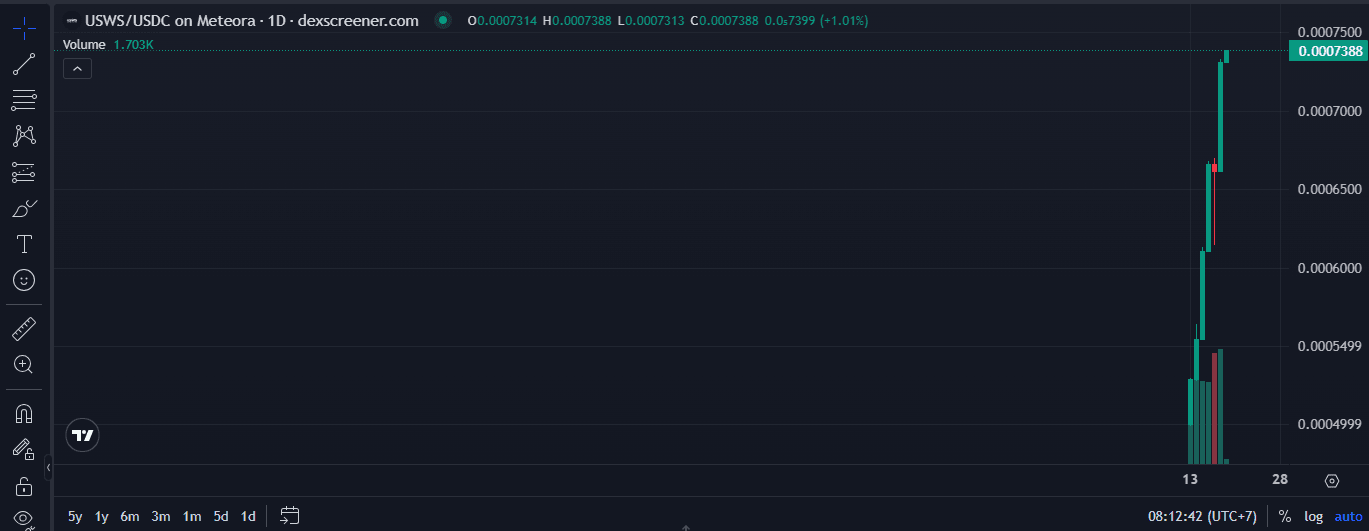
This means USWS is a real token that exists and can be traded. However, that is different from the question of whether its economic claims are true.
Read also: United Oil Trust Fund (UOTF) on Solana: Legit or Scam?
USWS Scam? Claims That Deserve Caution
The biggest red flag is the claim that each USWS represents a claim on water secured by the federal government. The site also refers to a US$50 billion “Strategic Water Reserve Act” that allegedly secures water rights across 14 states.
The problem is that the disclaimer on the same website clearly states that the project is a community-issued token and is not affiliated with any United States government agency or with several major companies mentioned in its narrative.
Furthermore, the site describes USWS as a “cultural receipt, nothing more and nothing less.” This statement is difficult to reconcile with the claim that the token grants rights to federal water reserves.
Because there does not appear to be legal documentation proving that USWS represents ownership or an official right to federal water, prospective buyers should not treat the token as a government-backed asset.
Read also: AORP Legit or Scam? Check Its Legality, Team, and Project Transparency
Red Flag: The Announcement Date Is in the Future
There is another highly conspicuous indicator.
On August 19, 2026, the project page was already displaying a headline dated September 14, 2026 stating that President Donald Trump had signed the “Strategic Water Reserve Framework.” That date was still nearly a month in the future when this article was written.
Presenting a future event as though it has already occurred is a serious red flag for information credibility.
Read also: Pons Launchpad Legit or Scam? Understand How It Works and Its Risks
USWS Supply Is Also Inconsistent
The project website states that the total USWS supply is only 1,000,000,000 tokens and describes it as a fixed supply.
However, data for the same contract address shows a circulating supply of around 9.999 billion USWS, or nearly 10 times the figure stated on the project website. Market price and market-cap data are also consistent with a supply of roughly 10 billion tokens.
A supply discrepancy of this magnitude is not a minor detail. Tokenomics is one of the most fundamental pieces of information when assessing the valuation of a crypto asset.
Read also: Is USOV Crypto Legit or a Scam? Check Its Reserves and Liquidity
Are There Any Positive Signs for the USWS Token?
There are several technical indicators that do not immediately suggest a contract problem. An automated check of the USWS/USDC pair currently shows a “No issues” status, although the platform also warns that automated audits are not 100% accurate.
The project also claims that the mint authority has been revoked, there is no transfer tax, and there is no team allocation.
However, contract security answers only part of the question. A token can have a contract that functions normally while still making marketing claims that cannot be verified.
Read also: Is USFR (United States Food Reserve) Legit? Here Are the Facts
So, Is USWS Safe to Buy?
For now, it is more appropriate to categorize USWS crypto as a high-risk, unverified asset rather than immediately calling it a scam or legit.
Red flags to watch for include:
- claims of rights to federal water without clear legal evidence;
- a disclaimer stating that the project is not affiliated with the US government;
- a headline dated in the future;
- a supply inconsistency of 1 billion versus nearly 10 billion;
- the token’s very recent launch;
- relatively low liquidity compared with its market cap.
If you are still interested, use the correct contract address and check holder distribution, liquidity, and on-chain transactions before buying. Do not use funds you cannot afford to lose.
To follow developments related to USWS, Solana tokens, and the latest crypto news, you can also register on Bittime and monitor market updates regularly. Use this information as research material, not as a guarantee of profit.
Conclusion: Is USWS a Scam or Legit?
There is not enough evidence to definitively state that USWS is a scam. The token does exist on Solana and has an active market.
However, several facts also make it difficult to confidently consider USWS legit. Claims about federal water reserves conflict with the project disclaimer, there is information dated in the future, and the supply shown on the website differs substantially from data for the same contract address.
The safest conclusion is that USWS is a speculative token with significant red flags that require further verification before buying.

Bittime is a licensed Digital Financial Asset Trader (PAKD) platform regulated and supervised by the Financial Services Authority (OJK) — where you can buy Bitcoin in Indonesia and hundreds of other crypto assets starting from Rp10,000. Registration is fast and secure, and you can get started today.
Track the conversion of USDT to IDR and the price movements of your favorite crypto assets in real time. Everything is available in one crypto investment app that can be downloaded for free from the Play Store.
Ready to get started? Register on Bittime now and execute your investment strategy on a platform trusted by millions of users in Indonesia.
FAQ
Is USWS a scam?
There is not enough evidence to definitively label it a scam. However, there are several red flags and claims that have not yet been adequately verified.
Is USWS legit?
USWS is a Solana token that is genuinely traded, but the existence of the token does not automatically make all of the project’s claims legitimate.
Is USWS backed by the US government?
The project itself states that it is not affiliated with any United States government agency. Therefore, do not treat USWS as an official government token.
What is the USWS supply?
The website states 1 billion tokens, but data for the same contract shows a supply approaching 10 billion USWS. Prospective buyers should pay attention to this inconsistency.
Is USWS safe to buy?
No crypto asset can be described as completely safe. In the case of USWS, the token’s very recent launch, limited liquidity, and red flags in the project’s claims make it a high-risk asset.
Disclaimer: The views expressed belong exclusively to the author and do not reflect the views of this platform. This platform and its affiliates disclaim any responsibility for the accuracy or suitability of the information provided. It is for informational purposes only and not intended as financial or investment advice.

.png)