USDT vs. Dollar Savings (USD): What's the Difference and Which One is Better?
2026-07-31
USDT and U.S. dollar savings accounts are often compared because both provide exposure to the value of the U.S. dollar. However, they are not the same type of product.
A USD savings account is a foreign-currency deposit held at a bank, whereas USDT is a stablecoin built on blockchain technology and designed to track the value of one U.S. dollar. Differences in asset status, protection, costs, accessibility, and risk mean that the best choice depends on the user’s objectives.
Key Takeaways
- U.S. dollar savings accounts are better suited to formal financial needs, travel, education, business, or holding foreign currency through a bank.
- USDT is more practical for digital asset transactions, transfers between platforms, and round-the-clock access to crypto markets.
- USDT is not the same as physical U.S. dollars, is not guaranteed to remain exactly at US$1, and does not receive deposit protection like a bank account.
USDT vs. U.S. Dollar Savings Accounts
The question of whether to save in USDT or USD cannot be answered simply by comparing their prices. Both track the U.S. dollar, but their ownership mechanisms and sources of risk are different.
When holding USD in a foreign-currency account, customers own a dollar-denominated balance managed by the bank. The account can be used to receive transfers, pay for international expenses, or hold funds in accordance with the bank’s terms.
When purchasing USDT, users own a digital token issued by Tether and circulating across multiple blockchains. USDT trades on crypto markets, so its price may sit slightly above or below US$1 depending on demand, liquidity, and market conditions.
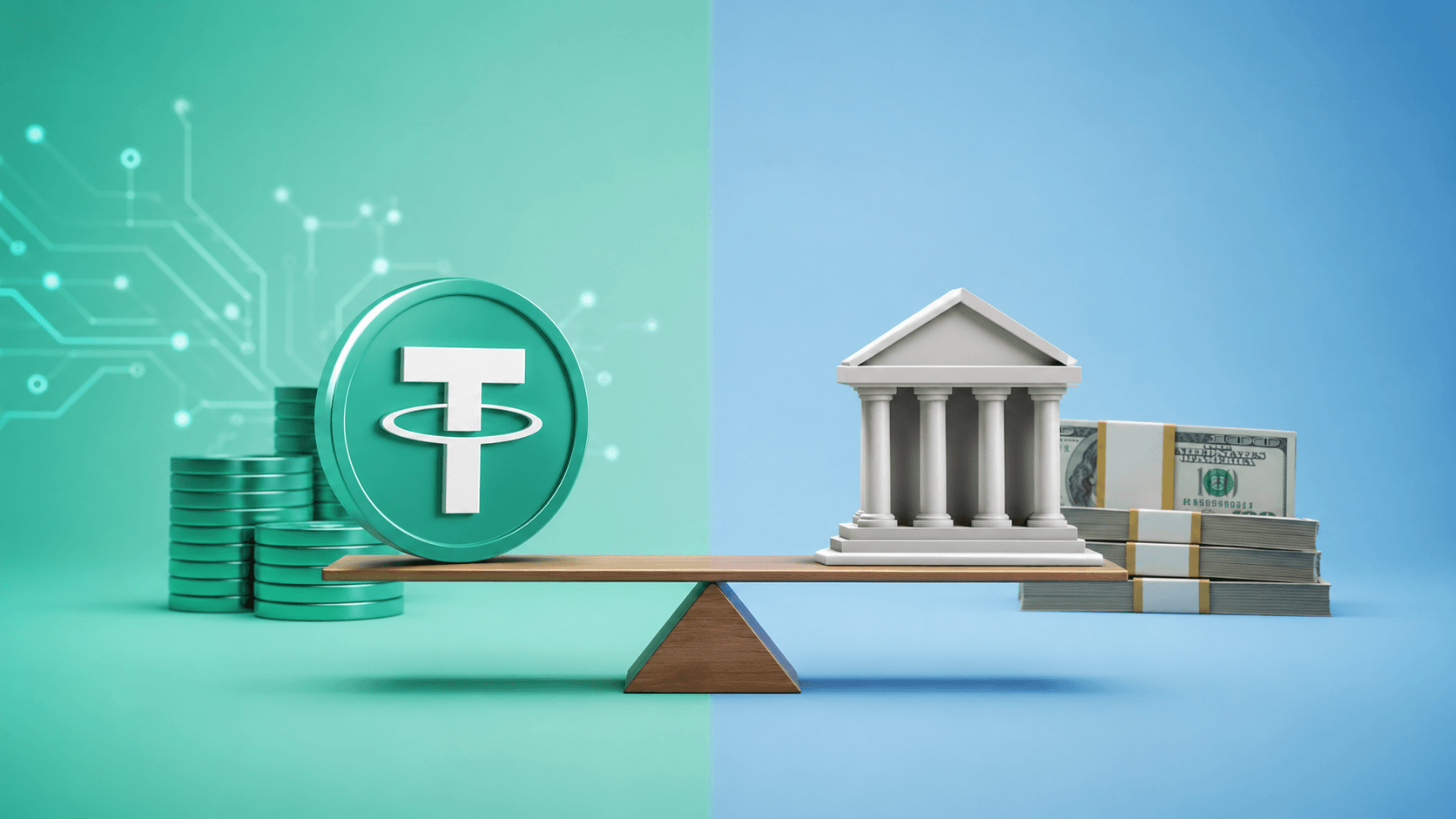
Source: AI-Generated Image
Status and Protection
USD is the official currency of the United States, while a U.S. dollar savings account is a bank deposit product. Foreign-currency deposits at participating banks may qualify for protection from Indonesia’s Deposit Insurance Corporation (LPS), provided they meet the applicable value limits, interest-rate limits, and other guarantee requirements.
USDT is a stablecoin crypto asset. It is not fiat money, not a bank deposit, and is not insured by LPS. Holders are exposed to risks involving the issuer, trading platform, custodian, wallet, and blockchain network.
Access and Speed
Foreign-currency accounts are convenient for formal needs such as tuition fees, travel, vendor payments, or receiving funds in U.S. dollars. International transfers may require bank processing hours, correspondent banks, and document checks.
USDT can be sent 24 hours a day. Its speed and cost depend on the network used. Users must verify that the destination address and network are correct because blockchain transactions generally cannot be reversed.
Costs and Returns
U.S. dollar savings accounts may involve administration fees, minimum-balance requirements, transfer fees, banknote withdrawal fees, and a spread between the bank’s buying and selling exchange rates.
USDT transactions may involve trading fees, spreads, withdrawal fees, and network fees. USDT does not earn interest simply by being held. Returns arise only when the token is placed in earn, lending, staking, or DeFi products, which introduce additional risks.
Read also: Could Tether (USDT) Disappear from European Exchanges? What Is Causing the Risk?
Characteristics of U.S. Dollar Savings Accounts
Foreign-currency savings accounts are suitable for people with specific needs denominated in USD. They are easier to use for formal payments and provide clearer account-recovery services than personal wallets.
Interest on U.S. Dollar Savings Accounts
Some banks pay interest based on the account type and balance. The rate may change. Customers who want their deposits to remain eligible for protection should ensure that the interest rate does not exceed the applicable guarantee limit.
Interest is generally not the only consideration when choosing a U.S. dollar savings account. For travel or education funds, transfer convenience and reliable access are often more important than pursuing the highest interest rate.
Administration Fees and Minimum Balances
Each bank applies different terms. Some accounts charge monthly fees in USD, require an initial deposit, or impose a minimum retained balance. Certain products may waive fees if a minimum balance is maintained.
These fees should be evaluated relative to the amount saved. An account with seemingly small charges may still be inefficient when the customer’s balance is limited.
Prospective customers should review several components before opening an account:
- initial deposit;
- minimum balance;
- monthly fees;
- foreign-currency transfer fees;
- cash withdrawal fees;
- the bank’s buying and selling exchange rates.
Exchange-Rate and Spread Risk
The rupiah value of USD savings rises when the dollar strengthens and falls when the rupiah strengthens. This means that saving in dollars still carries exchange-rate risk when the funds will ultimately be used in rupiah.
Customers also buy dollars at the bank’s selling rate and sell them back at the bank’s buying rate. The difference between these rates is an indirect cost. The more frequently conversions are made, the greater the effect of the spread on returns.
Read also: Why Is USDT Trading at an 8.5% Premium in India?
Characteristics of Holding Funds in USDT
USDT is widely used as a trading pair and as a means of transferring value within the crypto ecosystem. Users can move from one digital asset to another without always converting their balances back into rupiah.
Liquidity and 24-Hour Access
USDT markets operate every day. Users can buy, sell, or send tokens on weekends and public holidays as long as the platform and network remain available.
This flexibility is useful for traders, digital workers, or users who need to move assets between exchanges and wallets. However, continuous access can also encourage impulsive decisions when users do not have a clear plan.
USDT/IDR Price may also differ from a bank’s U.S. dollar exchange rate. The difference is influenced by local crypto-market demand, liquidity, spreads, and transaction fees.
Blockchain Network Options
USDT is available on multiple blockchain networks. Each network has a different address format, speed, fee structure, and level of platform support.
The sender and recipient must use the same network. Sending tokens through an unsupported network may cause funds to become inaccessible or lost. Users should make a small test transfer before sending a large amount.
Stablecoin Risk
USDT is designed to maintain a value close to US$1, but its market price is not guaranteed to remain exactly at one dollar. A stablecoin may temporarily depeg when confidence, liquidity, or market conditions are disrupted.
USDT holders also depend on the quality of reserve assets, issuer governance, redemption services, legal compliance, and the market’s ability to maintain liquidity.
Unlike a U.S. dollar balance at a bank, holders of USDT on the secondary market may not always be able to redeem small amounts directly with the issuer. Most users convert their tokens through exchanges or crypto markets.
Platform and Wallet Risks
Holding USDT on an exchange makes users dependent on the platform’s security and operations. Withdrawal disruptions, account compromises, or platform-related issues may restrict access to assets.
Holding USDT in a personal wallet provides greater control, but responsibility for security shifts to the private-key owner. A lost seed phrase generally cannot be recovered in the same way as a bank account password.
Phishing, fake applications, SIM swaps, incorrect network selection, and address errors can also cause permanent asset loss.
Read also: Is It Safe to Exchange Rupiah for USDT Now? Review the Benefits and Risks
Is USDT Safe as an Alternative to a U.S. Dollar Savings Account?
USDT is relatively more stable than Bitcoin or altcoins because it is designed to track the U.S. dollar. Even so, “stable” does not mean risk-free.
USDT can be useful for temporarily holding funds in the crypto market or as a digital transfer instrument. It should not be treated as equivalent to a bank-based U.S. dollar savings account with customer-service mechanisms and deposit protection.
USDT’s level of security is influenced by three layers:
- issuer and stablecoin reserve risk;
- exchange or custodian risk;
- user, wallet, address, and network risk.
USDT-based earn products are also not the same as interest on a savings account. Returns may come from lending, trading strategies, or platform incentives. The higher the offered return, the more important it is to examine credit risk, liquidity, fund lockups, and withdrawal capability.
USDT is also not ideal as the sole emergency fund. Money for urgent living expenses should be held in instruments that can be liquidated easily and accepted directly in everyday payment systems.
Read also: USDT to IDR: Which Method Has the Lowest Fees?
When Is the Right Time to Hold USDT?
USDT is more suitable when the purpose of the funds is directly related to digital assets, such as:
- maintaining a balance to purchase crypto assets;
- transferring funds between exchanges or wallets;
- reducing volatility after selling other crypto assets;
- receiving cross-border digital payments;
- using blockchain applications that accept stablecoins.
USDT can also serve as a temporary holding asset when users do not yet want to convert crypto-sale proceeds into rupiah. However, long-term holding requires an assessment of stablecoin and platform risks.
Avoid purchasing USDT solely because you expect the rupiah to weaken. The purchase price and final outcome are still affected by spreads, fees, local liquidity, and exchange-rate movements.
When Is a Bank-Based U.S. Dollar Savings Account More Suitable?
A USD savings account is more appropriate for travel expenses, overseas education, business transactions, remittance receipts, or planned spending in U.S. dollars.
A bank account is also easier to use as proof of funds and for transfers to universities, companies, service providers, or official institutions.
For beginners who do not yet understand wallets, blockchain technology, and digital asset security, a foreign-currency savings account offers a more familiar experience. Users can seek assistance from the bank if they lose access to their account or encounter transaction problems.
A USD savings account is also more suitable for people who prioritize deposit protection, formal record-keeping, and integration with other banking services.
Read also: How to Calculate the Fair USDT/IDR Price Using JISDOR: Is It Cheap or Expensive?
Saving in USDT or U.S. Dollars: Do You Have to Choose Only One?
USDT and USD bank accounts do not have to replace one another. They can serve different functions.
Funds intended for formal purposes can be placed in a foreign-currency account, while USDT can be used on a limited basis for digital asset trading or transfers. This approach reduces the risk of treating a single product as the solution to every financial need.
Before deciding on an allocation, consider:
- the intended use of the funds;
- the holding period;
- the need for 24-hour access;
- tolerance for technology-related risk;
- the need for deposit protection;
- experience using wallets;
- conversion and transaction costs.
How to Buy USDT Through Bittime
USDT can be purchased through Bittime after the user opens and verifies an account. The general steps are outlined below.
1. Register and Verify Your Account
Open the official app or website of Bittime, create an account using accurate information, and complete identity verification as instructed.
Enable a transaction PIN, two-factor authentication, and any other available security features. Never share your password or OTP code with anyone.
2. Deposit Rupiah
Select the deposit menu and use one of the available payment methods. Follow the displayed transfer instructions and confirm that the funds have been credited to your account balance.
Check the minimum deposit amount and applicable fees before transferring funds.
3. Find USDT
Open the market or asset-purchase menu, then search for Tether under the symbol USDT. Verify the asset name and symbol before completing a transaction.
4. Choose a Market or Limit Order
A market order executes the purchase at the currently available market price. This method is faster, but the final price may differ slightly as the market moves.
A limit order allows users to set their own purchase price. The transaction is completed only when the market price reaches the specified limit.
5. Confirm the Purchase
Enter the desired rupiah amount or quantity of USDT. Review the price, token amount, spread, and fees before confirming the transaction.
Once the order is completed, the USDT will be credited to the user’s asset balance.
6. Check the Network Before Transferring
When sending USDT to another wallet, ensure that the sender’s address and network match the recipient’s network. Choosing the wrong network may prevent the assets from arriving.
Make a test transaction before sending a large amount. Recheck the destination address and do not copy it from an untrusted source.
Interested in using USDT for digital asset purposes? Register with Bittime, complete account verification, and review the available USDT trading pairs. Also monitor the latest crypto news so that decisions are not based solely on price movements. Crypto assets remain risky and are not a substitute for an emergency fund.
Conclusion
USDT and U.S. dollar savings accounts are not two identical products. A USD savings account is a bank deposit denominated in foreign currency, while USDT is a digital token designed to maintain a value close to one dollar.
U.S. dollar savings accounts are more suitable for formal needs, travel, education, business, and holding foreign currency through a bank. USDT is more suitable for crypto trading, digital transfers, and round-the-clock market access.
The best choice depends on the objective. Prioritize a foreign-currency savings account when deposit protection and banking needs are the main considerations. Use USDT when blockchain flexibility is genuinely required and all associated risks are understood.
Bittime is a licensed Digital Financial Asset Trader (PAKD) platform supervised by Indonesia’s Financial Services Authority (OJK) — where you can buy Bitcoin in Indonesia and hundreds of other crypto assets starting from Rp10,000. Registration is fast and secure, and you can get started today.
Monitor the USDT-to-IDR conversion and track the price movements of your favorite crypto assets in real time. Everything is available in one crypto investment app that can be downloaded for free from the Play Store.
Ready to get started? Register with Bittime now and execute your investment strategy on a platform trusted by millions of users in Indonesia.
FAQ
Is USDT the Same as the U.S. Dollar?
No. USDT is a stablecoin designed to track the value of the U.S. dollar, while USD is the official currency of the United States. Holding USDT is not the same as holding a U.S. dollar balance at a bank.
Which Is Safer, USDT or a U.S. Dollar Savings Account?
A U.S. dollar savings account may qualify for deposit protection if it meets the applicable requirements. USDT carries issuer, platform, wallet, network, and potential depegging risks.
Does Holding USDT Earn Interest?
Not automatically. Returns arise only when USDT is placed in earn, lending, staking, or DeFi products, which introduce additional risks.
Is USDT Suitable for an Emergency Fund?
USDT is not ideal as the sole emergency fund because access depends on a platform, wallet, network, and conversion process. A primary emergency fund should be readily usable for everyday needs.
Is the USDT Price Always the Same as a Bank’s U.S. Dollar Exchange Rate?
No. The USDT/IDR price is influenced by the USD/IDR exchange rate, crypto-market demand, liquidity, spreads, and transaction fees, so it may differ from bank exchange rates.
Disclaimer: The views expressed belong exclusively to the author and do not reflect the views of this platform. This platform and its affiliates disclaim any responsibility for the accuracy or suitability of the information provided. It is for informational purposes only and not intended as financial or investment advice.

.png)


