Uniswap v4 Hooks: 50% Suspected Malicious, Risks to Users
2026-09-15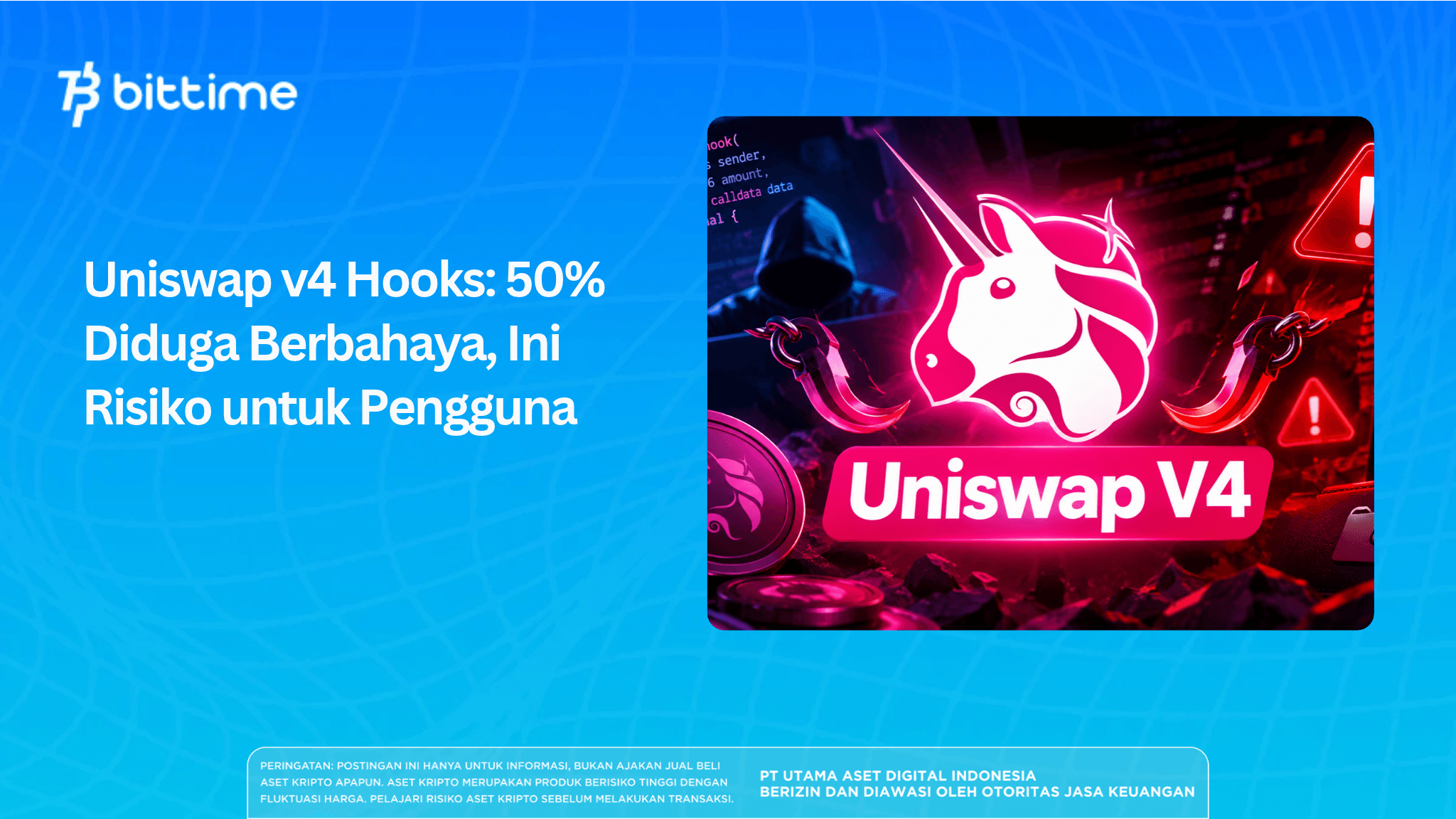
More than 50% of Uniswap v4 hooks analyzed are said to have potential security risks, drawing significant attention from the DeFi community. This finding has led users to question whether the new Uniswap v4 feature is truly safe or instead opens new vulnerabilities for smart contract attacks.
However, it is important to understand that these risks do not mean that all Uniswap v4 hooks are malicious or that every hook is dangerous. The main issue lies in the implementation of additional code that may have access to transaction processes and liquidity pools.
Unlike previous versions, Uniswap v4 provides greater flexibility through its hooks system. This feature allows developers to create additional functions, but it also increases the protocol's security complexity.
Key Takeaways
- Some Uniswap v4 hooks have potential security risks, but not all of them are dangerous.
- Hooks provide major innovation, but they expand the smart contract risk surface.
- Users should check code security before using hook-based pools.
What Are Uniswap v4 Hooks?
Uniswap v4 hooks are features that allow developers to add custom logic to Uniswap liquidity pools.
In previous versions, most pool behavior was determined by the protocol. In Uniswap v4, developers can add additional code that runs at specific points during the transaction process.
Simply put, hooks work like plugins that extend the functionality of a decentralized exchange.
Some functions that can be created using hooks include:
- dynamic trading fees;
- automated liquidity strategies;
- limit orders;
- custom trading logic;
- integration with other DeFi applications.
This innovation makes Uniswap v4 more flexible than previous generations. However, the more additional code that runs during transactions, the greater the potential risks that must be considered.
Read also: Uniswap Labs Buys PONS Token, Why Is Robinhood Chain So Important?
How Uniswap v4 Hooks Work in DeFi Transactions
To understand the risks of how Uniswap v4 hooks work, users need to understand when hooks are executed.
Hooks can be activated at several stages of a transaction.
1. Before a Swap
Hooks can execute code before a user performs a token swap.
For example:
- transaction validation;
- fee configuration;
- checking specific conditions.
2. After a Swap
Hooks can execute additional functions after a transaction is completed.
For example:
- providing rewards;
- recording activity;
- integrating with other protocols.
3. When Liquidity Is Added
Hooks can control how liquidity providers enter or exit a pool.
This opens opportunities for more complex DeFi strategies.
However, these additional functions also mean users need to be more cautious because the code being executed can affect the transaction process.
Read also: Not Bitcoin or XRP, These Altcoins Are Actually Breaking Out
Why Are Uniswap v4 Hooks Suspected of Being Risky?
The findings regarding malicious Uniswap v4 hooks emerged because some of the analyzed hooks showed implementation patterns that could create security issues.
It is important to note that the term “risky” does not always mean a contract was intentionally designed to steal funds. Risks can arise from bugs, poor code design, or excessively broad access.
Some of the main risks include:
1. Smart Contract Vulnerability
Hooks are code that can execute their own logic.
If there is a vulnerability in the code, the consequences may include:
- transaction manipulation;
- loss of funds;
- unintended changes in pool behavior.
2. Permission Risk
Some hooks may have extensive permissions.
The risks include:
- changing certain parameters;
- affecting transaction fees;
- restricting user activity.
The greater the control a contract has, the more important the audit process becomes.
3. External Call Risk
Hooks can interact with other contracts.
External interactions can create risks such as:
- reentrancy attacks;
- data manipulation;
- transaction execution failures.
4. MEV and Transaction Manipulation
Hooks can also create new surfaces for MEV risks.
Attacks such as:
- sandwich attacks;
- arbitrage manipulation;
- transaction ordering exploits;
have become a concern in modern DeFi design.
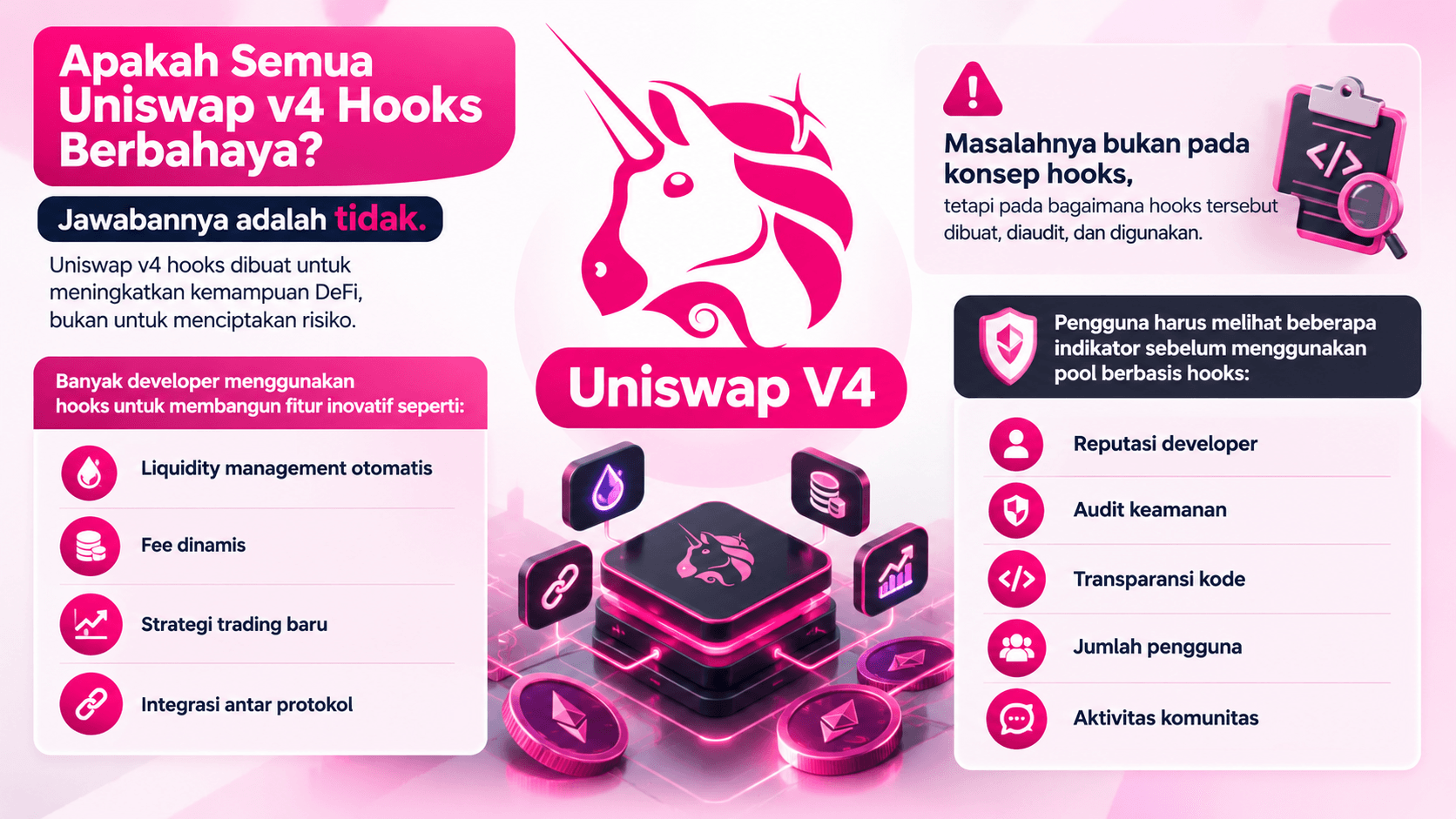
Are All Uniswap v4 Hooks Dangerous?
Many developers use hooks to build innovative features such as:
- automated liquidity management;
- dynamic fees;
- new trading strategies;
- cross-protocol integration.
The issue is not the concept of hooks, but how those hooks are created, audited, and used.
Users should look at several indicators before using hook-based pools:
- developer reputation;
- security audits;
- code transparency;
- number of users;
- community activity.
Read also: Uniswap Price Prediction: UNI Could Rise to $6 If It Breaks Above $4
Uniswap v4 Hooks Functions That Make DeFi More Flexible
Despite their risks, Uniswap v4 hooks functions represent one of the important innovations in the development of decentralized exchanges.
Some of the main benefits include:
Dynamic Fees
Hooks allow pools to adjust fees based on market conditions.
This can help liquidity providers optimize their strategies.
Automated Liquidity Management
Developers can create systems that automatically manage liquidity positions.
Custom Trading Features
Hooks enable features that previously required additional protocols.
For example:
- limit orders;
- arbitrage strategies;
- reward mechanisms.
DeFi Integration
Hooks can connect liquidity pools with various Web3 applications.
Read also: Uniswap (UNI) Price Prediction 2030: $100 from Standard Chartered
Impact of Uniswap v4 Hooks on Uniswap Coin (UNI)
The development of hooks can also affect sentiment toward Uniswap coin (UNI).
If Uniswap v4 successfully improves efficiency and attracts more users, the innovation could strengthen Uniswap's position as one of the largest decentralized exchanges.
However, security issues could have a different impact.
Increasing risks could affect:
- user trust;
- liquidity provider activity;
- investor perception of the ecosystem.
Nevertheless, UNI's price is not determined solely by hook security.
Other factors such as:
- trading volume;
- governance;
- protocol revenue;
- regulation;
also have a major influence.
How to Use Uniswap v4 Hooks Safely
Users do not need to avoid the entire Uniswap v4 ecosystem, but they should implement security measures.
Some steps that can be taken include:
- Use pools from trusted developers.
- Check whether the contract has been audited.
- Avoid unreasonable high APYs.
- Use a separate wallet for DeFi experiments.
- Do not grant token approvals without understanding the risks.
In DeFi, user security remains an important factor because blockchain transactions generally cannot be reversed.
The Future of Uniswap v4 Hooks and DeFi Security
The emergence of hooks shows that the DeFi industry is increasingly moving toward more flexible systems.
However, technological innovation always requires higher security standards.
The future of Uniswap v4 hooks will depend heavily on:
- audit quality;
- developer transparency;
- user education;
- community security standards.
If the ecosystem can overcome these risks, hooks could become an important foundation for the next generation of decentralized exchanges.
If you want to follow developments in Uniswap v4 hooks, DeFi, and the latest crypto news, you can register on Bittime and regularly monitor market updates.
Conclusion
Uniswap v4 hooks bring major changes to how liquidity pools work by giving developers the ability to add custom functions.
However, this flexibility also introduces new risks. The finding that some hooks have potential security issues is a reminder that DeFi innovation must go hand in hand with auditing and security.
Hooks are not a technology that should be avoided, but users need to understand how they work, the smart contract risks involved, and the reputation of the contract before interacting with them.
With the right approach, Uniswap v4 still has the potential to become one of the important innovations in the development of DeFi.

Bittime is a licensed and supervised Digital Financial Asset Trader (PAKD) platform regulated by the Financial Services Authority (OJK) — where you can buy Bitcoin in Indonesia and hundreds of other crypto assets starting from IDR 10,000. The registration process is fast, secure, and can be started today.
Monitor USDT to IDR conversions and the price movements of your favorite crypto assets in real time. Everything is available in a single crypto investment app that can be downloaded for free from the Play Store.
Ready to get started? Register now on Bittime and execute your investment strategy with a platform trusted by millions of users in Indonesia.
FAQ
What are Uniswap v4 hooks?
Uniswap v4 hooks are additional code that allows developers to create custom functions for Uniswap liquidity pools.
Are all Uniswap v4 hooks dangerous?
No. Most risks come from specific code implementations rather than the concept of hooks itself.
What are the biggest risks of Uniswap v4 hooks?
The main risks include smart contract bugs, excessive permissions, external calls, and potential transaction manipulation.
Is Uniswap coin (UNI) affected by the hooks issue?
Security issues can affect sentiment toward UNI, but UNI's price is also influenced by trading volume, governance, and market conditions.
How can Uniswap v4 hooks be used safely?
Use transparent, audited hooks from trusted developers before providing liquidity or conducting transactions.
Disclaimer: The views expressed belong exclusively to the author and do not reflect the views of this platform. This platform and its affiliates disclaim any responsibility for the accuracy or suitability of the information provided. It is for informational purposes only and not intended as financial or investment advice.

.png)