Profit-Making Strategies in Crypto Futures and How to Calculate Profits
2026-07-27
Crypto futures trading offers huge profit opportunities because you can take long (buy) positions when prices rise or short (sell) when prices fall, with the help of leverage that increases capital exposure.
However, the potential for large profits is always offset by the risk of equally large losses.
To be successful in futures, you need to understand the right strategy, disciplined risk management, and how to calculate profit/loss (PnL) accurately.
Key Points
Crypto futures trading allows you to profit in both rising (long) and falling (short) markets by utilizing leverage, but it also increases the risk of loss.
The calculation of profit/loss (PnL) for futures is based on the difference between the entry and exit prices, multiplied by the number of contracts and leverage, minus transaction costs and funding rates.
The main strategies for consistent profits include risk management (maximum 1-2% per trade), use of stop-loss, and low leverage (2x-5x) for beginners.
Trade futures wisely and safely. Register at Bittime Now
What Is Crypto Futures Trading?
Crypto futures are derivative contracts that allow you to speculate on the price movements of crypto assets without physically owning the assets. There are two main types of positions:
Crypto Futures Long
You buy a contract in the hope that the price will rise. Profit is earned from the difference between the selling price and the buying price.
Crypto Futures Short
You sell a contract in the hope that the price will fall. Profit is earned from the difference between the repurchase price and the initial selling price.
Read Also: How to Trade Futures on Bittime for Beginners
A key feature of futures is leverage, which allows you to open positions worth much more than your capital. For example, 10x leverage with $100 capital gives you $1,000 exposure.
How to Calculate Profit/Loss (PnL) in Crypto Futures
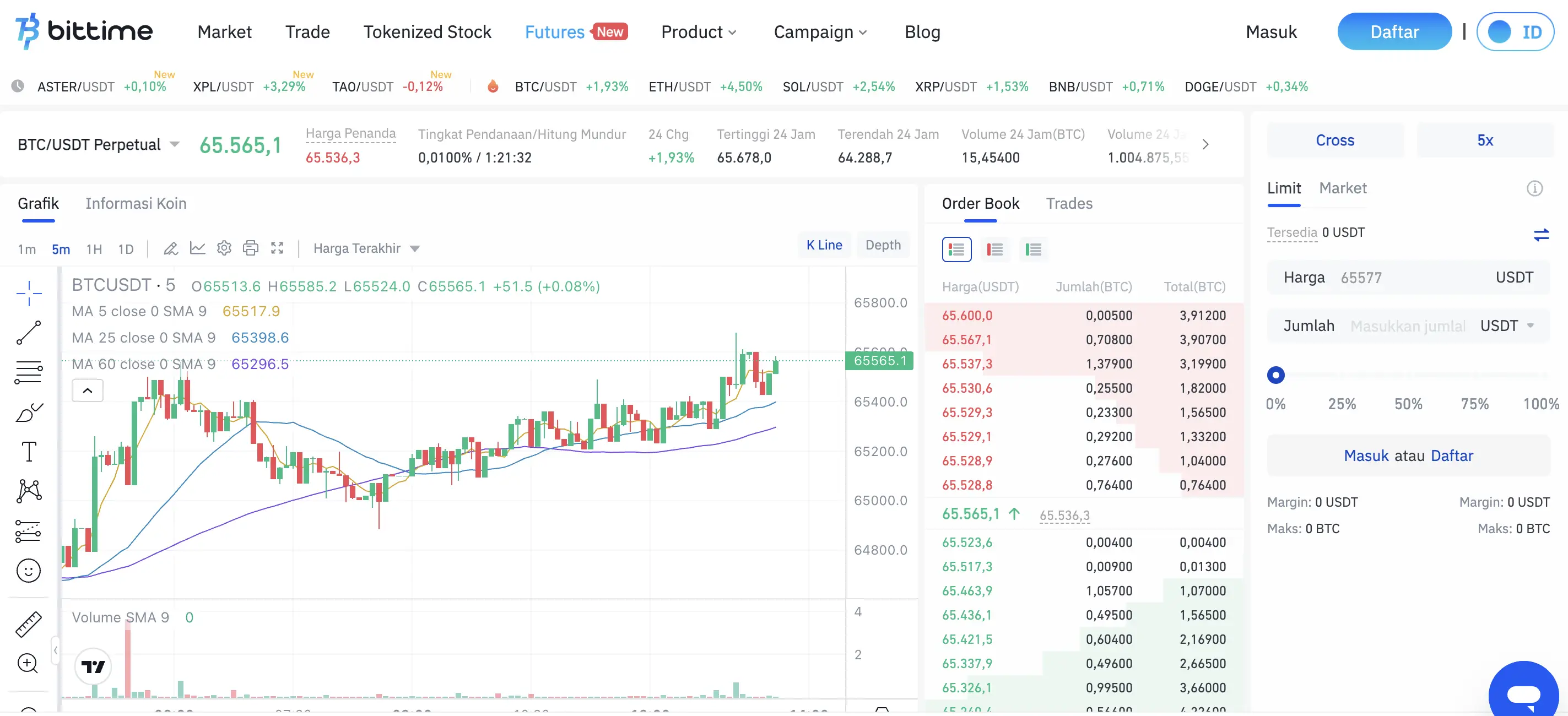
The calculation of PnL futures depends on the type of position (long or short) and the margin currency used (USDT-margined or coin-margined).
1. PnL for Long Positions (USDT-Margined)
Formula:PnL = (Exit Price - Entry Price) × Number of Contracts
Example:Entry long BTC at $60,000, 1 contract, exit at $65,000 → PnL = ($65,000 - $60,000) × 1 = $5,000 (profit)
2. PnL for Short Positions (USDT-Margined)
Formula:PnL = (Entry Price - Exit Price) × Number of Contracts
Example: Entry short BTC at $60,000, 1 contract, exit at $55,000 → PnL = ($60,000 - $55,000) × 1 = $5,000 (profit)
3. PnL with Leverage
Leverage magnifies profits and losses proportionally. If you use 10x leverage, your P&L is 10 times the price movement.
Example:$100 capital, 10x leverage = $1,000 position. Price rises 5% → 5% profit × $1,000 = $50 (50% of initial capital)
4. Costs Affecting PnL
Your net PnL should be reduced by:
- Transaction Fees (Trading Fees):Maker/taker fees charged when opening and closing positions.
- Funding Rate: Periodic fees paid or received on perpetual futures, depending on the direction of the position and the level of funding.
- Swap/Overnight Fee:Fees charged for positions held for more than one day (platform dependent).
Read Also: How to Take Profit from Crypto Trading to Avoid Losses
10 Profitable Strategies in Crypto Futures
1. Master the Fundamentals of Futures
Understand how futures contracts work (perpetual vs. dated), margin and leverage mechanisms, funding rates, and liquidation levels. Misunderstanding these fundamentals often leads to significant losses.
2. Use Leverage Responsibly
Start with low leverage (2x-5x), especially if you're a beginner. Avoid using maximum leverage, as it leaves a very small margin for error. Increase leverage only after you gain experience and consistency.
3. Develop a Solid Trading Strategy
Some commonly used strategies:
- Trend Following:Follow the trend direction using indicators such as moving average crossovers.
- Breakout Trading:Entry when the price breaks through the resistance or support level with high volume.
- Scalping: Fast entry and exit in low timeframes for small but consistent profits.
- Hedging: Hedge a spot position with an opposite futures position.
4. Implement Strict Risk Management
- Maximum risk 1-2% of total capital per trade.
- Always use stop-loss to limit losses.
- Adjust position size based on volatility and leverage.
- Use take-profit to secure profits systematically.
5. Monitor Market Sentiment and News
Crypto is highly sensitive to news and sentiment. Monitor on-chain analytics, funding rates, open interest, and macro news such as Fed decisions and inflation data.
6. Control Your Emotions and Stick to Your Plan
- Keep a trading journal to record every decision.
- Determine entry and exit before opening a position.
- Avoid revenge trading after losses.
- Take a break after experiencing a big loss or win.
7. Diversify and Avoid Overtrading
Don't put all your capital into one position or one asset. Trade multiple uncorrelated assets and focus on setup quality, not quantity.
8. Use Technical and On-Chain Indicators
Combine technical analysis (RSI, MACD, Bollinger Bands) with on-chain data (exchange inflow/outflow, whale alerts) to improve entry accuracy.
9. Take Advantage of Demo Accounts
Use paper trading to practice risk-free. Test strategies, try different scenarios, and build confidence before using real money.
10. Keep Learning and Adapting
The crypto market is changing rapidly. Join the community, track rates, and evaluate each trade to continually improve your strategy.
Read Also: Beginners Must Know! Here's What to Prepare for Before Trading Crypto Futures
Conclusion
Crypto futures trading offers significant profit opportunities with leverage and the flexibility of long/short positions.
However, the key to success is not only predicting market direction, but also managing risk, being disciplined in planning, and understanding PnL calculations accurately.
Treat futures as a business, not gambling, and profits will follow.

Check the prices of Bitcoin (BTC), Ethereum (ETH), XRP, Solana (SOL), and BNB, as well as the popular meme coin DOGE. You can trade directly on Bittime!
Bittime is a licensed and regulated Digital Financial Asset Trader (PAKD) supervised by Indonesia’s Financial Services Authority (OJK) — where you can buy Bitcoin in Indonesia and hundreds of other crypto assets starting from just Rp10,000. The registration process is fast, secure, and you can get started today.
Track USDT to IDR conversions and monitor your favorite crypto assets in real time. Everything is available in one crypto investment app that you can download for free on the Play Store
Ready to start? Register now on Bittime and execute your investment strategy with a platform trusted by millions of users in Indonesia.
FAQ
What is crypto futures trading?
Trading derivative contracts allows you to speculate on crypto price movements without owning the physical asset, with long or short options.
How to calculate profit in futures?
For long positions: (Exit Price - Entry Price) × Number of Contracts. For short positions: (Entry Price - Exit Price) × Number of Contracts.
What is leverage and how does it impact you?
Leverage is a loan from the platform that increases capital exposure. A 10x leverage with $100 capital yields a $1,000 position, magnifying both profits and losses tenfold.
What is a safe leverage for beginners?
Leverage of 2x-5x is recommended for beginners as it gives more room for price fluctuations.
What is the funding rate?
Periodic fees on perpetual futures paid or received depending on the direction of the position and the level of funding, aim to keep the futures price close to the spot price.
What is the difference between long and short positions?
Long = a buy position with the expectation that the price will rise. Short = a sell position with the expectation that the price will fall.
What is a stop-loss and why is it important?
A stop-loss is an automatic order to close a position when the price reaches a certain level, limiting the maximum loss.
Disclaimer: The views expressed belong exclusively to the author and do not reflect the views of this platform. This platform and its affiliates disclaim any responsibility for the accuracy or suitability of the information provided. It is for informational purposes only and not intended as financial or investment advice.
.png)