Warren Buffett's Timeless Recommendation: S&P 500 VOO Remains a Top Pick
2026-08-03
Warren Buffett is known for his success in picking quality individual stocks. However, his advice for most investors is much simpler: buy a low-cost S&P 500 index fund, hold it for the long term, and don't change your portfolio too often.
One of the most suitable productsai with this principle isVanguard S&P 500 ETF or VOO.
This ETF tracks the performance of the S&P 500, an index that includes large US companies from various sectors.
VOO isn't the only S&P 500 ETF and Buffett hasn't specifically designated it as the only choice.
However, the combination of diversification, low costs, liquidity, and passive management makes it often considered a practical representation ofWarren Buffett's flagship ETF.
Key Takeaways
Buffett suggested that 90% of his wife's inheritance be placed in a very low-cost S&P 500 index fund.
VOO charges an annual fee of 0.03%, so the majority of investment returns remain in the hands of investors.
The S&P 500 ETF is suitable for long-term strategies, but still carries market risks, large stock concentration, and exchange rate fluctuations for Indonesian investors.
Why Did Warren Buffett Choose the S&P 500 Index Fund?
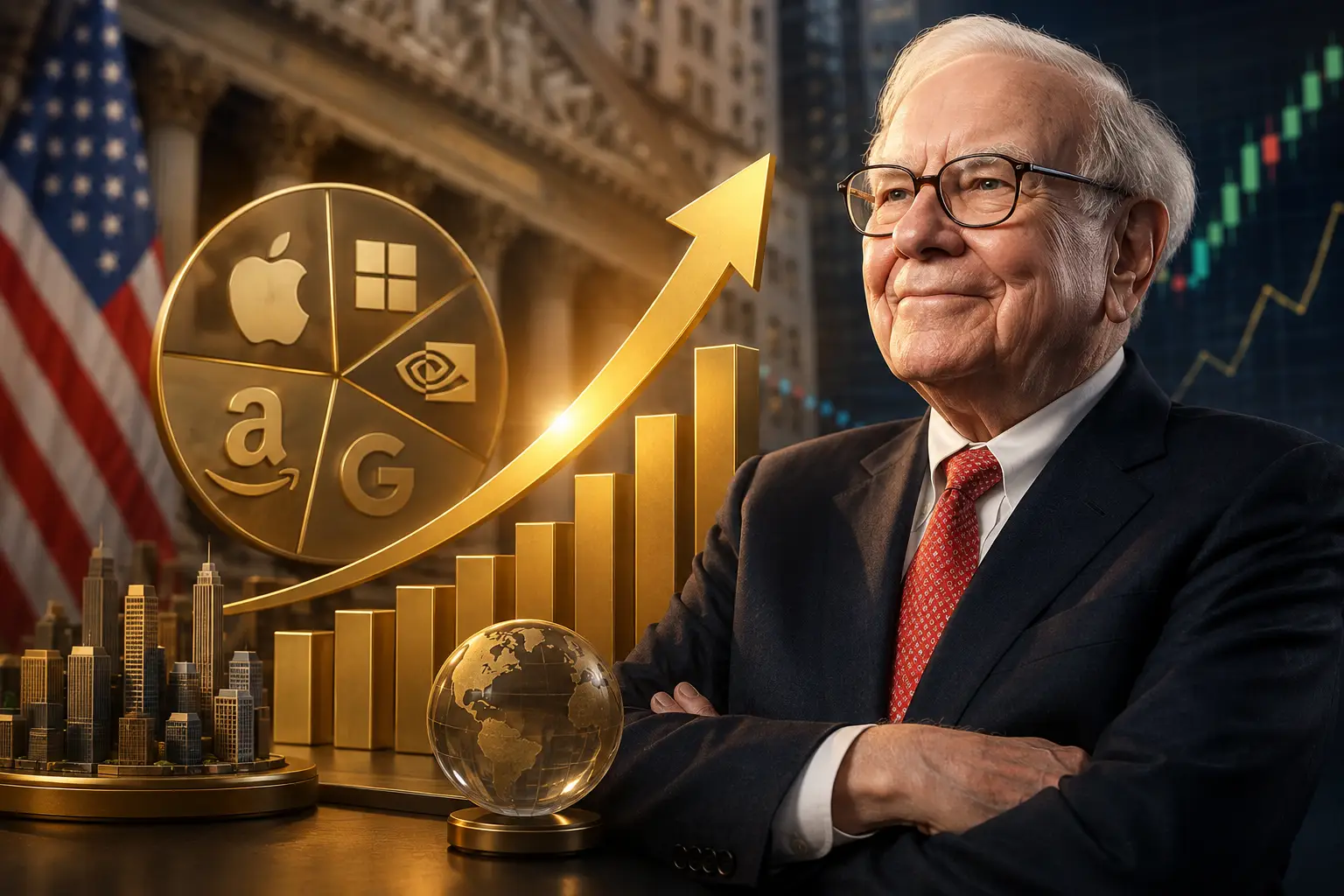
Source: AI
In Berkshire Hathaway's 2013 annual letter, Buffett revealed the investment instructions in his will.
He asked the trustee to place 10% of his wife's cash in short-term US government bonds and 90% in a very low-cost S&P 500 index fund.
Buffett specifically recommends Vanguard products.
InstructionsBuffett's inheritance distributionThis shows the difference between the strategiesprofessional investors and general investor needs.
Buffett can analyze companies, read financial statements, assess management, and wait for opportunities for years.
Most people don't have the same time, information, or experience.
Index funds offer a simpler approach. Investors don't have to guess which company will be the next winner.
By purchasing the S&P 500, they gain indirect ownership of hundreds of large companies in one product.
Read Also:List of Conglomerate Stocks You Must Know: Check Here!
What is the Vanguard S&P 500 VOO?
Vanguard S&P 500 Flightis an exchange-traded fund designed to track the performance of the S&P 500 index. Because it is an ETF, its units can be traded on the exchange like stocks during trading hours.
VOO uses a passive approach. Managers do not attempt to select stocks that are expected to outperform the market.
The portfolio follows the composition of the index, with greater weighting given to companies with higher market capitalizations.
The advantage of this approach is diversification.
A single company's decline doesn't automatically destroy the entire portfolio because the funds are spread across various sectors, such as technology, finance, healthcare, industrials, energy, and consumer goods.
However, VOO's diversification remains focused on large US companies.
This ETF is not a global portfolio and does not provide broad exposure to small-cap stocks, emerging markets, or bonds.
Read Also:What Is GOOGLX? How to Buy Alphabet Tokenized Stock on Bittime
0.03% Annual Fee is a Key Advantage
VOO hasannual fee 0.03%based on Vanguard data as of April 28, 2026. This means,Management fees are roughly equivalent to about US$3 per year for every US$10,000 invested, before taking into account changes in portfolio value.
Vanguard notes that the industry's average ETF fees are well above those levels.
Seemingly small cost differences can have a big impact over decades.
Fees not only reduce the balance in the current year, but also reduce capital that could have continued to grow through compounding.
This is the reason Buffett repeatedly mentionsekankanalow-cost index funds.
Investors cannotcontrol market movements, but they can control costs, transaction frequency, and investment holding discipline.
Read Also:How to Buy AAPLX on Bittime: Tokenized Apple Stock for Beginners
Buffett's Bet Against Hedge Funds
Buffett's views on passive investing have been tested throughbetting against hedge funds. He bet that an S&P 500 index fund would beat a group of five fund-of-hedge-funds over the ten years from 2008 to 2017.
The final results were starkly different. The S&P 500 index fund recorded a cumulative return of 125.8%, while the five hedge fund groups generated returns ranging from 2.8% to 87.7%. The average annual return of the index funds was 8.5%, higher than the entire comparison group.
This bet doesn't prove that all active managers fail. The lesson is that layered fees and complex trading decisions create significant barriers.
Even professional managers must generate a high enough edge to cover costs before providing additional returns to investors.
Take advantage of today’s opportunity to get started with investing. Sign up to Bittime and start building your portfolio.
Is it true that 90% of managers lose to the index?
The statement that90% of managers loseThis doesn't apply equally to every period and category. However, the data shows that consistently beating the index is indeed very difficult.
SPIVA U.S. Year-End 2025 reports that 79% of large-cap active stock funds in the U.S. lagged the S&P 500 throughout 2025.
SPIVA research also showed that failure rates generally increased as the observation period was extended.
The problem isn't just choosing a manager with a history of good results. Investors must also determine whether that performance stems from skill, favorable market conditions, or simply luck.
Past performance does not guarantee that the same manager will continue to outperform after fees.
VOO is not trying to beat the market.
The goal is to provide returns close to the index after deducting very low fees.
Read Also:Learn Crypto Trading: Understanding Trading Pairs, Market Orders, Order Books, and Limit Orders
How Can a $10,000 Investment Become Over $40,000?
A recent report on Buffett's recommendations noted that a $10,000 investment in a strategy that tracks the S&P 500 could grow to more than $40,000 over ten years, depending on the starting point, ending point, and dividend reinvestment.
These figures are not a guarantee of results over the next ten years. The stock market can experience corrections, recessions, or extended periods of low growth.
The key message isn't that capital will definitely quadruple, but that time and compounding can make a big difference. Investors who constantly dip in and out of the market risk missing out on recovery periods and key bullish days.
Is VOO Suitable for All Investors?
VOO can be pchoice forlong-term investment recommendations, especially forinvestors who want broad exposure to large US companies without picking individual stocks.
However, VOO is not a risk-free product. Its value can decline sharply during stock market downturns. Its capitalization-weighted nature also means its performance is significantly influenced by a number of very large technology companies.
Indonesian investors face additional risks such as fluctuations in the dollar exchange rate against the rupiah, brokerage fees, dividend taxes, currency conversion fees, and regulations regarding access to foreign products. Investors should also ensure that the product aligns with their objectives, time horizon, and risk tolerance.
Buffett's own strategy isn't to put all his funds in stocks. His legacy mandates still allocate 10% to short-term government bonds as a more stable investment.
Read Also:bStocks vs. xStocks: Which Tokenized Stock Platform is Superior?
Conclusion
VOO remains a top choice in Buffett's strategy discussions because it offers something that is hard to beat: broad access to large US companies at a cost of just 0.03% per year.
Its advantage doesn't come from its ability to predict the next stock price increase. VOO relies on American business growth, diversification, low costs, reinvestment, and timing.
For long-term investors, Buffett's lesson isn't simply "buy VOO." The more important principles are avoiding excessive fees, not chasing short-term performance, maintaining diversification, and remaining disciplined during market volatility.
Let’s start trading crypto with the largest assets, such as BTC/IDR and ETH/IDR, right in the Bittime app.
Bittime is a licensed and regulated Digital Financial Asset Trader (PAKD) supervised by Indonesia’s Financial Services Authority (OJK) — where you can buy Bitcoin in Indonesia and hundreds of other crypto assets starting from just Rp10,000. The registration process is fast, secure, and you can get started today.
Track USDT to IDR conversions and monitor your favorite crypto assets in real time. Everything is available in one crypto investment app that you can download for free on the Play Store
Ready to start? Register now on Bittime and execute your investment strategy with a platform trusted by millions of users in Indonesia.
FAQ
What ETFs does Warren Buffett recommend?
Buffett recommends a very low-cost S&P 500 index fund and specifically mentions Vanguard in his legacy instructions. He doesn't suggest that VOO is the only product available.
What is VOO?
VOO is a Vanguard ETF that tracks the performance of the S&P 500 index, providing exposure to large US companies.
How much does VOO cost annually?
VOO's expense ratio is 0.03% per year based on Vanguard data as of April 28, 2026.
Why does Buffett prefer index funds?
Index funds offer diversification, low costs, and simple strategies. Investors don't need to constantly pick stocks or seek out active managers capable of beating the market.
Is VOO guaranteed to make a profit?
No. VOO's price may decline following the US stock market. Past results do not guarantee future returns.
Is VOO suitable for Indonesian investors?
VOO can be considered by investors who understand US stocks, currency risks, taxes, brokerage fees, and market volatility. Its suitability depends on individual objectives and risk profile.
Disclaimer: The views expressed belong exclusively to the author and do not reflect the views of this platform. This platform and its affiliates disclaim any responsibility for the accuracy or suitability of the information provided. It is for informational purposes only and not intended as financial or investment advice.
.png)