Is Public American Dividend (PAD) Legit or a Scam? Check the Risks
2026-11-06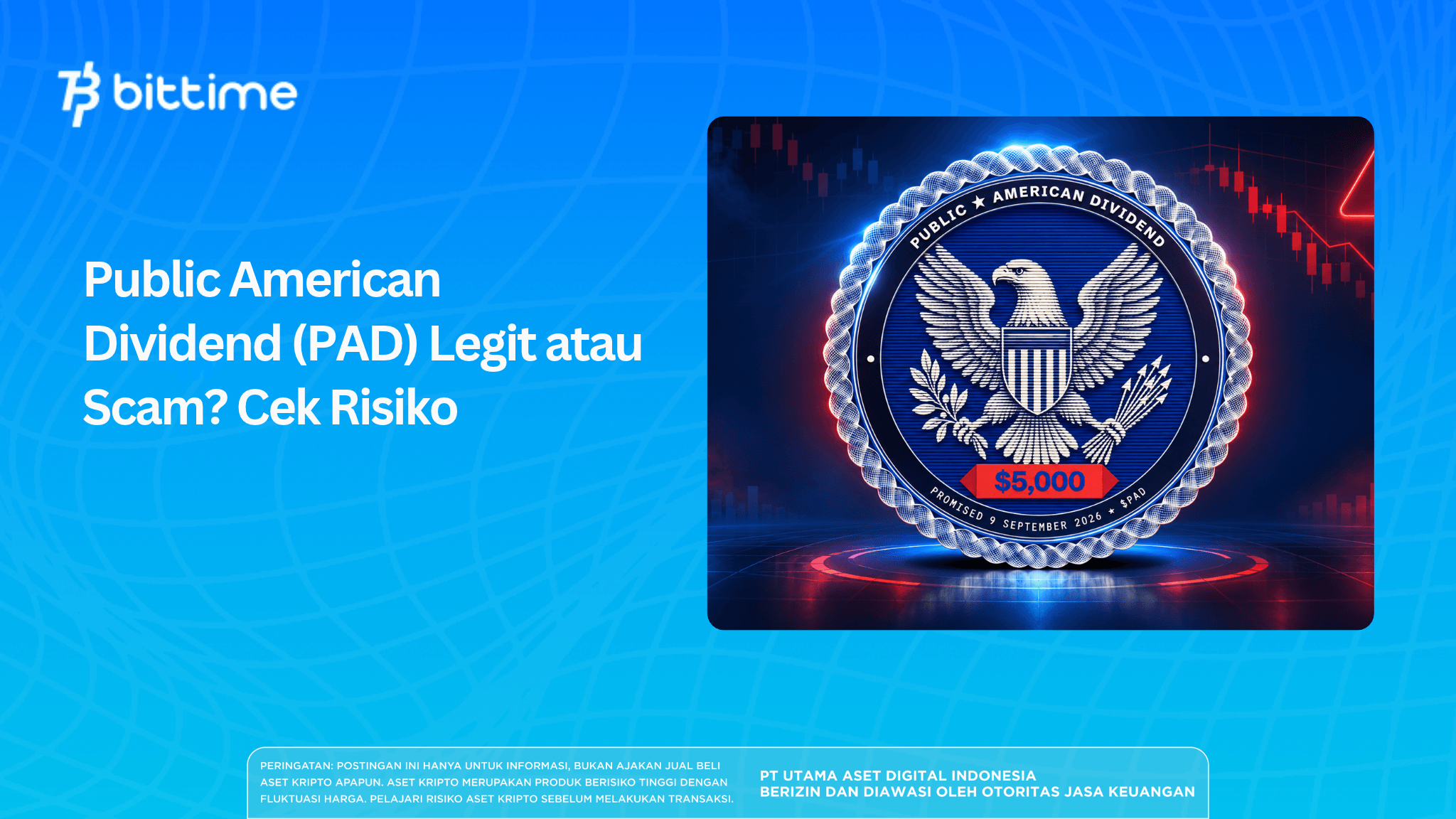
Is Public American Dividend legitimate or a scam? This question has been drawing attention since the PAD token appeared on the Solana market with a narrative centered on U.S. dividends. However, one finding deserves closer scrutiny: the PAD token traded on a decentralized exchange (DEX) has a different contract address from the token listed on the Public American Dividend website.
The difference is significant. The PAD token on PumpSwap has a supply of approximately 1 billion, while the project website lists a supply of 20 million tokens. Then there is the $5,000 dividend featured in its narrative, even though the website explicitly states that PAD holders are not entitled to such payments. So what does PAD actually offer, and how significant are the risks?
Key Takeaways
- Two PAD tokens were identified on Solana, with different contract addresses and token supplies.
- The Public American Dividend website states that PAD is not a U.S. government token and does not distribute $5,000 dividends.
- High trading activity and favorable automated security scan results do not guarantee that a token is risk-free.
What Is Public American Dividend (PAD)?
Public American Dividend, or PAD, is the name of a Solana-based token that draws on the idea of distributing dividends to U.S. citizens.
Its narrative is tied to discussions of a $5,000 payment for American adults, associated with import tariff policies and political developments in the United States.
The name Public American Dividend makes the project sound like an investment instrument that generates income for its holders.
However, the token model described on the project website does not operate like a dividend-paying stock.
PAD holders have no entitlement to periodic profit distributions, government revenue, or guaranteed payments.
In fact, the website describes the token as an independent, speculative asset.
Given these characteristics, PAD's price largely depends on trading activity and market interest in the project's theme.
Is Public American Dividend Legitimate or a Scam? Here Are the Facts
There is a difference between a token that genuinely exists on the blockchain and a trustworthy investment project.
In PAD's case, the token's existence can be verified. There are recorded transactions, active trading pairs, and accessible price data.
However, these facts do not establish whether PAD is a safe investment.
To assess that, we need to examine how the token is identified, whether the project's claims align with the facts, and the conditions of the market where it trades.
The review found that the PAD name is used by assets with different contract addresses.
This is a significant concern because someone who finds PAD on a trading platform may not be looking at the same token described on the project's website.
There is insufficient evidence to label every token named PAD a scam.
However, until the tokens' identities and the relationships between their contracts are clear, claims of legitimacy should not be accepted at face value.
Two PAD Tokens Have Different Contract Addresses
One of the most notable findings from the PAD investigation is the existence of two distinct Solana contract addresses.
Both use the PAD name or ticker, but they have different token characteristics.
PAD Traded on PumpSwap
The PAD token found in the PAD/SOL trading pair on PumpSwap has the following contract address:
cgroWcQiEf73UsPPhvBsf81Kcn88EKrfFUSfE7Jpump
This token comes from the Pump.fun ecosystem and has a supply of approximately 1 billion PAD.
Its trading activity can be viewed through transaction records on the Solana network.
PAD Listed on the Project Website
Meanwhile, the Public American Dividend website displays this contract address:
PADr9C9X3oFiyD8hgdGcQYCLcWJmox7kXPs25BQsSv4

The token supply listed on that website is approximately 20 million PAD.
In other words, the two token supplies differ by a factor of 50.
Such a large discrepancy shows that these are distinct on-chain assets, not simply two price pages for the same token.
Is one a newer version, a migration, or an entirely separate project? The available information does not establish the relationship between them.
Why Does the Contract Address Matter?
Names and tickers are not unique identifiers in cryptocurrency.
Anyone can create a token with a ticker resembling another project, even using a similar logo or description.
That is why checking the contract address should be the first step when evaluating a token.
Two assets with the same name can have very different prices, supplies, ownership distributions, and risks.
For PAD, using the price of one contract to evaluate the token under another contract could lead to incorrect conclusions.
Does PAD Really Pay $5,000 Dividends?
The word Dividend in the name Public American Dividend can easily create the impression that buyers will receive regular payments.
This impression is reinforced by the project's references to a proposed $5,000 payment for U.S. citizens.
However, the information on the project website does not support the idea that token holders are entitled to that money.
The Public American Dividend website states that its token does not entitle holders to dividends, rebates, or any specific income distributions.
There is also no mechanism guaranteeing that PAD can be redeemed for a payment from the U.S. government.
So why does the project use the $5,000 figure?
The amount is part of the project's political theme, not a payment attached to each token.
This is an important distinction.
A token may use an economic or government-policy narrative to build a community identity, but that narrative does not automatically create financial benefits for its holders.
Buying PAD does not entitle you to a $5,000 dividend.
If anyone promotes PAD as a way to receive government payments, that claim warrants scrutiny because it conflicts with the risk disclosures on the project website.
Is PAD an Official U.S. Government Token?
There is no verified evidence that Public American Dividend is an official cryptocurrency issued by the U.S. government.
In fact, the project website states that PAD is not affiliated with the White House, the U.S. Treasury Department, Donald Trump, or any other federal agency.
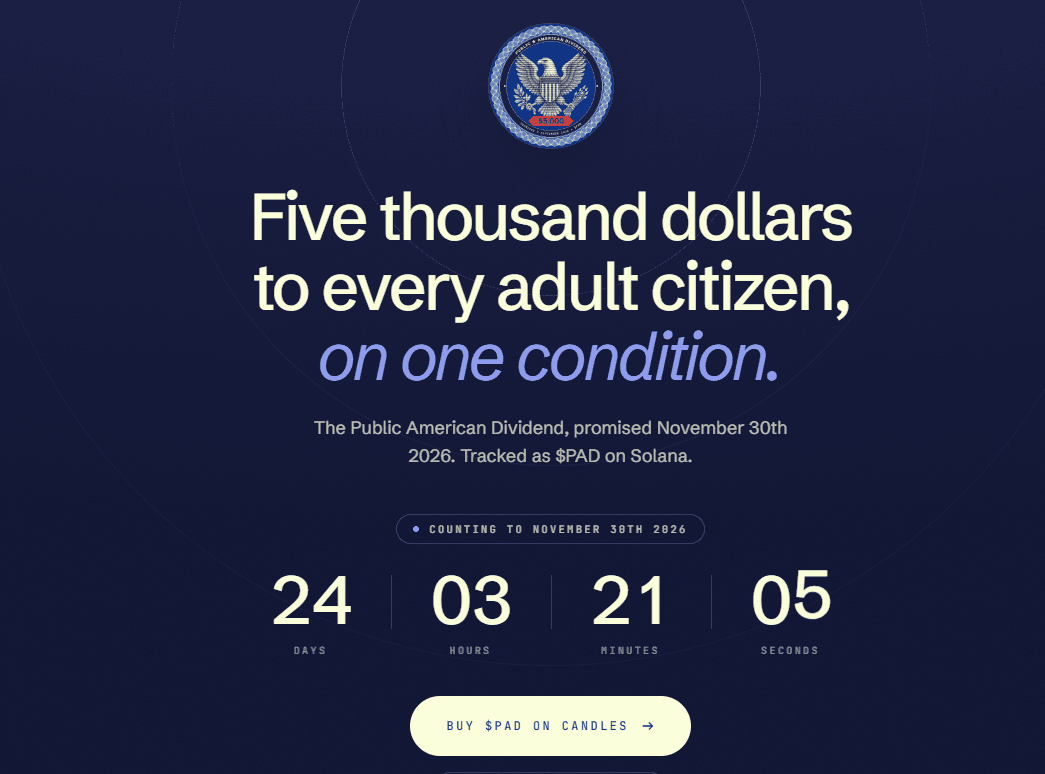
Using American terminology, national symbols, or public-policy narratives does not prove government endorsement. The same applies to the countdown to November 30, 2026, displayed on the project website.
That date should not be treated as a confirmed schedule for distributing profits to holders. In the world of meme coins, political themes are often used to attract market attention.
However, the popularity of a narrative does not make an asset an officially approved investment product or guarantee its value.
PAD Coin Price and Trading Activity
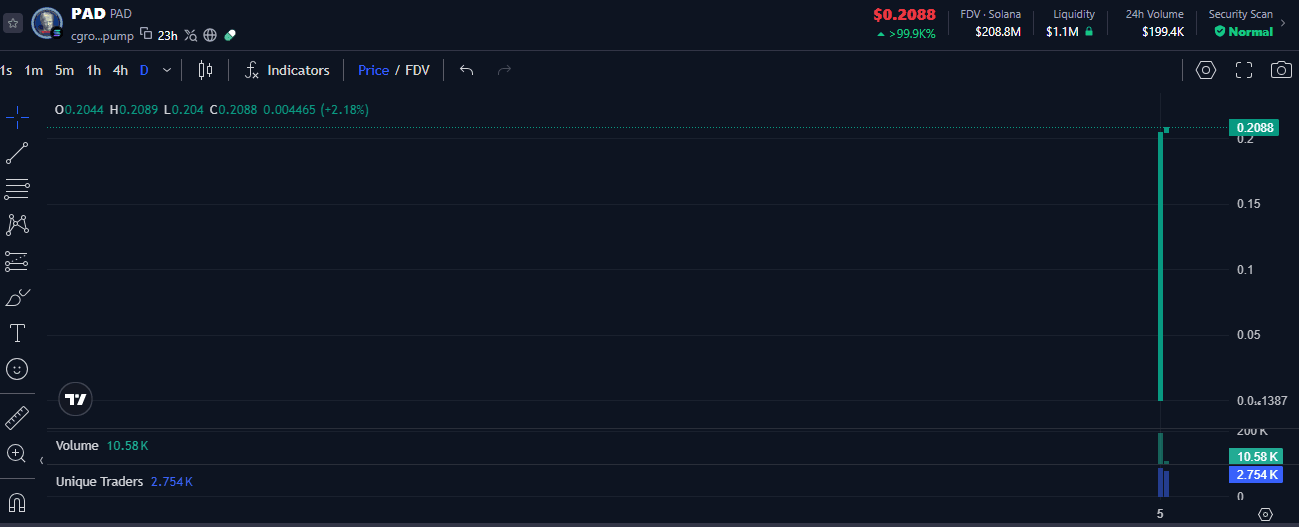
Beyond the project's claims, PAD's trading conditions are also worth examining. In a snapshot taken on November 6, 2026, the PAD token with the cgroW...pump contract was trading at approximately $0.2085.
Liquidity in the PAD/SOL pair was around $1.1 million, while its displayed fully diluted valuation (FDV) reached approximately $208.5 million.
That valuation appears substantial for a token that was only about one day old at the time of the review. However, FDV is often mistakenly interpreted as the amount of money available in the market.
In reality, it is an estimated valuation based on the token's price and supply. By comparison, the $1.1 million in liquidity represents only about 0.5% of the $208.5 million FDV.
This comparison is not a slippage calculation, but it highlights the large gap between the displayed valuation and the funds available in the trading pool.
This means the last traded price may not be the price a holder can obtain when selling a large number of tokens.
Do Numerous Buy Transactions Mean PAD Is Safe?
A high number of buy transactions in a new token often catches traders' attention. However, frequent buying does not necessarily indicate healthy demand.
For example, ten small purchases may not be enough to offset one large sell order. Beyond the number of transactions, the value of each purchase and sale also needs to be examined.
Repeated wallet activity is also worth monitoring to determine whether trades come from many users or are concentrated among a few accounts. Without that analysis, it is difficult to assess the true strength of demand for PAD.
PAD Tokenomics: Why Are the Supplies Different?
The supply discrepancy is another reason the two PAD tokens need to be analyzed separately.
The token in the PumpSwap pair has a supply of approximately 1 billion PAD, while the contract listed on the project website has 20 million PAD.
These figures affect how market valuation is calculated. A token with a lower unit price does not necessarily have a smaller valuation if its supply is much larger, and vice versa.
The project website also claims that the team holds no reserved allocation and that both buy and sell taxes are set at 0%. However, claims about token distribution should be checked against wallet ownership data.
A 0% transaction tax does not mean trading is entirely free of costs. Users may still incur network fees, platform charges, and slippage when making transactions.
Has PAD's Security Been Verified?
One PAD token returned normal results in an automated security scan. However, the market data provider reviewed had not yet marked the token's identity verification as complete.
These two findings are not contradictory. The automated scan indicates that the system detected no issues with the parameters it tested at that time.
An unverified status, meanwhile, means the token's identity or official affiliation has not been established through the data provider's verification process. The problem is that automated scan results are often mistaken for a comprehensive security audit.
In reality, such scans cannot confirm the developers' integrity, rule out market manipulation, or guarantee the safety of investors' funds.
What About Mint Authority and Freeze Authority?
On the Solana network, several technical permissions deserve attention.
Mint authority relates to the ability to issue additional tokens, while freeze authority can allow certain token accounts to be frozen under specific conditions.
These permissions matter because they can affect the supply and users' ability to transfer their assets.
The PAD token with the cgroW...pump contract uses the Token-2022 program.
This program supports additional features, but using the program does not mean that all of those features are automatically enabled.
To understand the risks, the token's authority settings and extensions must be examined directly. Because the two PAD contracts have different characteristics, a security assessment of one token should not be applied to the other.
PAD Coin Risks: Liquidity and the Potential for a Rug Pull
The price displayed on a DEX may differ from the price actually received when selling. The difference depends on liquidity conditions, transaction size, and price changes during execution.
The shallower the market relative to the transaction size, the greater the potential slippage. This risk is especially important for newly launched tokens, whose liquidity can change rapidly.
An asset may appear active as buying increases, yet face substantial selling pressure if many holders attempt to exit at once. Liquidity pool protections also need to be checked.
If liquidity providers retain the ability to withdraw most of the pool's funds, traders may face greater risk. However, that possibility alone does not mean a rug pull has occurred.
Proving such an event requires verifiable transaction records and liquidity changes. Ownership concentration is another equally important risk.
If most of the supply is held by a small number of wallets, token movements by major holders could significantly affect the price.
For that reason, evaluating PAD requires more than examining its price and trading charts.
Is PAD Coin Safe to Buy?
Questions about PAD's safety must be answered with reference to the specific token being examined. For the cgroW...pump contract, trading activity and market data are available.
However, its connection to the contract listed on the Public American Dividend website remains unconfirmed. Meanwhile, the project website explicitly states that its token grants no right to dividends or government payments.
From an investment standpoint, PAD remains highly risky because its value is influenced by sentiment, liquidity, and shifting market interest. Its extremely short trading history at the time of the review also limits the historical data available for assessing price behavior.
PAD is therefore better understood as a speculative asset than as an instrument for earning dividend income.
If you are considering this token, understanding its contract identity and the risks involved in selling is far more important than focusing solely on potential price gains.
Five Things to Check Before Buying PAD
Before interacting with a PAD token, several basic checks can help you avoid mistakes.
- Verify the complete contract address. Do not select a token based solely on the name, ticker, or logo shown on a DEX.
- Confirm the project's identity. Match the contract information against verifiable official announcements, not merely links included in the token's metadata.
- Review the token's permissions. Check whether mint authority, freeze authority, or other contract features could affect supply and transfers.
- Examine liquidity and holder distribution. A high price means little if market depth is thin or the supply is concentrated among a few wallets.
- Read the project's risk disclosures. Make sure the advertised benefits are actually provided to token holders rather than being merely part of the marketing narrative.
These steps cannot guarantee an investment free from losses, but they can help identify risks before funds are committed.
If you want to learn how to assess Solana tokens and understand the risks of crypto investing, you can sign up for Bittime to follow market news and read educational resources about digital assets.
Conclusion
Is Public American Dividend legitimate or a scam? Based on the available information, there is not enough evidence to reach a single conclusion about every token using the PAD name.
The most important finding is the existence of two contracts with different supplies and on-chain identities. In addition, the Public American Dividend website itself states that its token has no official connection to the U.S. government and does not distribute $5,000 dividends.
This means PAD's risks are not limited to whether its price will rise or fall. Readers must also identify the specific token they are examining, understand its liquidity conditions, and distinguish marketing claims from benefits supported by evidence.
For an asset with such a limited trading history, these checks are essential before making a decision.
Bittime is a licensed Digital Financial Asset Trader (PAKD) regulated and supervised by Indonesia's Financial Services Authority (OJK) — where you can buy Bitcoin in Indonesia and hundreds of other cryptocurrencies starting from IDR 10,000. Registration is fast and secure, and you can get started today.
Track the conversion of USDT to IDR and real-time price movements of your favorite cryptocurrencies. Everything is available in one crypto investment app that you can download for free from the Play Store.
Ready to get started? Sign up for Bittime now and put your investment strategy into action on a platform trusted by millions of users in Indonesia.
FAQ
Is Public American Dividend (PAD) Legitimate or a Scam?
Tokens named PAD do exist on the Solana blockchain, but multiple contracts with similar identities have been found. Trading activity alone does not prove that a project is legitimate or safe. There is insufficient evidence to classify every asset named PAD as a scam.
Does PAD Really Pay $5,000 Dividends?
No. The Public American Dividend website states that token holders have no entitlement to $5,000 payments, dividends, or government revenue. That amount is part of the project's narrative, not a promised return for holders.
Why Does PAD Have Two Contract Addresses?
The two tokens examined have different Solana mint addresses, with supplies of approximately 1 billion and 20 million PAD, respectively. They are separate on-chain assets despite sharing similar names or tickers. Their official relationship cannot be established from the available information.
Has PAD Been Audited, and Is It Safe?
One PAD token showed normal results in an automated security scan, but that is not equivalent to a comprehensive independent audit. Token identity, contract permissions, holder distribution, and liquidity protections still need separate assessment. No security scan can guarantee that a token's price will not decline.
What Are the Biggest Risks of Buying PAD Coin on Solana?
PAD's risks include selecting the wrong contract, extreme price swings, limited liquidity, and uncertainty about the relationship between tokens sharing the same name. Large sales may also incur significant slippage. Before buying, verify the token's identity and the market conditions of the specific asset.
Disclaimer: The views expressed belong exclusively to the author and do not reflect the views of this platform. This platform and its affiliates disclaim any responsibility for the accuracy or suitability of the information provided. It is for informational purposes only and not intended as financial or investment advice.
.png)