Aster Coin: Price Prediction After 99% Buyback and 5 Billion Token Burn
2026-07-17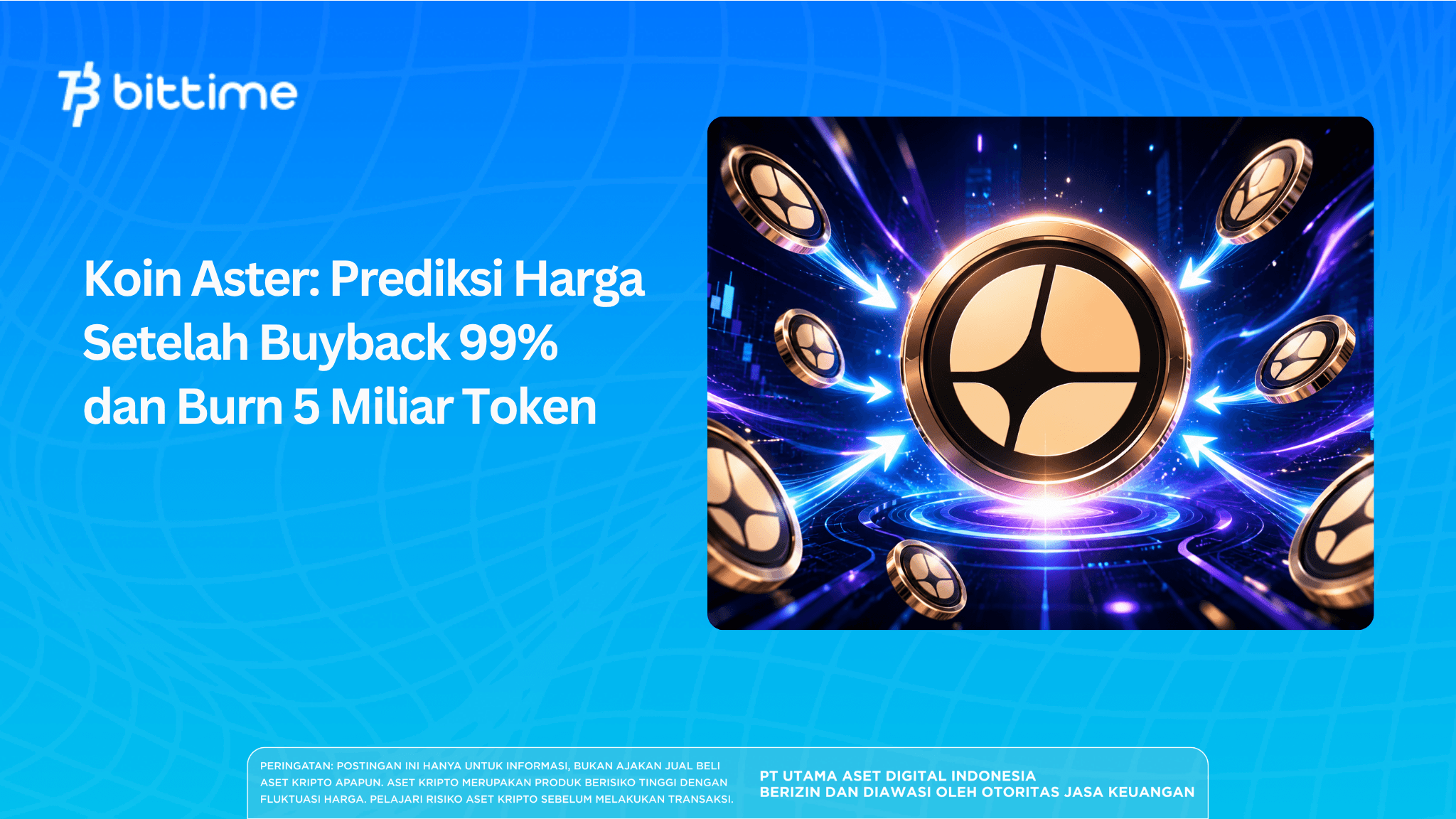
Aster Coin has again attracted attention after updating its tokenomics by allocating 99% of platform fees to ASTER buybacks.
The program included a burn of an equivalent amount of the token reserve, with the long-term goal of reducing the total supply from 8 billion to 3 billion ASTER.
Key Takeaways
- 99% of the platform's daily fees are used to purchase ASTER from the market through an automated mechanism.
- Each ASTER repurchase will be offset by a token burn from the reserve until the total supply reaches 3 billion.
- The impact on price remains dependent on trading volume, platform revenue, Bitcoin conditions, and selling pressure from token holders.
What is Aster Coin?
ASTER is the primary token in the Aster ecosystem, a decentralized trading platform that offers perpetual and spot trading. This token is used in the staking system, governance, incentivization, and development of the Aster Chain ecosystem.
ASTER's fundamental value is highly dependent on platform activity. The more traders use Aster, the greater the potential transaction fees generated.
With the latest tokenomics, a significant portion of these fees no longer goes solely to the protocol treasury but is instead directed toward purchasing ASTER from the market.
This change creates a clearer link between platform usage and token demand. However, this relationship doesn't automatically guarantee price increases, as market conditions, liquidity, and token holder behavior still play a significant role.
Read also:ASTER Coin on the Rise: Price Prediction and Impact of Binance's CZ Purchase
Aster 99 Percent Buyback: How Does It Work?
The ASTER buyback mechanism uses 99% of daily platform fees to purchase tokens on the open market.
Purchases are automated using the time-weighted average price (TWAP) method, spreading transactions over multiple periods rather than a single large purchase.
The buyback tokens aren't immediately destroyed. They're added to Loyalty Rewards and then distributed to veASTER holders based on the number of tokens and the lockup duration.
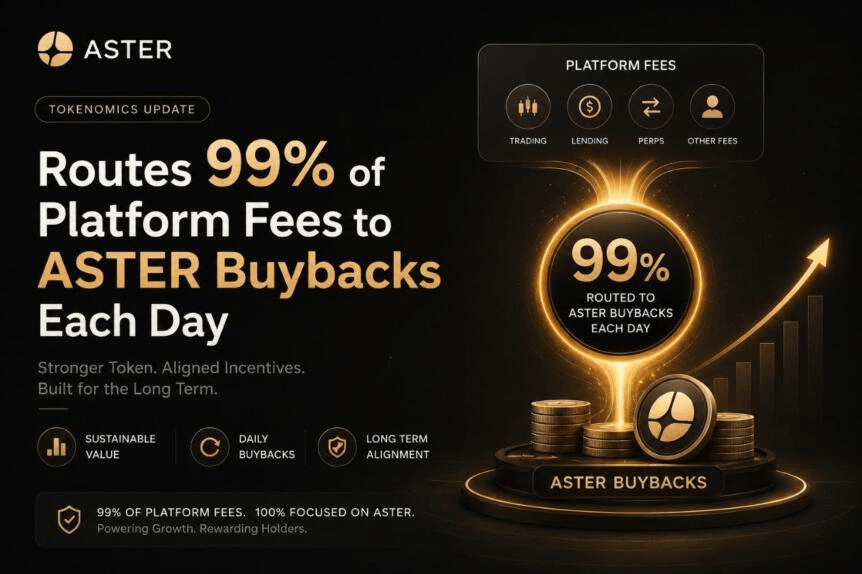
The flow can be explained as follows:
- Users make transactions on the Aster platform.
- The platform earns revenue from trading fees.
- 99% of daily fees are used to purchase ASTER.
- ASTER purchases are allocated as staking rewards.
- An equivalent amount of ASTER reserves was permanently destroyed.
This model can generate regular buying demand as long as the platform generates sufficient revenue. This means that the buyback power is determined not only by the 99% percentage but also by the size of the fees collected.
As much as 99% of small revenues will still result in small buyback amounts. Therefore, investors need to pay attention to trading volume, active user numbers, protocol revenue, and buyback frequency.
Read also:ASTER Crypto Price Prediction from End of October to 2026: Could It Rise Again?
Understanding the Aster 198 Percent Mechanism
The term 198% mechanism comes from the combination of two different actions:
- 99% of platform fees are used for ASTER buybacks.
- ASTER in an amount equivalent to the buyback proceeds is burned from reserves.
This figure doesn't mean Aster spent 198% of its revenue. Cash expenditures for token purchases still account for 99% of platform fees. The additional 99% represents reserve tokens destroyed at a one-to-one ratio to the number of buyback tokens.
For example, when platform revenues are sufficient to purchase 1 million ASTER, the protocol will purchase 1 million ASTER from the market.
Afterward, another 1 million ASTER from the reserve is destroyed. Overall, the system generates market demand for 1 million tokens while reducing the total supply by 1 million tokens.
This distinction is important because buybacks and burns have different effects. Buybacks increase market demand, while burns reduce overall available supply.
Read also:How to Buy ASTER on DEX: A Complete Beginner's Guide & Safety Tips
Aster Burn 5 Billion Tokens Not Done All at Once
The 5 billion ASTER burn target stems from the plan to reduce the initial total supply from 8 billion to 3 billion tokens. This results in a targeted supply reduction of 62.5%.
This program isn't a one-time burn. It's implemented in stages and depends on the amount of ASTER purchased using platform fees. Burns are scheduled periodically and can last for extended periods.
The speed of achieving the 3 billion supply target depends on several factors:
- The amount of daily income of the platform.
- ASTER price when the buyback process was carried out.
- Perpetual and spot trading volumes.
- Number of new markets available on Aster.
- Protocol consistency executes tokenomics policies.
There's also a difference between total supply and circulating supply. Tokens burned from reserves aren't necessarily previously circulating in the market.
Therefore, reserve burns can reduce potential future dilution, but they don't necessarily directly reduce the number of tokens currently in circulation.
Read also:King Aster (KASTER): A New Altcoin Worth Buying?
Is Aster Staking Really Inflation-Free?
The statement "Aster staking is inflation-free" should be interpreted with caution. A portion of staking rewards comes from ASTER repurchased using platform revenue. This component is relatively more sustainable than a model that continually mints new tokens to pay out returns.
However, the Aster staking system also has a base reward pool derived from the ecosystem's token allocation. Therefore, not all rewards can be considered completely inflation-free or emission-free.
Aster staking uses two reward layers:
Base APY
These rewards are related to validator performance and the amount of ASTER delegated. Validators who contribute more to the network can earn a larger share of the rewards.
Loyalty Rewards
These rewards take into account the lockup duration, token amount, trading activity, and veASTER value. ASTER buyback proceeds are also included in the Loyalty Rewards pool.
This model can reduce reliance on emissions because some of the returns are backed by the platform's real revenue. However, investors should still verify the source of each reward and the token distribution schedule.
Read also: XNC Price Prediction 2026–2030: Can Adoption Drive Price?
Today's Aster Price and Market Conditions
On July 17, 2026, the ASTER price was around US$0.61, or approximately Rp11,000 per token. The circulating supply was recorded at nearly 2.7 billion ASTER, while the total supply remained at around 7.8 billion tokens.
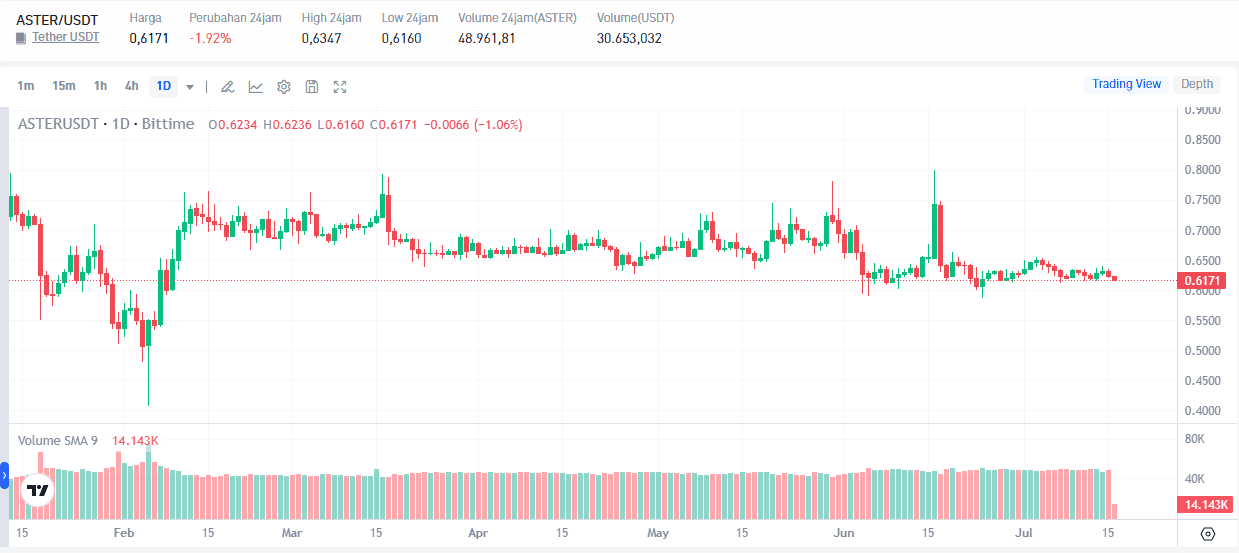
This price is still well below ASTER's record high. This indicates that the market has not yet fully valued the buyback and burn program.
The price reaction following the tokenomics announcement also exhibited a common pattern in the crypto market. Prices briefly strengthened following the news, but the gains weren't entirely sustained. Some market participants likely took profits after the initial surge.
This situation emphasizes that positive news can create short-term momentum, while a sustainable trend requires evidence of consistent revenue, transaction volume, and supply reduction.
Read also: Noxa (NOXA) Price Prediction 2026–2030: Can Its Ecosystem Thrive?
Aster Coin Price Prediction After Buyback and Burn
ASTER price predictions should use multiple scenarios, not a single definitive number. Buybacks can increase demand, but the price remains influenced by overall crypto market conditions.
Skenario Bearish: US$0,40–US$0,55
ASTER could potentially move into this area if Aster's transaction volume declines, platform revenue weakens, or Bitcoin enters a deeper correction.
Selling pressure can also arise if staking rewards re-enter the market or token distribution outpaces demand growth. In such circumstances, buybacks may not be sufficient to absorb the entire sold supply.
Moderate Scenario: US$0.70–US$1.00
A moderate scenario could occur if buybacks are consistent, platform volume is stable, and supply gradually decreases. The US$1 area is also a psychological level that is likely to attract trader attention.
With a circulating supply of approximately 2.7 billion tokens, a price of US$1 would result in a market capitalization of approximately US$2.7 billion. This valuation still requires growth in Aster activity, but it's not out of the question if the perpetual DEX sector continues to grow.
Skenario Bullish: US$1,20–US$1,80
ASTER could enter a bullish scenario if it experiences increased trading volume, generating higher fees, and accelerating buybacks. An increase in the number of tokens locked in staking could also reduce the liquid supply in the market.
This scenario requires strong altcoin market support, increased Aster Chain adoption, and consistent verifiable burns. Without fundamental growth, a rise towards that range is riskier and relies more on speculation.
Read also: BrilliantCrypto (BRIL) Price Prediction 2026–2030: Prospects, Risks, and Is It Still Worth Watching?
Simulation of the Impact of the 3 Billion ASTER Supply Target
A 3 billion supply target could mitigate potential long-term dilution. However, a decrease in supply cannot be used as the sole basis for calculating price.
In theory, if the market capitalization remains the same and the number of tokens decreases, the price per token can increase. In practice, market capitalization also fluctuates based on sentiment, protocol revenue, liquidity conditions, regulations, and investor confidence.
The 3 billion ASTER target will also be unattainable in the short term if platform fees don't generate significant buybacks. Investors should not calculate the valuation as if all 5 billion tokens were burned today.
More relevant indicators to monitor include:
- Weekly or bi-weekly buyback value.
- The number of ASTERs actually burned.
- Total supply after each burn period.
- Platform revenue and trading volume.
- The amount of ASTER locked in staking.
- Percentage of rewards derived from buybacks.
- Changes in circulating supply.
Read also:Sultan Coin Price Prediction 2026–2030: Can CTO Survive?
Aster's Potential After Bitcoin Halving
Halving Bitcoin In April 2024, the halving will reduce the amount of new Bitcoin miners receive. Historically, the period following a halving has often drawn attention because changes in Bitcoin supply can influence crypto market sentiment.
However, the halving doesn't directly guarantee ASTER's rise. Its impact occurs through several channels, such as increased interest in crypto assets, capital inflows into altcoins, global liquidity conditions, and changes in Bitcoin's dominance.
ASTER has the potential to benefit when the market enters a risk-on phase and investors begin to seek assets outside of Bitcoin.
Conversely, ASTER could lag if capital remains concentrated in Bitcoin or investors reduce exposure to DeFi tokens.
The 99% buyback provides ASTER with an internal catalyst that isn't solely dependent on Bitcoin's cycle. However, the strength of that catalyst is still determined by Aster's actual revenue.
Read also:TAIKO Price Rise: Causes, Analysis, and Predictions for 2026
Factors That Can Drive ASTER Prices
Several factors could support price increases in the medium to long term:
- Growth in trading volume
Increased volume results in higher costs and strengthens buyback power. - Transparent burn execution
Verifiable on-chain transactions help increase confidence in the target supply. - Increased number of locked ASTERs
Tokens that are staked for long periods can reduce the liquid supply. - Aster Chain Expansion
The use of the network for applications, validators, trading, and on-chain activities can increase the utility of ASTER. - The growth of the perpetual DEX sector
The shift of traders from centralized platforms to on-chain trading could expand the market Aster serves. - Increased listing revenue
The cost of permissionless spot listings can be an additional source of buybacks if the number of listings increases.
Risks to Consider
Deflationary tokenomics does not eliminate investment risks. Some of ASTER's main risks include:
- Decrease in platform trading volume.
- Tight competition with other perpetual DEXs.
- Staking rewards are sold after distribution.
- Burns are mostly from tokens that are not yet in circulation.
- Changes to buyback policy through governance decisions.
- Smart contract vulnerabilities or network disruptions.
- Bitcoin correction and altcoin market decline.
- Regulatory uncertainty regarding crypto derivatives trading.
Investors also need to distinguish between revenue-driven increases and sentiment-driven increases. The new buyback program will have a sustainable impact if the platform can maintain activity and transaction costs.
Is ASTER Worth Watching?
The latest tokenomics make ASTER more attractive than models that rely solely on emissions to pay for staking. The relationship between platform revenue, buybacks, rewards, and burns is more direct.
However, a 99% buyback isn't the only reason to buy. Investors still need to assess Aster's ability to maintain volume, compete with competitors, expand its network, and consistently execute burnouts.
To keep up with the latest price developments and tokenomics news, you can register at Bittime and check crypto market updates before making a decision. Use the latest data and tailor each transaction to your individual risk profile.
Conclusion
Aster Coin has a new fundamental catalyst through a 99% buyback mechanism, a reserve token burn, and a targeted supply reduction from 8 billion to 3 billion ASTER. This model has the potential to create consistent demand while reducing potential dilution.
ASTER price predictions must still consider platform revenue, trading volume, the number of locked tokens, Bitcoin's condition, and selling pressure from staking rewards. A moderate scenario is in the US$0.70–US$1.00 range, while a bullish scenario requires stronger fundamental growth.

Monitor buybacks, burn transactions, and total supply developments before concluding that new tokenomics will automatically drive up the price.
Bittime is a licensed and regulated Digital Financial Asset Trader (PAKD) supervised by Indonesia’s Financial Services Authority (OJK) — where you can buy Bitcoin in Indonesia and hundreds of other crypto assets starting from just Rp10,000. The registration process is fast, secure, and you can get started today.
Track USDT to IDR conversions and monitor your favorite crypto assets in real time. Everything is available in one crypto investment app that you can download for free on the Play Store
Ready to start? Register now on Bittime and execute your investment strategy with a platform trusted by millions of users in Indonesia.
FAQ
What is Aster's 99% buyback?
Aster uses 99% of the platform's daily fees to purchase ASTER from the market. The buyback tokens are then allocated to stakers through Loyalty Rewards.
Will Aster burn 5 billion tokens at once?
No. The 5 billion figure represents a gradual reduction in the supply from 8 billion to 3 billion ASTER. The speed depends on the number of tokens repurchased.
What is the 198% Aster mechanism?
This term combines a 99% buyback with an equivalent burn of reserve tokens. It doesn't mean Aster used 198% of its revenue to buy tokens.
Doesn't staking ASTER cause inflation?
Part of the reward comes from buybacks, eliminating the need for new token minting. However, the base reward can also come from ecosystem token allocation, so the term "inflationless" should be used sparingly.
What is the predicted price of ASTER?
A moderate scenario is around US$0.70–US$1.00, while a bullish scenario is around US$1.20–US$1.80. These ranges are not guaranteed, as prices are highly dependent on market conditions and platform revenue.
Disclaimer: The views expressed belong exclusively to the author and do not reflect the views of this platform. This platform and its affiliates disclaim any responsibility for the accuracy or suitability of the information provided. It is for informational purposes only and not intended as financial or investment advice.
.png)