Indonesia's Middle Class Downgraded: Is Cost of Living the Main Burden?
2026-08-28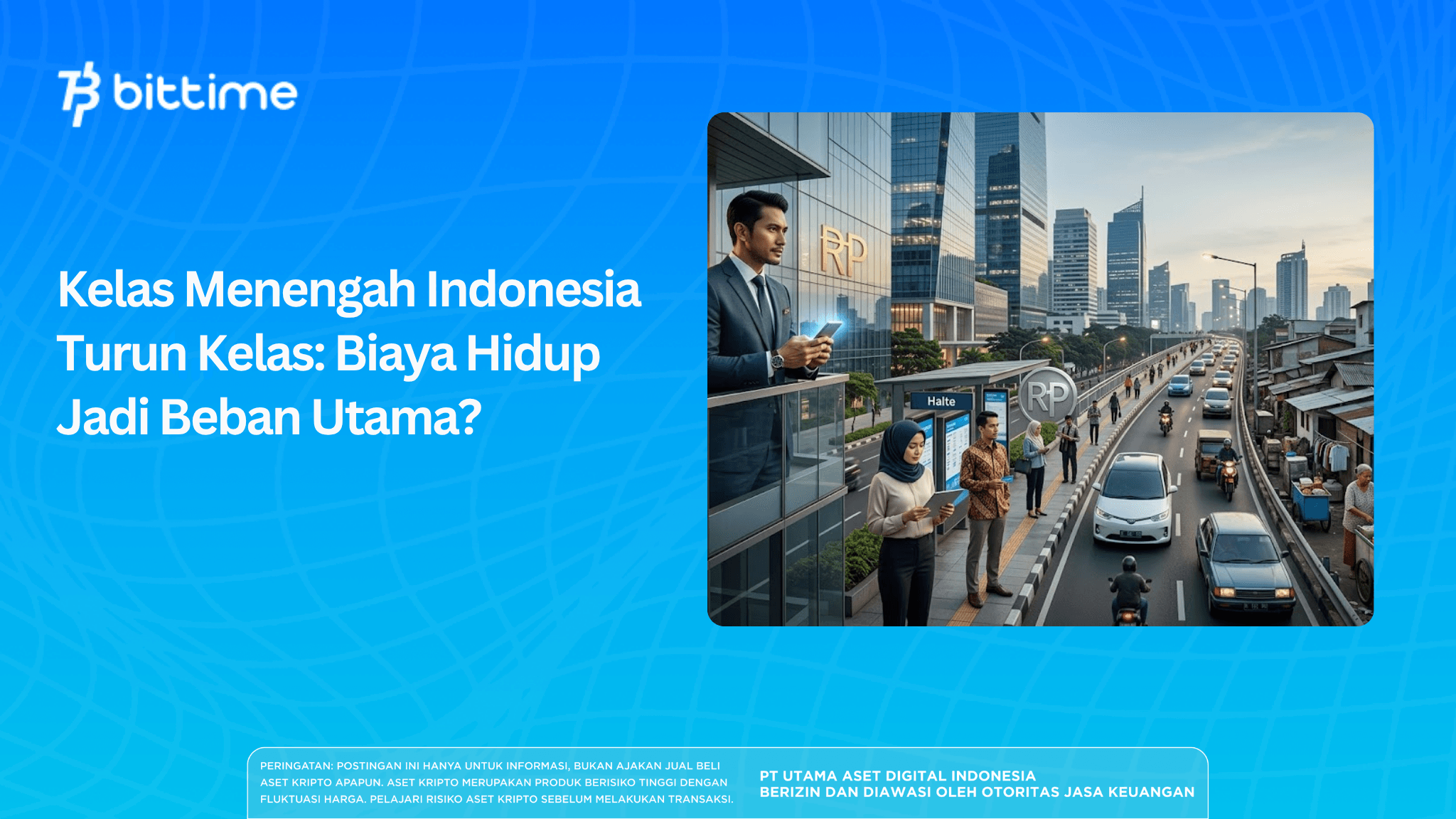
President Prabowo Subianto himself revealed the data in front of DPR RI members back in May 2026. Indonesia's economy has grown at an average of 5% per year over the past seven years, equivalent to 35% cumulatively, but poverty rates have actually increased and Indonesia's middle class has shrunk.
That admission serves as a fitting starting point to dissect why the condition of Indonesia's middle class today feels far heavier than the growth figures boasted by the government.
Three months after that statement, Statistics Indonesia recorded that the economy grew 5.29% in the second quarter of 2026. A figure that is statistically solid, but did little to help middle-class households whose savings continue to be eroded by rising food prices, fuel prices, and the benchmark interest rate.
The phenomenon of the middle class being downgraded is not a new story, but 2026 has become a moment when the anxiety feels more tangible, even becoming one of the fuels for the wave of demonstrations in late August.
Key Takeaways
- Indonesia's middle-class population shrank from 57.33 million (2019) to 46.7 million (2025), while the economy continued to grow at around 5% per year.
- Pressure comes from multiple directions at once: a ~32% increase in fuel prices, 100 bps increase in BI rate within a month, food inflation, and a lack of social safety nets for this group.
- Middle-class economic grievances are cited as one factor that colored the August 27, 2026 protests, though not the sole trigger.
High Economic Growth, but Why Is the Middle Class Shrinking?
Official data do show a positive trend. GDP in Q2 2026 was recorded at Rp 6,552.1 trillion, with the main support coming from the manufacturing industry and household consumption, while the first semester grew a stable 5.45% on an annual cumulative basis. The World Bank, in its Indonesia Economic Prospects report from June 2026, even noted that Q1 2026 grew 5.6%, the highest achievement since Q2 2021.
The problem is, these figures do not align with the reality of Indonesia's middle class declining in population. Based on the World Bank's standard, which refers to per capita spending levels, the number of Indonesia's middle class fell from 48.2 million in 2024 to 46.7 million in 2025, as reported by Pikiran Rakyat.
Looking further back, the decline is even sharper: from 57.33 million people in 2019 to 47.85 million in 2024, according to BPS data cited by Asatu News.
Also Read: Nvidia AI Funding $500 Billion, AI Crypto Tokens Also Benefiting?
Economists refer to this pattern as the opposite of the K-shaped recovery phenomenon commonly discussed post-pandemic. If K-shape describes the upper group rising and the lower group falling, Indonesia's situation looks more like E-shape: the upper class remains protected, the lower class remains vulnerable but still touched by social assistance, while the middle class is squeezed alone in the middle without adequate protection.
Senior economist Ferry Latuhihin even openly criticized the 5.29% growth because it is deemed insufficient to create quality jobs, in line with findings from the Center of Reform on Economics (Core) Indonesia, which stated that the growth figure does not truly reflect an increase in people's purchasing power.
If you are looking for a way to secure some assets amid this uncertainty in purchasing power, opening an account on a digital asset exchange supervised by the OJK could be a safe first step to start learning. Register a Bittime account now to start exploring asset diversification options legally and transparently.
Mounting Burdens from All Directions
Pressure on Indonesia's middle class rarely comes from a single source. Senior analyst at the Indonesian Strategic and Economic Action Institution (ISEAI), Ronny Sasmita, told Kontan that the current pressure is occurring simultaneously: rising living costs, shrinking savings space, and declining job security are moving together, not in turns.
Some concrete factors recorded throughout 2026:
- Fuel price hikes. Prices of Pertamax and Pertamax Green rose suddenly by around 32%, hitting directly the group whose fuel consumption is relatively high in their monthly shopping basket, according to a Kompas.id report.
- Aggressive rate hikes. Bank Indonesia raised interest rates three times in one month, totaling 100 basis points, reaching 5.75% in June 2026.
- Food inflation surges. Annual inflation rose from 2.42% to 3.08% in May 2026, with food price hikes being the main contributor to the erosion of middle-class household savings, according to economist Sobar from Muhammadiyah University of Yogyakarta.
- Social safety nets not targeting them. The distribution of social assistance through the National Social and Economic Data Single System (DTSEN) is indeed on target for the poor, but the middle class receives almost no similar protection.
- Home ownership burden. As many as 70.05% of primary home purchases depend on mortgages, so the ability to own a home is highly dependent on the ability to make long-term installments amid stagnant income, noted Kontan.
The combination of these factors makes the status of the middle class being pressured not just a perception, but clearly reflected in savings figures and changing consumption patterns. A phenomenon that some observers call "shopping with wariness": people are still shopping, but without a sense of financial security behind it.
From Wallets to the Streets: The Link to the August 27, 2026 Protests
Years of accumulated economic grievances finally colored the wave of demonstrations in Jakarta on August 27, 2026. The People's Movement Alliance (GERAM), comprising 14 student and civil society organizations, took to the front of the DPR/MPR RI building with 10 demands, including demanding accountability for policies deemed to be widening economic inequality, as well as an evaluation of the Merah Putih Village Cooperative and Free Nutritious Meal programs.
Other groups, such as the Pati Bersatu Community Alliance, brought different demands, namely the ratification of the Asset Forfeiture Bill and the death penalty for corruptors, indicating that economic issues are intertwined with governance and corruption issues in one wave of action.
From the financial market side, M. Rizal Taufikurahman, Head of the Macroeconomic and Financial Center at INDEF, told Suara.com that the demonstrations added negative sentiment to the IHSG and the rupiah, especially since the stock index had already corrected 1.48% to level 6,405 even before the action took place.
Investors are said to be watching whether this action is a pure expression of democracy or develops into a broader disruption of economic activity.
However, it is important to note that economic grievances are not the only trigger. Henri Subiakto, a professor at Airlangga University, reminded that public disappointment with economic conditions does not automatically turn into mass action on a large scale without a clear political trigger.
He assessed that the character of Indonesian society is relatively patient and accustomed to facing difficulties, so the scale of the August 27, 2026 protests is not necessarily as large as the riots of the previous year.
Conclusion
The 5.29% economic growth in Q2 2026 is indeed real statistically, but it does not automatically translate into financial security for Indonesia's middle class. The combination of fuel price hikes, high interest rates, food inflation, and the lack of social safety nets makes the group that has long been the engine of domestic consumption the most vulnerable to being downgraded.
This accumulated frustration over the years ultimately colored the wave of protests on August 27, 2026, although economic issues were mixed with political demands and anti-corruption efforts. Going forward, the success of economic growth needs to be tested not only by GDP figures, but also by its ability to genuinely lift, rather than erode, the condition of Indonesia's middle class.
Check prices for Bitcoin (BTC), Ethereum (ETH), XRP, Solana (SOL), GRAM, and BNB as well as top memecoin DOGE. You can trade directly at Bittime!

Bittime is a Digital Financial Asset Trader (PAKD) platform licensed and supervised by the Financial Services Authority — where you can buy Bitcoin in Indonesia and hundreds of other crypto assets starting from Rp10,000. Registration is fast, secure, and can be started today.
Monitor USDT to IDR conversion and the price movements of your favourite crypto assets in real-time. All available in one crypto investment app that can be downloaded for free on the Play Store.
Ready to start? Register now at Bittime and execute your investment strategy with a platform trusted by millions of users in Indonesia.
FAQ
What is the middle class according to World Bank standards?
The World Bank measures the middle class based on per capita household spending levels, not just income. This group is considered to have relative financial stability compared to the poor and vulnerable groups.
Why is Indonesia's middle class pressured even though the economy grew 5.29%?
Because the pressure from living costs such as fuel price hikes, interest rates, and food inflation is rising faster than their real income. This group is also no longer the main target of government social assistance.
What is the current size of Indonesia's middle class?
Based on BPS and World Bank data, Indonesia's middle-class population is recorded at around 46.7 million people in 2025, down from 57.33 million people in 2019.
What is the connection between economic pressure and the August 27, 2026 protests?
Middle-class economic grievances are cited by several economists as one of the factors that colored the protest action. However, the demands of the action were broader, covering political issues and anti-corruption.
What is the impact of the middle-class decline on the national economy?
The middle class has long been the main driver of domestic consumption, so its shrinkage risks weakening purchasing power and long-term economic growth. This condition also widens the gap between macroeconomic performance and real public welfare.
Disclaimer: The views expressed belong exclusively to the author and do not reflect the views of this platform. This platform and its affiliates disclaim any responsibility for the accuracy or suitability of the information provided. It is for informational purposes only and not intended as financial or investment advice.

.png)