Is IOF Coin Legit or a Scam? Check Institutional Oil Fund Data
2026-10-06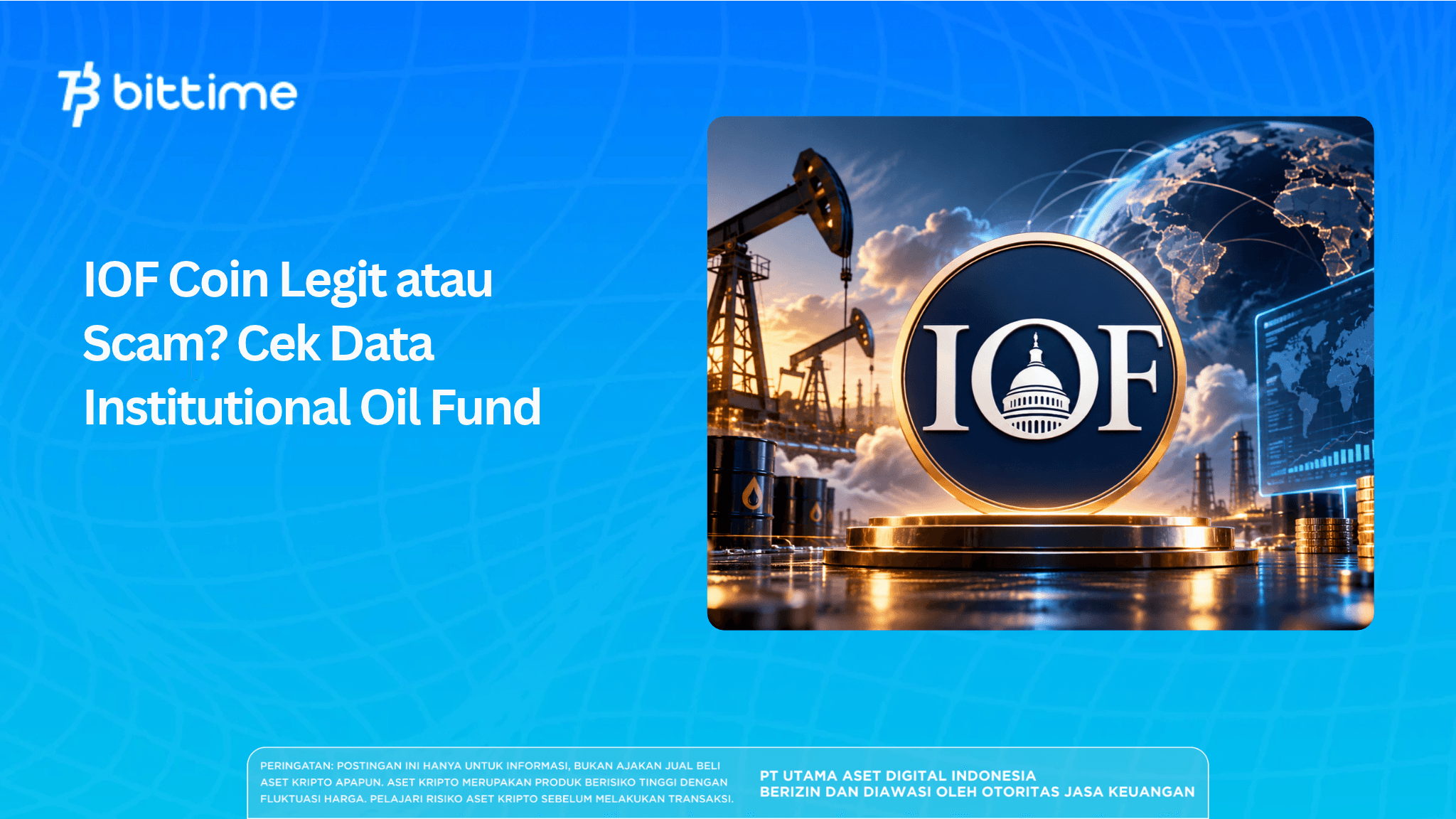
The biggest question about whether IOF coin is legit is not simply whether the token is being traded or has a market cap of millions of dollars. More importantly, the available data should show whether the token has reasonable, transparent characteristics and no major red flags.
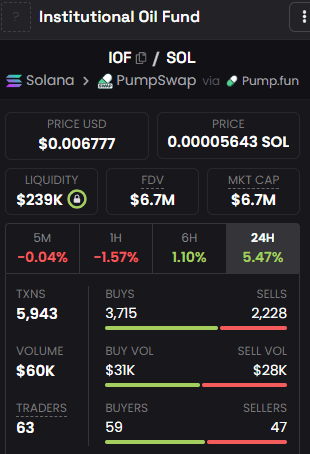
Institutional Oil Fund, or IOF, is atoken on the Solana network with an IOF/SOL pair. In the latest data snapshot, IOF is trading at around US0.00684, with a market cap and FDV of around US6.8 million, while liquidity is around US$240 thousand. This data shows market activity, but it is not sufficient to conclude that IOF is fully legitimate or risk-free.
Key Takeaways
- IOF has trading activity and liquidity, but its market cap of around US$6.8 million is much larger than its liquidity of around US$240 thousand.
- Market data is not sufficient to prove that IOF is legitimate or a scam, so the holder distribution, creator wallet, and token structure still need to be examined.
- IOF is still considered a new token, so volatility and liquidity risk should be major considerations.
What Is Institutional Oil Fund (IOF)?
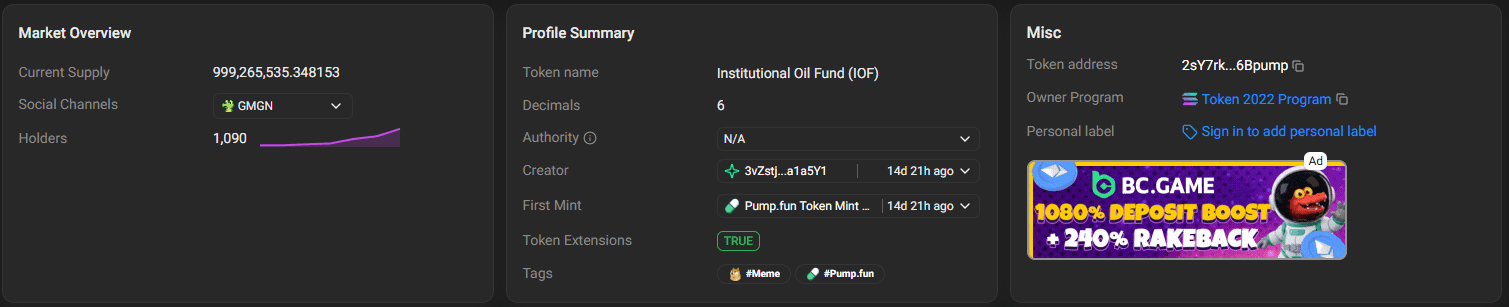
Institutional Oil Fund, or IOF, is a token traded on the Solana network. The analyzed pair is IOF/SOL and is on PumpSwap throughPump.fun. The contract address shown for IOF is 2sY7rkMCQyFNcSpHm3fciJf2ptYRg3cYpn4srN6Bpump.
The presence of a token on the Solana network does not automatically prove that the project is safe. Solana only indicates the blockchain on which the token is issued and traded.
Therefore, the question “is IOF legit?” should be answered by considering several indicators together. Price, volume, liquidity, holders, the contract, and wallet activity should be assessed separately so the analysis is not based solely on the token’s popularity.
Is IOF Coin Legit or a Scam?
It would be premature to call IOF a scam simply because it is a new token or is traded on aDEX. Conversely, the existence of liquidity and transaction activity is also not enough to call IOF a fully legitimate token.
A more appropriate approach is to consider positive signals and risk signals together.
Read also:Is ATFS Coin Legit? An Analysis of American Trust Fund System
Positive Signals Observed
Some data indicates that IOF does indeed have an active market.
- There is an IOF/SOL pair.
- Liquidity is around US$240 thousand.
- The market cap is around US$6.8 million.
- There are thousands of transactions over a 24-hour period.
- The pair has been active for around 15 days.
This data shows that IOF is not merely a token without market activity. However, these indicators only show market activity, not definitive proof of the project’s legitimacy.
Red Flags That Still Need to Be Checked
There are several things that cannot be determined from market data alone.
These include:
- Token ownership distribution.
- Creator wallet activity.
- Liquidity lock status.
- Rights or permissions associated with the contract.
- Token concentration in specific wallets.
- The identity and credibility of the team.
- Token utility that can actually be verified.
Therefore, concluding that “IOF is legit” requires further investigation.
Read also:Is SARP (Strategic American Protocol) Coin Legit or a Scam?
IOF Market Cap and Liquidity Analysis
One of the most interesting data points is the comparison between market cap and liquidity.
In the latest snapshot, IOF has a market cap of around US$6.8 million, while liquidity is around US$240 thousand. This means liquidity is only around 3.5% of the market cap.
That figure does not automatically mean IOF is a scam. However, the ratio is important because market cap and liquidity serve different functions.
Market cap represents the market value based on the token price and circulating supply. Liquidity shows how many assets are available in the pool to facilitate trading.
With liquidity of around US$240 thousand, transactions that are relatively large compared with the pool size can potentially cause greater price impact. This condition can make the price move quickly when buying or selling pressure occurs.
In that pool, the data shows around 17.73 million IOF and 981.30 SOL in the liquidity pool, with values of approximately US$121 thousand and US$118 thousand, respectively.
What Does This Mean for Investors?
A market cap of US$6.8 million does not mean that US$6.8 million in cash is ready to leave the market.
This is one of the common misconceptions when analyzing small-cap tokens.
If many holders want to sell at the same time, liquidity becomes an important factor in determining how much pressure is placed on the price.
Read also:Is UDR Coin Legit? Check the Contract, Liquidity, and Risks of United Dividend Reserve
How Is IOF Holder Distribution?
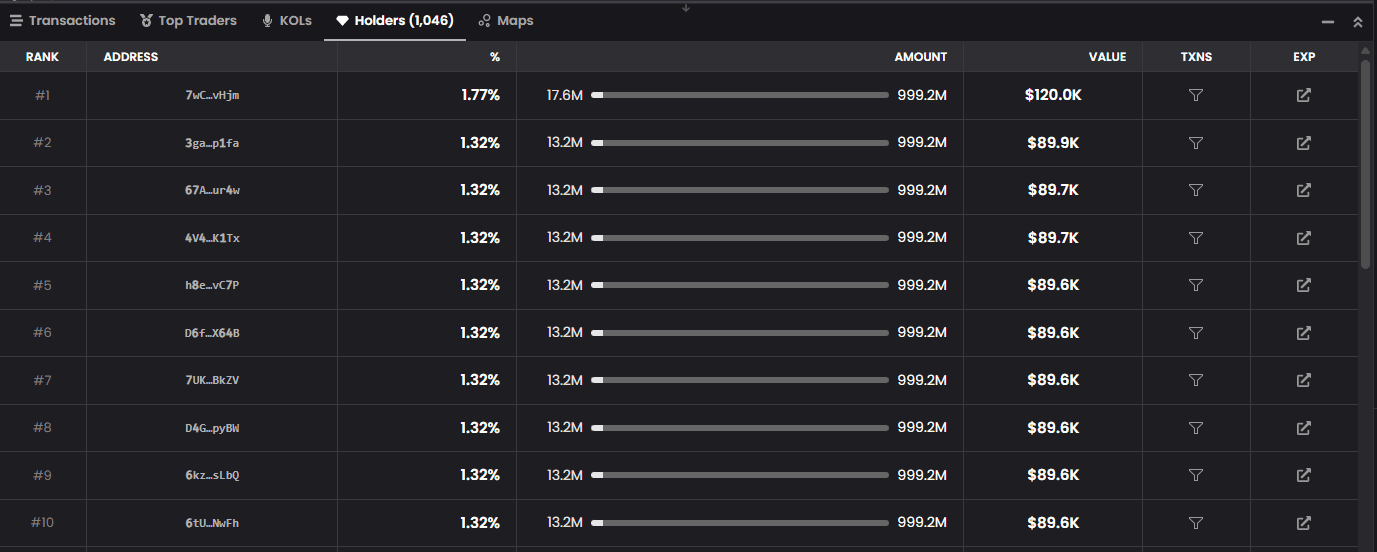
The latest data shown for the IOF pair indicates around 1,046 holders. This shows that the token already has a holder base, but the number of holders alone does not indicate whether the distribution is healthy.
For example, 1,000 holders do not necessarily mean ownership is evenly distributed. Most of the supply could be held by a small number of wallets.
Therefore, holder analysis should examine:
- Top 10 holders.
- Top 20 holders.
- The percentage of supply held by the largest wallet.
- Creator or developer balance.
- Wallets receiving large amounts of tokens.
- Token movements from the main wallet to the DEX.
If supply concentration is very high, several large wallets may have a significant influence on the price.
Check the IOF Creator Wallet
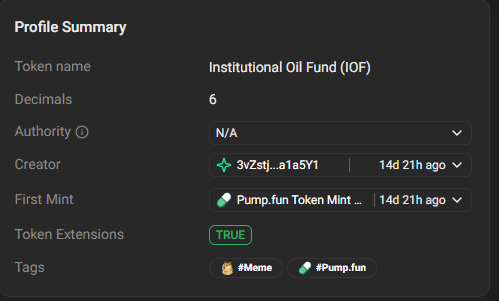
The creator wallet is an important part of IOF token due diligence.
Things that should be checked include:
- Does the creator still hold IOF?
- How many tokens are held?
- Has the creator ever sold the token?
- Have tokens been sent to several new wallets?
- Is that wallet connected to significant trading activity?
- Are there any unusual transaction patterns?
The available pair data is not sufficient to verify all activity of that creator wallet. Therefore, it is not appropriate to state that the creator wallet is safe or suspicious without directly examining the address.
Check IOF Liquidity
Liquidity is one of the important indicators for assessing the risk of a new token.
IOF currently has around US$240 thousand in liquidity on the analyzed pair. The pool consists of approximately US$121 thousand in IOF and US$118 thousand in SOL.
However, there is an important difference between available liquidity and locked liquidity.
Available liquidity means there are assets in the pool to support transactions. A liquidity lock means there is a mechanism that restricts certain parties from withdrawing liquidity for a specified period.
Therefore, looking only at the US$240 thousand figure is not enough to conclude that IOF liquidity is safe.
Read also:Is SI Coin Legit? Check the Fundamentals and Super Intelligence Narrative
What Does IOF Trading Activity Show?
The latest data shows around 5,952 transactions over a 24-hour period with a volume of around US$63 thousand. There were 3,719 buy transactions and 2,233 sell transactions during that period.
That volume indicates real trading activity.
However, the number of transactions should not be interpreted as proof that a token has strong fundamentals.
A token with high speculative activity can generate many transactions even when its utility and fundamentals remain unclear.
Therefore, volume should be used as one indicator, not as the primary determinant of legitimacy.
Is IOF Solana Safe to Buy?
The short answer: this cannot be determined from the available data alone.
The fact that IOF is on Solana does not automatically make the token safe. Solana is a blockchain, while token risk is determined by the contract, supply distribution, liquidity, wallets, developers, and market behavior.
Before buying IOF, make sure the contract address being used is correct:
2sY7rkMCQyFNcSpHm3fciJf2ptYRg3cYpn4srN6Bpump
Do not search for the token only by the name “Institutional Oil Fund” or the ticker “IOF”. Tokens with the same name and ticker can appear in different places.
Read also:Is DOTF Coin Legit? Check Digital Oil Trust Fund and Its Risks
5 Things to Check Before Buying IOF
1. Verify the contract address
Use the contract address as the token’s identity, not just its name.
Check whether the address being used matches the token being analyzed.
2. Check the holder distribution
See whether the supply is distributed or concentrated among several wallets.
High concentration can increase volatility risk when large wallets transact.
3. Check liquidity
Do not look only at market cap.
Also check the amount of liquidity and how that liquidity is managed.
4. Check the creator wallet
Review the activity of wallets associated with the creation of the token.
Pay attention to large transfers, sales, and token movements to other wallets.
5. Check trading activity
Check volume, buy transactions, sell transactions, the number of traders, and changes in activity over time.
High activity does not always mean strong fundamentals. However, extreme changes in volume can be a signal that warrants further investigation.
Read also:Is VSOF Coin Legit? Review of Vanguard Strategic Oil Fund and VSOF Token Risks
Is IOF a Scam?
Based on the available market data, there is not enough evidence to conclude that IOF is a scam based only on market cap, liquidity, volume, and the number of holders.
On the other hand, that data is also not sufficient to state that IOF is 100% legitimate.
What can be said at this point is that IOF has real trading activity, available liquidity, and an established holder base. The pair has also been active for around 15 days, and the DEX data shows an audit status of “No issues,” but the same platform warns that audit results are not always 100% accurate.
Therefore, determining whether IOF is legitimate or a scam still requires additional checks, especially of holder distribution, the creator wallet, liquidity lock, and contract structure.
What Are the IOF Risks to Watch?
Liquidity Risk
With liquidity of around US$240 thousand compared with a market cap of around US$6.8 million, large orders can have a significant impact on the price.
New Token Risk
The IOF pair was created only around 15 days ago. Tokens with short market histories have less historical data for assessing price and liquidity behavior.
Holder Concentration Risk
The number of holders does not automatically indicate a healthy distribution. Large wallets still need to be examined.
Limited Information Risk
Additional token data on DexScreener is currently listed as unavailable. This means some fundamental information cannot be verified through that data.
Volatility Risk
Tokens with relatively small market caps and limited liquidity can experience rapid price changes when market activity changes.
So, Is IOF Legit or a Scam?
If the question must be answered based on the available data, the answer is:
It cannot yet be categorized as a scam, but there is also not enough evidence to state that IOF is fully legitimate.
There are several positive indicators of market activity. IOF has liquidity of around US$240 thousand, a market cap of around US$6.8 million, thousands of transactions, trading volume, and more than 1,000 holders in the latest snapshot.
However, several important factors still need to be verified, especially holder distribution, creator wallet activity, liquidity lock status, and the structure and permissions of the contract.
In other words, IOF is not a token that should be evaluated solely based on its price or market cap.
If you want to follow developments in other crypto assets and get the latest market information, you cansign up on Bittime to monitor the market and conduct research before making a decision.
Conclusion
Whether IOF coin is legitimate or a scam cannot be determined solely from price movements or market cap. The latest data shows that Institutional Oil Fund has an active market with a market cap of around US$6.8 million, liquidity of around US$240 thousand, 24-hour volume of around US$63 thousand, and more than 1,000 holders.
However, relatively low liquidity compared with the market cap, along with the pair being only around 15 days old, means volatility risk still needs to be considered. The creator wallet status, ownership distribution, and liquidity lock should also be checked before reaching a final conclusion.
Therefore, for now it is more accurate to say that IOF has not been proven to be a scam, but it is also not sufficiently verified to be considered fully legitimate. Conduct research based on the contract address and the latest on-chain data before making a decision.

Bittime is a licensed Digital Financial Asset Trader (PAKD) platform regulated and supervised by the Financial Services Authority (OJK) — where you can buy Bitcoin in Indonesia and hundreds of other crypto assets starting from Rp10,000. Registration is fast and secure, and you can get started today.
Track the conversion of USDT to IDR and the price movements of your favorite crypto assets in real time. Everything is available in one crypto investment app that can be downloaded for free from the Play Store.
Ready to get started? Sign up now on Bittime and execute your investment strategy with a platform trusted by millions of users in Indonesia.
FAQ
Is IOF coin legit?
IOF has real trading activity, liquidity, and observable holders on the Solana network. However, this data is not sufficient to prove that IOF is fully legitimate, so the contract, holder distribution, creator wallet, and liquidity still need to be examined.
Is IOF a scam?
There is not enough evidence from the available market data to state that IOF is a scam. Conversely, the absence of evidence of a scam does not mean that the token is risk-free.
What is Institutional Oil Fund?
Institutional Oil Fund is a token with the ticker IOF that is traded on the Solana network. The analyzed pair is IOF/SOL, and the contract address used is 2sY7rkMCQyFNcSpHm3fciJf2ptYRg3cYpn4srN6Bpump.
How can I check whether the IOF token is legitimate or a scam?
Start by verifying the contract address, then check liquidity, holder distribution, the creator wallet, token supply, and trading activity. Do not base your decision on a single indicator.
Is IOF Solana safe?
This cannot be determined simply because IOF is on Solana. Token safety should be assessed based on the contract and on-chain data, including liquidity, holder distribution, the creator wallet, and token mechanisms.
Disclaimer: The views expressed belong exclusively to the author and do not reflect the views of this platform. This platform and its affiliates disclaim any responsibility for the accuracy or suitability of the information provided. It is for informational purposes only and not intended as financial or investment advice.

.png)