HYPE Ready to Unlock 14.18 Million Tokens, Under Selling Pressure?
2026-08-25
Hyperliquid (HYPE) just hit a record price of US$83.27 on August 24, 2026 before correcting to around US$77.50.
The rally has nearly quadrupled HYPE since the start of the year, but the bullish momentum now faces a major test: Hyperliquid is scheduled to unlock approximately US$1.2 billion worth of tokens on August 29.
This HYPE token unlock is not a regular release.
Approximately 14.18 million HYPE will be included in the vesting schedule, equivalent to 1.4% of the total supply and approximately 2.7% of the circulating market capitalization.
The question is, will this additional supply trigger selling pressure on HYPE or will it be absorbed by Hyperliquid's revenue growth and buyback mechanism?
Key Takeaways
Hyperliquid will conduct a HYPE unlock of 14.18 million tokens on August 29, 2026, with a value of approximately US$1.2 billion based on the price at the time of publication of the source article.
Approximately 46.6% of the unlock allocation is allocated to insiders, 46.3% to the community, and 7% to the Hyper Foundation.
Token unlocking doesn't automatically mean all tokens are sold immediately. Historical data shows the number of tokens actually claimed is much smaller.
HYPE Unlock on August 29, 2026, Attracts Market Attention
Hyperliquid will face one of the largest Hyperliquid token unlock schedules since the token generation event (TGE) in November 2024.
On August 29, 2026, approximately 14.18 million HYPE are scheduled to be unlocked, valued at approximately US$1.2 billion. This represents 1.4% of the total maximum supply and approximately 2.7% of the circulating market capitalization.
The distribution also attracted attention. Approximately 46.6%, or approximately US$560 million, was allocated to insiders, including early investors and core contributors.
As much as 46.3% falls into the community category, while 7% is allocated to the Hyper Foundation.
This schedule isn't the end of the vesting process. A similar-scale unlock is scheduled for September 29th and will continue periodically until November 2029.
This means that the HYPE supply unlock is a long-term process, not just a matter of one date.
Read also: Crypto Rally Hype: Why Is Hyperliquid Token Rising After US Regulation News?
Token Unlock Is Not the Same as Dump
One common mistake in reading token unlock HYPE is assuming that all unlocked tokens will immediately go to the exchange.
However, unlocked tokens are not necessarily claimed by their owners, claimed tokens are not necessarily sold, and sold tokens are not necessarily thrown onto the open market.
Data cited by TechFlow from Tokenomist shows that as of March 2026, approximately 405 million HYPE has been unlocked at the contract level.
However, only about 3.19 million tokens were actually claimed and entered circulation, with a claim rate of about 0.79%.
The pattern suggests that a US$1.2 billion headline does not automatically reflect the amount of money that will be the selling pressure for HYPE.
However, the current situation is different compared to the previous period because the price of HYPE is near a record high.
Token holders who previously chose not to sell when HYPE was at US$20–US$60 may have a different incentive when the price approaches US$80.
Trading HYPE/IDR with Bittime now!
Can Hyperliquid Buybacks Absorb New Supply?
Hyperliquid has a mechanism that is a major differentiator in dealing with additional supply.
The Assistance Fund directs approximately 97% to 99% of the protocol's revenue to automatically purchase HYPE on the open market.
The tokens in the fund are then treated as burned based on a community decision.
As of July 2026, the Assistance Fund reportedly had purchased approximately 45.7 million HYPE. The protocol's annual revenue is estimated at around US$1.3 billion, with monthly revenue ranging from US$58 million to US$80 million.
The average buyback is around US$1.8 million to US$2 million per day.
However, the scale still needs to be compared to the unlock. If the entire US$1.2 billion worth of HYPE were sold at once, monthly buybacks would only absorb about 6%–7% of the selling pressure.
Mathematically, a full dump would be much larger than the short-term buyback capacity.
The full dump scenario itself is considered unrealistic.
If only 5%–10% of the unlock value is actually subject to selling pressure, or around US$60 million–US$120 million, the buyback mechanism could provide a much more meaningful buffer.
Read Also:How to Buy Hyperliquid (HYPE): A Complete Guide for Beginners in Indonesia
Does HYPE's Price Reflect Positive Expectations?
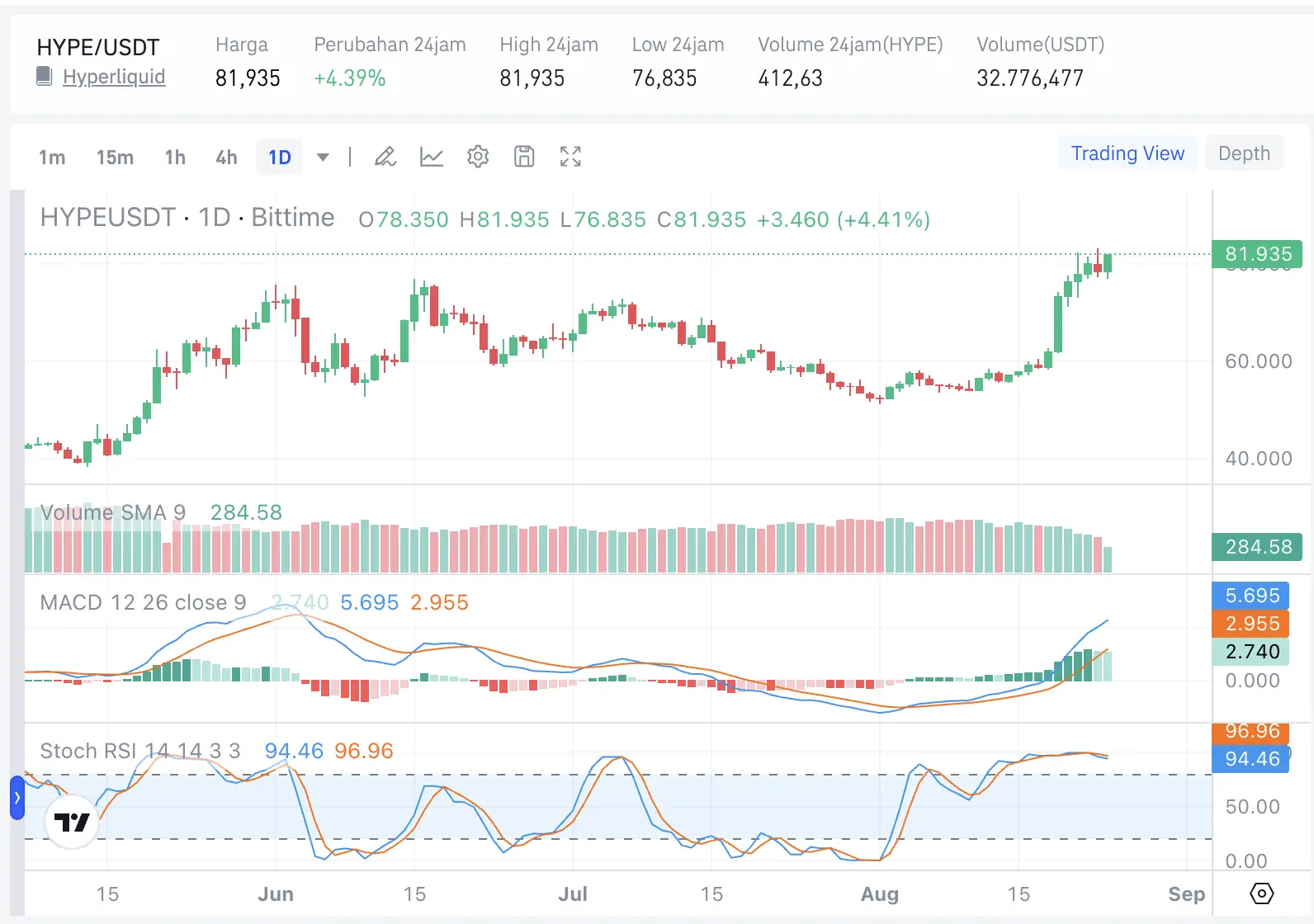
HYPE ke USDT via Bittime Market
Timing the HYPE unlock becomes even more important as the token price just hit an ATH.
HYPE moved from around US$54 at the end of July to US$83 on August 24, or up nearly 54% in one month.
The increase was supported by Hyperliquid's fundamental activity.
Daily trading volume ranges from US$6 billion to US$8 billion, while open interest is around US$3.5 billion.
Monthly fee revenue is also reported to frequently surpass Ethereum and Solana.
Additionally, Bitwise's HYPE ETF provides additional institutional access.
Developments related to Hyperliquid's access to the US market also served as a catalyst for increasing investor optimism.
The problem is, some of those positive expectations may already be reflected in the price of US$83.27.
With valuations already high, the market becomes more sensitive to negative news.
If the unlock results in a larger-than-expected selloff, HYPE could experience a correction even if the protocol's fundamentals remain strong.
For investors who want to monitor the price of HYPE and other crypto assets, register on Bittime to follow market movements from one platform.
How Big is the Risk of HYPE Selling Pressure?
The impact of the HYPE unlock token will depend heavily on the behavior of token holders.
If insiders and other recipients retain or stake unlocked tokens, the effective additional supply in the market could be much smaller.
Conversely, if a large portion of tokens are claimed and sold, selling pressure can increase significantly.
Moreover, monthly unlocks will continue to occur when only a fraction of the total HYPE supply is currently in circulation.
Around 22.2% of the total supply is in circulation, while 48% is still locked up, according to data cited by TechFlow.
This makes the HYPE supply unlock issue structural.
Even if the August 29th unlock is successfully absorbed by the market, investors will still need to factor in additional supply in the following months.
Read Also:Hyperliquid Burn HYPE US$1.07 Million, What Does This Mean for HYPE's Price?
HYPE's Long-Term Risks
Hyperliquid's buyback mechanism also has a pro-cyclical nature. When trading activity increases, volume increases and fees increase.
Higher incomes then increase HYPE purchases, which can reduce supply and support prices.
However, this mechanism can work the other way around during bear markets. Trading volumes can potentially drop, protocol revenues shrink, and buyback values decrease.
At the same time, the unlock schedule remains consistent with the calendar so that additional supply does not automatically stop when market conditions worsen.
Therefore, HYPE price prediction is not enough just by looking at the unlock schedule.
Investors also need to monitor Hyperliquid volume, fee income, open interest activity, the number of tokens actually claimed, and the flow of tokens to exchanges.
Conversion 1 HYPE to IDR- Hyperliquid to Indonesia Exchange Rate
Conclusion
The HYPE unlock of 14.18 million on August 29, 2026, does have the potential to create selling pressure, but it is not correct to assume that the entire US$1.2 billion will immediately enter the market.
Historical data shows the claim rate is much smaller than the number of tokens that have technically been unlocked.
Risks remain elevated as HYPE has just hit an ATH and most bullish catalysts have already been priced in by the market.
If demand remains strong and Hyperliquid's operations continue to generate substantial revenue, buybacks could help absorb some of the pressure. Conversely, a large sell-off from unlock recipients could lead to a sharper correction.

Bittime is a licensed and regulated Digital Financial Asset Trader (PAKD) supervised by Indonesia’s Financial Services Authority (OJK) — where you can buy Bitcoin in Indonesia and hundreds of other crypto assets starting from just Rp10,000. The registration process is fast, secure, and you can get started today.
Track USDT to IDR conversions and monitor your favorite crypto assets in real time. Everything is available in one crypto investment app that you can download for free on the Play Store
Ready to start? Register now on Bittime and execute your investment strategy with a platform trusted by millions of users in Indonesia.
FAQ
What is HYPE token unlock?
HYPE token unlock is the process of releasing previously locked tokens based on a vesting schedule. Unlocked tokens may not be immediately claimed or sold on the market.
When is the next HYPE unlock?
The next HYPE unlock is scheduled for August 29, 2026, with approximately 14.18 million HYPE to be unlocked. Its value is estimated at around US$1.2 billion based on prices at the time of publication.
Does the HYPE unlock definitely make the price go down?
No. Token unlocks increase the potential available supply, but the price still depends on the number of tokens actually claimed and sold and the strength of market demand.
How much HYPE will be unlocked?
Around 14.18 million HYPE, equivalent to 1.4% of the total supply and around 2.7% of the circulating market capitalization.
Can Hyperliquid's buyback withstand selling pressure?
Buybacks can help absorb some selling pressure, especially if only a small portion of unlocked tokens are actually sold. However, if all tokens are released to the market, the short-term buyback capacity is much smaller than the unlock value.
What impact does HYPE unlock have on price?
The impact can be increased volatility and selling pressure if a large number of tokens enter the market. Conversely, if the majority of tokens remain held or used within the ecosystem, the direct impact on prices can be more limited.
Disclaimer: The views expressed belong exclusively to the author and do not reflect the views of this platform. This platform and its affiliates disclaim any responsibility for the accuracy or suitability of the information provided. It is for informational purposes only and not intended as financial or investment advice.
.png)