Futures Trading: History and How It Works
2026-08-05
Futures trading allows market participants to agree on the price of an asset for a future transaction. This instrument was originally developed to help farmers, traders, and commodity buyers cope with unpredictable price changes.
Today, futures contracts extend beyond agricultural products. Market participants can find contracts based on energy, metals, currencies, bonds, stock indices, and other assets on futures exchanges.
Despite increasing accessibility, futures trading has a different mechanism than conventional asset purchases. Traders need to understand contract value, margin, leverage, daily settlement, and expiration dates before opening a position.
Key takeaways
Futures are standardized contracts to buy or sell an asset at a predetermined price and date.
Position profits and losses are calculated daily through a mark-to-market mechanism.
Leverage reduces capital requirements, but can also result in losses exceeding the initial deposit.
What is futures trading?
Trading futures There isis the activity of buying or selling futures contracts whose value is determined by an underlying asset. These contracts are traded on an exchange with predetermined specifications, such as contract size, asset quality, tick size, maturity month, and settlement method.
Contract buyers take a long position because they expect the price to rise. Sellers take a short position because they expect the price to fall or want to protect the value of their assets.
Unlike spot transactions, traders don't always receive the underlying asset immediately. Most positions are closed before maturity, while certain contracts are settled in cash or through physical delivery, as per product rules.
Read Also:Bittime Secures First Futures Trading License in the Era of OJK Crypto Oversight
History of futures trading
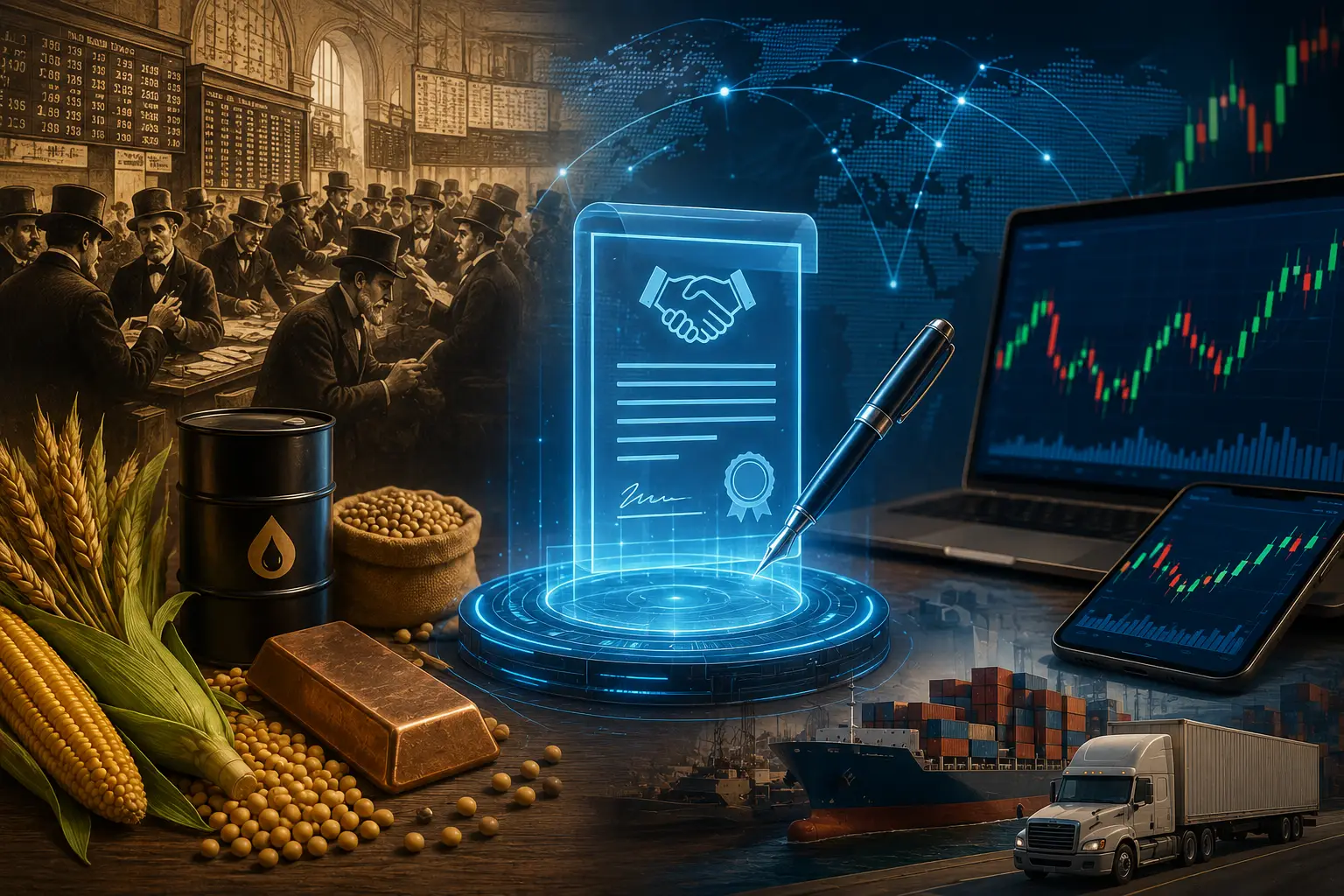
Source : AI
Early forms of futures contracts were used in commodity trading long before the establishment of modern exchanges. Charles Schwab notes that similar futures contracts were used in Japanese rice trading in the early 1700s.
Its modern development occurred in the United States in the 19th century. Chicago became a center of agricultural trade after a network of canals and railroads connected production areas with wider markets.
The Chicago Board of Trade or CBOT was formed in 1848 to make grain trading more organized.
The exchange then introduced standardized futures contracts in 1865, including the use of margin and a centralized clearing process to reduce the risk of default.
Get to know how the market works before opening a position. Register at Bittime now and build your investment portfolio with ease.
From commodities to financial markets
Initially, futures contracts focused on agricultural products such as wheat, corn, butter, eggs, and livestock. These instruments helped producers lock in selling prices while providing buyers with certainty about prices and supply.
Throughout the 20th century, futures products expanded to include metals, energy, government bonds, interest rates, foreign exchange, and stock indices.
The CME began trading currency futures in 1972, while index products and other financial instruments developed in the following decades.
Trading has also shifted from an open outcry system on the stock exchange floor to an electronic platform.
The CME Globex began operating electronic futures trading in 1992, accelerating the market's shift to global transactions that take place almost throughout the business day.
Read Also:50 Futures Trading Terms That Beginners Must Understand
How futures trading works
How futures trading works begins when a trader selects a contract based on the underlying asset and expiration month.
Each contract has a multiplier that determines how much the position value changes when the price moves.
For example, an oil contract represents 1,000 barrels at US$80 per barrel.
The notional value is as much as US$80,000, although traders typically only deposit a fraction of that amount as margin.
If a trader buys a contract and the price rises to US$84, the change in value is US$4 times 1,000 barrels or US$4,000.
If the price drops to US$76, the trader suffers a loss of the same amount before transaction costs.
Long and short positions
A long position is used when a trader predicts the contract price will rise. A profit occurs if the contract can be resold at a higher price, while a price decrease results in a loss.
A short position works the opposite way. The trader sells the contract first and attempts to buy it back at a lower price.
The ability to open long or short positions allows futures to be used in both rising and falling market conditions. However, both positions carry obligations and risks as long as the contract remains closed.
Read Also:Long vs Short Crypto Futures Strategy: When to Buy and Sell?
Margin and leverage functions
Futures margin isn't the full payment for purchasing an asset. Margin is a guarantee or performance bond that demonstrates the trader's ability to fulfill their contractual obligations.
Because margin only covers a portion of the notional value, traders gain greater market exposure than their deposited capital. This mechanism is called leverage.
Leverage can increase profits when prices move as predicted.
However, small price changes can also reduce the account balance quickly, even causing losses exceeding the initial margin.
Read Also:What is Leverage in Crypto? Here are the Types!
Mark-to-market and margin calls
Futures positions are revalued daily through mark-to-market. The exchange sets the daily settlement price and then calculates the profit or loss on any open positions.
Daily profits go into the account balance, while losses reduce available funds.
If equity falls below the maintenance margin, traders may be asked to add funds through a margin call.
Brokers can liquidate positions if additional funds are not immediately available. This liquidation can occur when the market moves negatively, resulting in the closing price not necessarily meeting the trader's expectations.
Hedging and speculation
Producers and companies use futures to hedge or reduce price uncertainty. Farmers, for example, can sell futures contracts before harvest to help lock in the selling price of their produce.
Airlines or transportation companies can use energy contracts to mitigate the impact of rising fuel costs. Gains or losses on the contracts are designed to offset price changes in the physical market.
Speculators don't necessarily own or need the underlying asset. They seek to profit from price fluctuations while providing liquidity for market participants hedging.
Read Also:Margin Call on Crypto Futures? Do This to Avoid Liquidation
Risk futures trading
Risk of futures trading the most prominent comes from leverage.
Traders can handle large value contracts using much smaller capital, but still bear the change in value of the entire contract.
Other risks arise from volatility, margin calls, forced liquidations, and slippage. Stop orders can help manage positions, but they don't guarantee that a trade will be executed at the specified price when the market moves rapidly.
Traders should also pay attention to expiration and settlement methods.
Positions left open for too long may enter the cash settlement or physical delivery process according to contract specifications.
Read Also:Profit-Making Strategies in Crypto Futures and How to Calculate Profits
Things to check before trading
Traders should read the contract specifications before opening a position. Important information includes the multiplier, tick value, trading hours, margin, contract month, last trade date, and settlement mechanism.
Position size should be calculated based on the risk you can afford, not just the minimum margin available. A small margin doesn't necessarily mean a low position risk.
Futures are complex instruments and are not suitable for all investors.
The CFTC warns that many retail traders could lose their entire capital and under certain circumstances could still be liable for additional losses.
Ready to trade with two-way opportunities? Try Bittime Futures and start trading crypto derivatives right from the Bittime market
Bittime is a licensed and regulated Digital Financial Asset Trader (PAKD) supervised by Indonesia’s Financial Services Authority (OJK) — where you can buy Bitcoin in Indonesia and hundreds of other crypto assets starting from just Rp10,000. The registration process is fast, secure, and you can get started today.
Track USDT to IDR conversions and monitor your favorite crypto assets in real time. Everything is available in one crypto investment app that you can download for free on the Play Store
Ready to start? Register now on Bittime and execute your investment strategy with a platform trusted by millions of users in Indonesia.
FAQ
Is futures trading the same as buying an asset?
No. Traders trade contracts that track the value of the underlying asset, rather than always buying the asset directly.
Why do futures use margin?
Margin serves as collateral to ensure buyers and sellers can fulfill their contractual obligations. It is not a down payment and is not a measure of maximum loss.
Do traders have to wait for the contract to expire?
No. Most traders close their positions with an opposite trade before the contract expires.
Can futures losses exceed initial capital?
Yes. Leverage and sharp price movements can result in losses greater than the initial margin deposit.
What is the difference between futures and forwards?
Futures have standard specifications and are traded on exchanges. Forwards are typically executed directly between two parties with customized terms and traded over-the-counter.
Disclaimer: The views expressed belong exclusively to the author and do not reflect the views of this platform. This platform and its affiliates disclaim any responsibility for the accuracy or suitability of the information provided. It is for informational purposes only and not intended as financial or investment advice.
.png)