Dow Jones and S&P 500 Fall After the Fed Raises Interest Rates
2026-09-17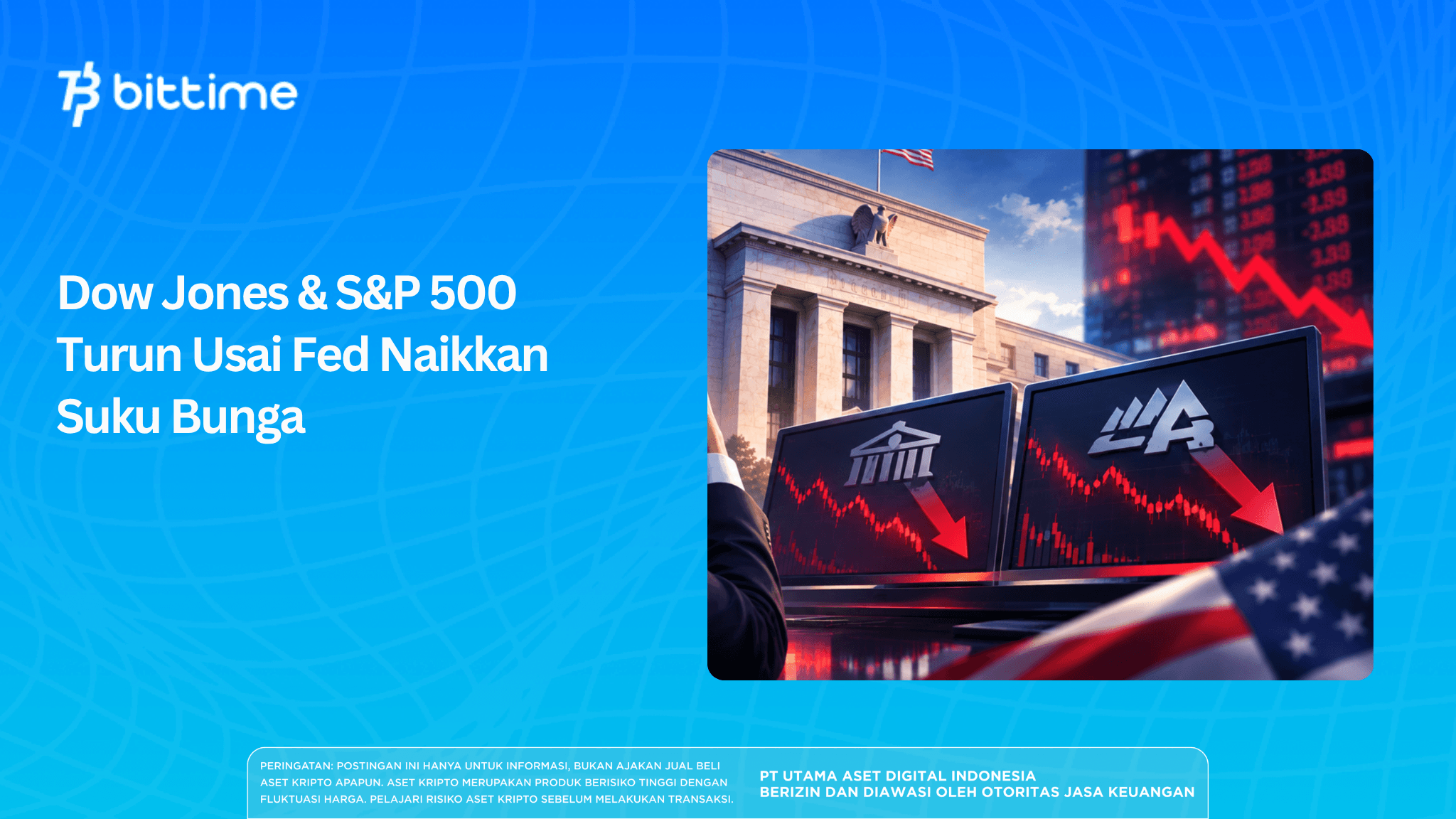
The U.S. stock market became volatile again after the Federal Reserve (Fed) raised its benchmark interest rate on September 16, 2026.
The policy immediately put pressure on several major Wall Street indexes, with the Dow Jones falling 1.2% and the S&P 500 declining 0.4% at the close of trading.
The Fed's rate hike had actually been widely anticipated by market participants. However, investor attention then shifted to signals that the U.S. central bank remained open to further rate hikes because inflation was still considered too high.
Key Takeaways
- The Dow Jones fell 1.2%, or 631.21 points, to 51,461.90, while the S&P 500 declined 0.45% to 7,551.81.
- The Fed raised interest rates by 25 basis points to a range of 3.75%-4% and remains open to another rate hike in 2026.
- Investors are now watching inflation, Treasury yields, oil prices, and U.S. economic data as key factors influencing the direction of the stock market.
Dow Jones and S&P 500 Fall After Fed Decision
The Federal Reserve raised the federal funds rate target by 25 basis points to 3.75%-4%. The decision was unanimously approved by FOMC members and marked the first interest rate hike since 2023.
The Fed stated that U.S. economic activity continued to expand solidly, while inflation remained elevated.
The initial stock market response was relatively muted because the 25-basis-point increase had already been priced in.
However, pressure increased after investors digested the Fed's views on inflation and the possibility of tighter monetary policy.
Based on the September 16 closing data, the Dow Jones fell 631.21 points, or 1.21%, to 51,461.90. Meanwhile, the S&P 500 declined 0.45% to 7,551.81. The Nasdaq Composite was relatively stable, falling less than 0.1%.
The movement shows that the market was responding not only to the rate hike decision but also to the outlook for the Fed's future policy.
Read Also: The Fed Raises Interest Rates 0.25% Today, Here's the Impact on Stocks, the Dollar, and Bitcoin
Why Does a Fed Rate Hike Pressure U.S. Stocks?
The effect of a Fed rate hike on the stock market primarily stems from changes in the cost of capital and asset valuations.
When interest rates rise, borrowing costs for companies and consumers may also increase. This can potentially reduce business expansion, consumption, and investment.
On the other hand, higher bond yields can make fixed-income assets increasingly attractive compared with stocks.
The pressure can be more pronounced for companies with high valuations or those heavily dependent on financing and long-term growth expectations.
In its September decision, the Fed also projected the federal funds rate to be around 4.1% at the end of 2026. This projection is above the current range, prompting markets to once again price in the possibility of tighter monetary policy.
Therefore, the short-term outlook for the stock market will largely depend on whether inflation begins moving toward the Fed's target or remains elevated.
The U.S. market is heavily influenced by the Fed's policies. Want exposure to U.S. stocks? Sign up on Bittime and start investing through tokenized stocks.
Treasury Yields Draw Investor Attention
In addition to the Fed's decision, Treasury movements are an important factor in the U.S. stock market.
Federal Reserve data showed that Treasury yields on 10-year Treasuries were around 5% on September 16, while 2-year Treasury yields were around 4.67%.
Higher yields can put additional pressure on stocks by increasing the discount rate investors use to value companies' future cash flows.
This also explains why markets can remain volatile even when a rate hike has been anticipated. Investors are not only looking at today's decision but also trying to assess how long interest rates will remain at elevated levels.
Read Also: BTC This Week: Fed and CLARITY Act Become Key Drivers of Bitcoin Price
What Should Investors Watch in the U.S. Stock Market Today?
Following the decline in the Dow Jones and S&P 500, several indicators will be closely watched in the next trading session.
The first is U.S. inflation data. If inflation remains elevated, pressure to maintain tight monetary policy could increase.
The second is Treasury yields. Persistently high yields can weigh on stock valuations, particularly as investors adjust their expectations for interest rates.
The third is oil prices. Higher energy prices can increase inflationary pressure and limit room for monetary policy easing.
Meanwhile, the strength of the U.S. economy is also an important factor. The Fed said domestic consumption remains resilient, productivity growth is strong, and capital investment remains solid.
This means that a decline in the indexes does not automatically indicate a fundamental shift across the entire U.S. economy. Investors need to monitor economic data developments continuously.
Check prices for tokenized stocks such as Nvidia Tokenized Stock Ondo (NVDAX), Netflix Tokenized Stock Ondo (NFLXON), Microsoft Tokenized Ondo (MSFTON) and many more only on Bittime.
What Is the Outlook for U.S. Stock Investment?
For investors following U.S. stock investments, the volatility following the Fed's decision serves as a reminder that changes in monetary policy can affect multiple asset classes simultaneously.
In a high-interest-rate environment, the market typically pays greater attention to corporate earnings quality, cash flow, debt levels, and a business's ability to maintain growth.
Therefore, the subsequent movements of the Dow Jones and S&P 500 will largely depend on a combination of inflation, Fed policy, Treasury yields, energy prices, and the latest economic data.
For now, the Wall Street decline reflects a market adjustment to the prospect of relatively high interest rates, rather than being solely the result of the 25-basis-point hike in September.

Gain exposure to shares of leading technology companies through tokenized stocks such as AMZON, TSLAX, MSFTON or GOOGLX on the Bittime market.
Bittime is a licensed and supervised Digital Financial Asset Trader (PAKD) platform regulated by the Financial Services Authority — where you can buy Bitcoin in Indonesia and hundreds of other crypto assets starting from IDR 10,000. The registration process is fast, secure, and can be started today.
Monitor the USDT to IDR conversion and your favorite crypto asset prices in real time. Everything is available in one crypto investment app that can be downloaded for free from the Play Store.
Ready to get started? Sign up on Bittime now and execute your investment strategy with a platform trusted by millions of users in Indonesia.
FAQ
Why did the Dow Jones fall after the Fed raised interest rates?
The Dow Jones fell as investors responded to the rate hike as well as signals that the Fed could raise interest rates again. High Treasury yields also added pressure on stocks.
How much did the S&P 500 decline?
The S&P 500 fell 0.45% in trading on September 16, 2026, and closed at 7,551.81.
What is the Fed interest rate after the September 2026 hike?
The Fed raised the federal funds rate by 25 basis points to a range of 3.75%-4%.
Can the Fed still raise interest rates?
Yes. The September projection shows a median federal funds rate of around 4.1% at the end of 2026, indicating that a further increase from the current range remains possible.
What is the impact of a Fed rate hike on U.S. stocks?
Higher interest rates can increase the cost of capital, weigh on economic activity, and make bonds more competitive with stocks. The impact varies by sector and the fundamental conditions of each company.
Disclaimer: The views expressed belong exclusively to the author and do not reflect the views of this platform. This platform and its affiliates disclaim any responsibility for the accuracy or suitability of the information provided. It is for informational purposes only and not intended as financial or investment advice.

.png)