How to Trade Futures on Bittime for Beginners
2026-07-16
Crypto derivative trading is growing rapidly in Indonesia along with increasing investor interest in more flexible strategies. One of the products now available is Bittime Futures, which allows users to gain potential profits whether asset prices rise or fall.
To help users understand how this product works, Bittime implements several activation stages before the service can be used. If you want to start trading Futures on Bittime, understanding each step from registration, activation, to opening your first position will help you trade with greater confidence.
Key Takeaways
- Bittime Futures allows traders to take Long or Short positions without having to own the crypto assets directly.
- Before starting to trade, users must complete registration, identity verification (KYC), and the Knowledge Test as a form of consumer protection.
- Risk management such as wise use of leverage, stop loss, and position sizing is very important to avoid large losses.
What Are Crypto Futures and How Do They Work?
Before learning how to use Bittime Futures, it is important to first understand what crypto futures are.
Crypto futures are derivative contracts whose value follows the price movements of crypto assets such as Bitcoin (BTC), Ethereum (ETH), or other digital assets. Unlike spot trading, traders do not buy the crypto asset directly, but instead trade contracts that represent the price of that asset.
One of the main characteristics of perpetual futures is that they have no expiration date. As long as the margin balance is sufficient, positions can be held indefinitely.
To keep the contract price close to the market (spot) price, the system uses a funding rate mechanism, which is periodic payments between traders opening Long and Short positions. This mechanism maintains balance between the contract price and the asset price in the market.
Here are the advantages of futures trading you should know:

How to Trade Futures on Bittime for Beginners
Bittime implements a user flow designed so that users understand the risks before starting to trade. Here are the steps.
1. Register a Bittime Account
The first step is to create an account through the Bittime app or official website using an active email address or phone number. Once the account is successfully created, users can access all available services on the platform.
2. Complete Identity Verification (KYC)
Before using the Futures service, users are required to complete the Know Your Customer (KYC) process.
This stage aims to verify user identity according to regulatory requirements while increasing transaction security. Documents typically required include official identity cards and facial verification process.
3. Complete the Bittime Knowledge Test
After completing KYC, users are required to take the Knowledge Test before gaining access to the Futures feature.
The Knowledge Test consists of a series of questions about the basics of futures trading, including how leverage works, margin, liquidation risk, and perpetual contract mechanisms.
This requirement is part of consumer protection efforts so that users understand the characteristics of derivative products before starting to trade. This approach is also in line with risk management practices applied to futures trading services in Indonesia.
Investor Daily reported that the implementation of the Knowledge Test is one of Bittime's commitments to improving user education after obtaining a futures trading license from the regulator.
Read Also: Hyperliquid Becoming More Dominant, Perpetual Futures Open Interest Reaches US$4.3 Billion
4. Deposit and Transfer Funds
After passing the Knowledge Test, users can make deposits according to the available payment methods.
Once you have made a deposit, users can transfer funds from the spot account to the Bittime Perpetual Futures Integrated account so they can start trading immediately. The process is quite simple: just click on your fund account, then click transfer from spot account to Integrated Perpetual account.
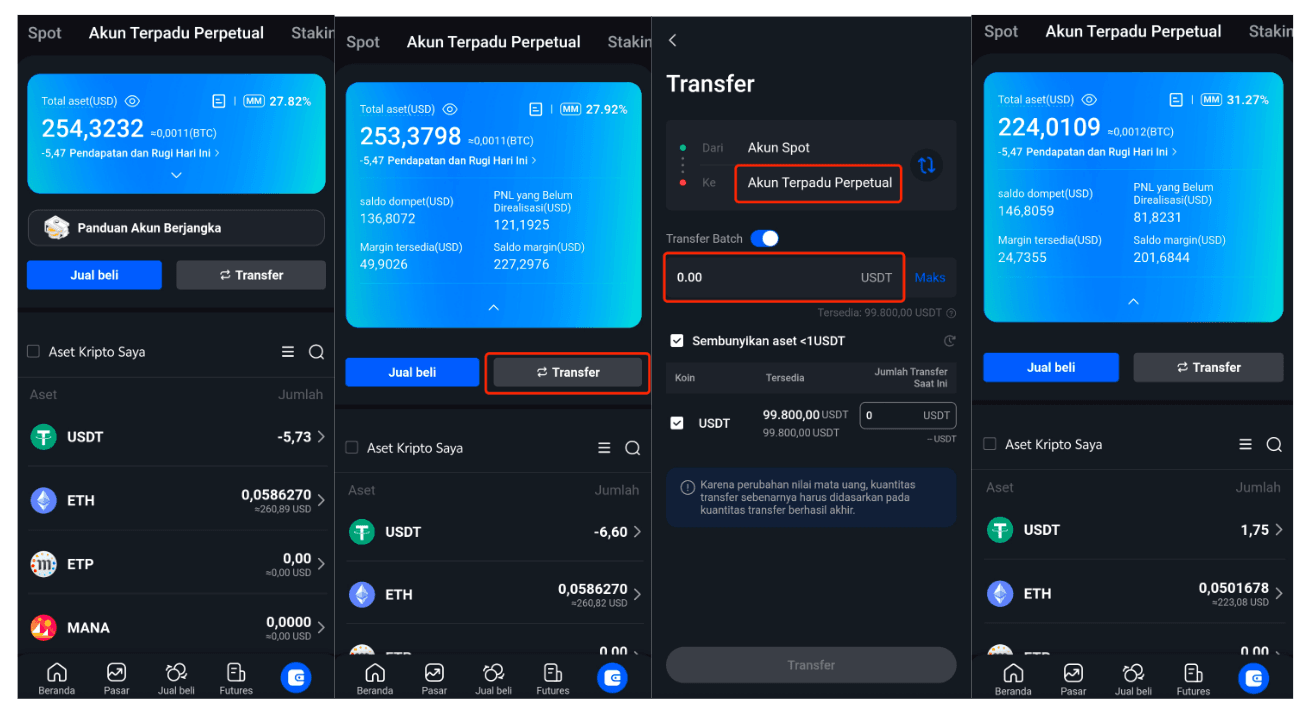
These funds will be used as margin, which is collateral to open trading positions. The margin amount will determine the value of the position that can be opened, especially when using leverage.
5. Open a Trading Position
The next step is to select the crypto asset pair you want to trade.
Users can determine:
- a Long position if you expect the price to rise;
- a Short position if you expect the price to fall;
- leverage size;
- margin amount;
- Stop Loss and Take Profit levels.
After all parameters are confirmed, the position will open and its value will move according to market price changes.
Bittime also provides two margin mode options: Cross Margin and Isolated Margin.
In Cross Margin mode, all assets in the account can be used to support positions, making capital efficiency higher. Meanwhile, Isolated Margin limits risk only to the margin allocated for a specific position.
Read Also: Kalshi vs Polymarket, Competing for Crypto Perpetual Futures
Select the Futures Pair You Want to Trade
After the Integrated Futures Trading Account is active and margin balance is available, the next step is to select the asset pair (trading pair) you want to trade through the Futures page on Bittime.
Based on the Bittime Futures interface display, the process is quite simple.
Click the Futures menu
At the top of the Bittime app or website, select the Futures menu to enter the perpetual contract trading page. This menu is the center of all futures trading activities, from asset selection to opening positions.
Select asset pair
On the left side of the trading page, there is a list of available perpetual contracts, for example:
- BTC/USDT
- ETH/USDT
- XRP/USDT
- SOL/USDT
- SUI/USDT
Click on one of the pairs you want to trade. For example, if you want to trade Bitcoin, select BTC/USDT Perpetual.
Use the search column
If the desired asset pair is not immediately visible, use the Search Pair column to type the token name or asset symbol. This search feature makes it easy for traders to find futures contracts without having to scroll through the entire asset list.
Once the pair is selected, the price chart, order book, Mark Price information, Funding Rate, and position opening form will automatically adjust to that asset so traders can immediately proceed to the order setting stage.
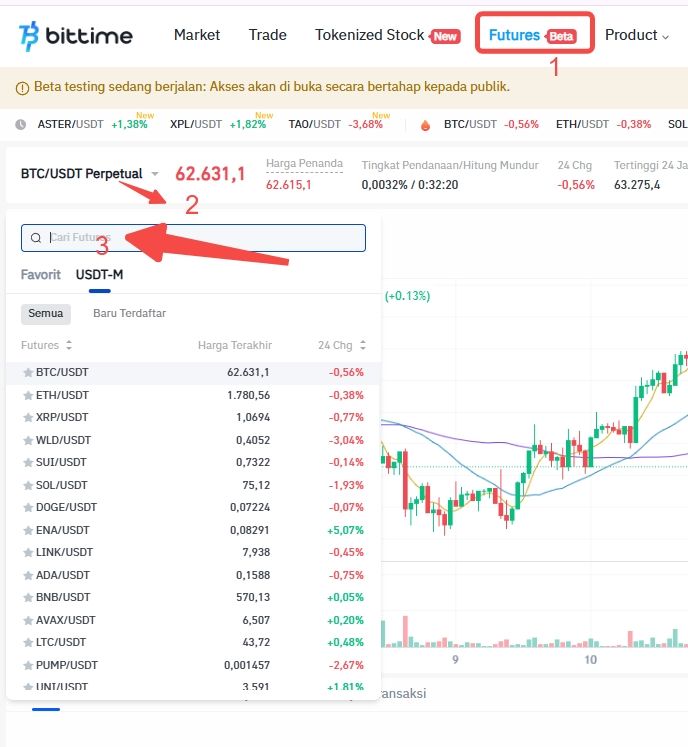
Image: Bittime Futures page display showing the Futures menu, list of perpetual contract pairs, and pair search column to select assets before opening a trading position.
6. Set Trading Parameters
After selecting the asset pair, determine the transaction parameters before opening a position.
Some settings to pay attention to include:
- choosing Long or Short position;
- choosing Cross Margin or Isolated Margin mode;
- setting leverage size;
- entering margin amount;
- determining Stop Loss and Take Profit.
Make sure all parameters have been double-checked before pressing the order confirmation button, because every futures transaction carries risks influenced by market volatility and the leverage used.
Read Also: What is Leverage in Crypto? Here are the Types!
Understanding Bittime's Integrated Futures Trading Account
One of the updates to the Bittime Futures service is the presence of the Integrated Futures Trading Account.
This system integrates all futures assets into one dashboard so users can more easily monitor margin, assets, and ongoing positions.
Another advantage is support for using more than 40 crypto assets as collateral. In addition, unrealized profits can also be counted as part of the account margin, making capital usage more efficient.
On the assets page, users can monitor several important indicators, including:
- Initial Margin (IM) Ratio, which is the margin usage ratio when opening a position.
- Maintenance Margin (MM) Ratio, an indicator that shows the level of liquidation risk.
- Available Margin, which is the margin still available to open new positions.
- Total Assets, the total value of assets in the Integrated Futures Trading Account.
These features help traders monitor account conditions more easily, especially when managing multiple positions at once.
Read Also: 10+ Best AI Coins 2026: Here is the List of Artificial Intelligence Themed Cryptos!
Understanding Leverage, Margin, and Liquidation Risk
The feature that most distinguishes Bittime Futures from spot trading is the use of leverage.
Leverage allows traders to control a larger transaction value than the capital they have. For example, Rp1 million capital with 10x leverage allows users to open a position worth Rp10 million.
However, leverage not only amplifies potential profits but also amplifies potential losses. If the price moves against the prediction until the margin is no longer sufficient, the system can automatically perform liquidation to prevent larger losses.
Therefore, beginner traders should use leverage conservatively while understanding how margin and liquidation limits work before increasing position size.
In addition, traders also need to pay attention to the funding rate, which is the periodic fee paid between Long and Short parties to keep the contract price close to the spot market price. This fee can affect trading results if positions are held for a long time.

Basic Crypto Futures Trading Strategies for Beginners
Although futures offer more flexible opportunities, risk management remains the main factor in maintaining consistent trading results.
Some basic strategies that can be applied include:
- following the main market trend before opening a position;
- using Stop Loss to limit losses;
- determining profit targets through Take Profit;
- using low leverage while still in the learning stage;
- not using all capital on a single transaction.
Traders are also advised to understand market conditions before opening positions. Factors such as high volatility, global economic data releases, and sentiment toward Bitcoin often influence crypto asset price movements in a short time.
Developing discipline in risk management is often more important than seeking large profits in a single transaction.
Read Also: US Stock Tokenization: Hold Your Favorite US Stocks, Get 7% Rewards Every Day
Conclusion
Trading Futures on Bittime provides users with the opportunity to gain exposure to crypto asset price movements through Long or Short positions.
However, because it is a derivative product with a higher level of risk, users are required to go through registration, identity verification, and Knowledge Test stages before starting to trade.
By understanding the concepts of leverage, margin, funding rate, and applying good risk management, beginner traders can build a stronger foundation before being active in the crypto futures market.

Bittime is a licensed and supervised Digital Financial Asset Trader (PAKD) platform by the Financial Services Authority — the place where you can buy Bitcoin in Indonesia and hundreds of other crypto assets starting from Rp10,000. The registration process is fast, secure, and you can start today.
Monitor USDT to IDR conversion and the price movements of your favorite crypto assets in real-time. All are available in one crypto investment app that can be downloaded for free on the Play Store.
Ready to start? Register now at Bittime and execute your investment strategy with a platform trusted by millions of users in Indonesia.
FAQ
What are crypto futures?
Crypto futures are derivative contracts that follow the price of crypto assets without requiring traders to own the assets directly.
What is the function of the Knowledge Test on Bittime?
The Knowledge Test aims to ensure that users understand how futures work and their risks as part of consumer protection before being able to access the feature.
Can trading Futures on Bittime generate profits when prices fall?
Yes. Traders can open Short positions if they expect the asset price to decline.
What is the difference between spot and futures trading?
Spot trading involves buying crypto assets directly, while futures trade contracts that follow the asset's price movement without physical asset ownership.
Is crypto futures trading suitable for beginners?
It is suitable if users have understood the basics of leverage, margin, and risk management. Because the risk is higher than spot, beginners should use low leverage and only trade with funds they are prepared to risk.
Disclaimer: The views expressed belong exclusively to the author and do not reflect the views of this platform. This platform and its affiliates disclaim any responsibility for the accuracy or suitability of the information provided. It is for informational purposes only and not intended as financial or investment advice.

.png)