How to Mine Zcash (ZEC) on Zmine: Complete Guide 2026
2026-10-22
How to mine Zcash on Zmine needs to be understood correctly: users collect $MINE tokens, not mine ZEC directly. Zmine distributes rewards through virtual hashpower obtained from free sessions, ZEC staking, boost packs, Genesis Pass, tasks, and referrals.
Free sessions can be started without a deposit. However, rewards enter as an unverified balance, so they cannot be sold before the user meets the verification requirements and moves them to a verified balance. The litepaper specifies verification using a passkey and a one-time payment of 0.0003 ZEC.
This guide covers how to start mining on Zmine, tokenomics changes, costs to watch out for, and the difference between $MINE balances on the platform and tokens that can be sent to a personal wallet.
Key Takeaways
- Zmine distributes $MINE through virtual hashpower, not ZEC mining rewards from the Zcash network.
- Free mining is available, but verification with a passkey and a 0.0003 ZEC payment is required before rewards can be moved to a tradable balance.
- Halving changed to every 15 days starting October 16, 2026; mining results still depend on participation, platform rules, and liquidity.
What Is Zmine and the $MINE Token?
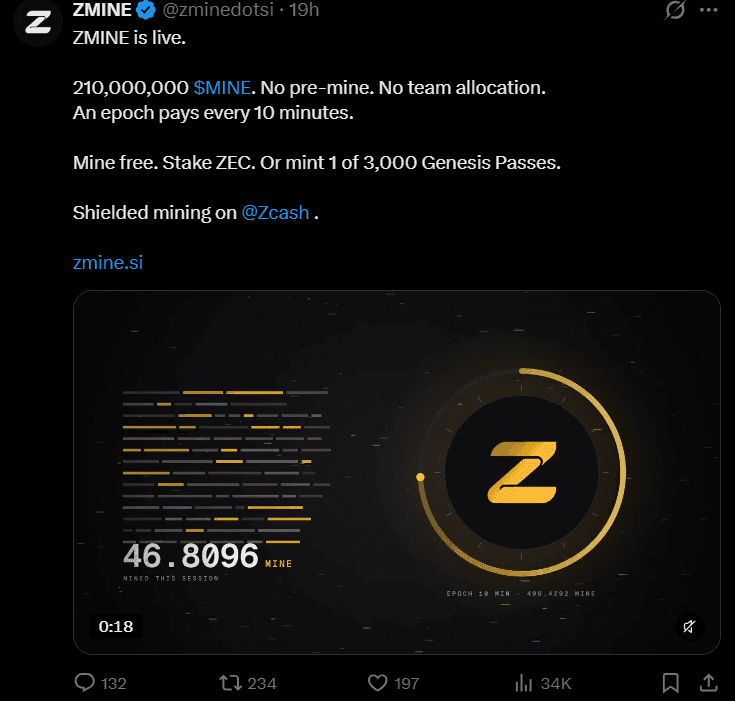
Zmine is a platform that distributes $MINE through reward periods called epochs. Each epoch lasts 10 minutes, then the system distributes rewards based on the account's hashpower recorded when the epoch is completed.
Hashpower here is not computing power for running Proof of Work. The number serves as a weight for reward distribution within the Zmine system. Therefore, users do not need to prepare mining equipment to join free sessions.
According to the litepaper, the total supply of $MINE is set at 210 million tokens with no pre-allocation for the team, sales, or treasury.
The entire distribution is designed to come out of the mining pool through epoch rewards. That statement is a project provision, not a guarantee of security or the token's market value.
Read also: Does Zcash Have an Advantage Bitcoin Does Not? Here Is What Grayscale Says
Does Zmine Really Mine Zcash?
Not in the sense of directly mining ZEC. The litepaper states that Zmine hashpower is not Proof of Work, but a number that determines each account's share of $MINE rewards.
ZEC is used for several needs on the platform, such as staking, buying boost packs, minting Genesis Pass, and paying verification. Meanwhile, $MINE is still recorded in Zmine's internal ledger.
Thus, the term "how to mine Zcash on Zmine" in this guide refers to the activity of earning $MINE on a platform that uses Zcash, not running equipment to obtain ZEC block rewards.
Read also: Crypto Mining Explained: How It Works, Mining Rigs, and a Beginner's Guide
How to Mine on Zmine for Beginners
1. Create an account and save recovery access
Open the official Zmine website and follow the account creation process. According to the litepaper, the system provides a login key and a recovery phrase containing 24 words, without email registration or a conventional password.
The login key is used to sign in, while the recovery phrase can issue a new login key when old access is lost. If both are lost, Zmine states that the account cannot be recovered through customer support.
Store both pieces of information securely. Enable two-factor authentication through an authenticator app to add protection to login and actions that move funds.
2. Activate a free session for 24 hours
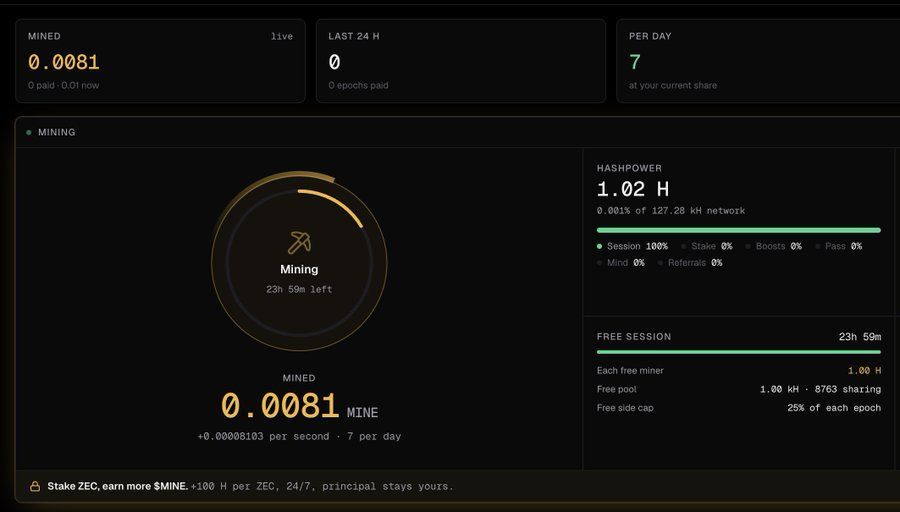
After signing in, activate a free session through the mining page. One session lasts 24 hours and takes a share of the shared free pool of 1,000 H.
The base hashpower per session depends on the number of active sessions, with a lower limit of 1 H and an upper limit of 25 H. For example, the litepaper lists 10 H per account when there are 100 active sessions.
Free sessions do not require a ZEC deposit. However, starting mining without a cost is different from selling the results: rewards still enter the unverified balance until the verification process and balance migration are completed.
3. Extend the session to maintain the streak
The litepaper states that extending a session within the last 30 minutes before it ends can maintain the streak. The streak bonus increases by 2% per consecutive day up to a maximum of 20%, and applies to hashpower sources associated with active sessions.
Check the session end time on the dashboard. Accounts without sessions, stake, packs, or task credits do not receive passive rewards automatically.
4. Understand estimates and final rewards
The $MINE number moving on the mining page is a projection of the account's share in the current epoch. The final amount only enters the ledger after the epoch is completed.
If total hashpower changes before completion, the final reward may differ from the previous estimate. Therefore, the number displayed at a given moment is not appropriate to use as a guarantee of daily income.
Zmine Verification: Cost and How to Activate the Balance
Verification is an important stage if users want to sell mining results. According to the litepaper, this process requires two components: a passkey on the user's device and a one-time payment of 0.0003 ZEC.
Payment can be made from the Zmine balance or an external wallet according to platform instructions. For external payments, the litepaper emphasizes that the displayed memo must be included because it is used to identify the payment.
The $MINE balance flow is as follows:
- Mining rewards enter the unverified balance.
- The user completes account verification once.
- The user moves or migrates $MINE to the verified balance.
- The verified balance can be used according to the features and terms of the marketplace.
Account verification does not make all subsequent rewards automatically enter the verified balance. New rewards still arrive as unverified and need to be migrated again; the litepaper states that the migration is free and can be done repeatedly.
The stated verification deadline is April 13, 2027. According to the project plan, accounts that have not been verified after that window closes will no longer be able to verify their mining results; the remaining supply will be handled through a redistribution mechanism whose rules will be announced before implementation.
How to Increase Hashpower on Zmine
In addition to free sessions, Zmine offers several hashpower sources. The most important difference is whether ZEC remains recorded as the user's asset or has been spent.
ZEC Staking
Staking provides 100 H for every 1 ZEC and starts being counted from the next epoch. Staked ZEC remains recorded as owned by the user, but it is in Zmine's custody wallet, not a personal wallet fully controlled by the user.
The litepaper explains that there is a staking reserve with a transparent address displayed on the Wallet page. The reserve is intended to support staking balances on a one-to-one basis.
Unstaking requires a 24-hour cooldown. Hashpower from that ZEC stops generating rewards immediately after the unstaking process begins.
The term staking here refers to the platform's internal mechanism for obtaining $MINE hashpower, not the user's participation in the Zcash network's Proof of Stake consensus.
Boost pack
A boost pack exchanges ZEC for hashpower valid for a limited time. Unlike staking, the ZEC used to buy a pack is spent to the treasury.
The prices and specifications above follow the litepaper that was reviewed; compare them again with the offer in the app before buying.
The estimated pack results depend on the total network hashpower. As more hashpower joins, a pack's share of rewards may decrease, so initial estimates are not a guarantee of breaking even.
Genesis Pass
Genesis Pass costs US$2 in ZEC denomination at the time of mint and provides 30 H per pass. The litepaper sets a maximum of 3,000 passes and states that the hashpower remains active without the need for a free session.
However, the pass is currently described as non-transferable and non-refundable. The term "permanent" refers to the hashpower provision in the system, not a promise of fixed income or unlimited profit.
Check mint availability directly on the platform; the supply limit does not indicate how many passes are still available.
Tasks and referrals
Correct task answers provide 5 H for 24 hours, with a limit of 12 answers per day. Active referrals can also add hashpower, while the referral commission stated in the litepaper is 5% of the referred user's rewards, paid from the mining pool.
Hashpower from sessions, referrals, and tasks combined can receive a maximum of 30% of an epoch's rewards. This limit differs from the old provision of 25%.
Read also: Crypto Mining 2026: Is It Still Profitable?
$MINE Tokenomics and the Halving Schedule Change
According to the litepaper, the emission schedule was changed on October 16, 2026, specifically at epoch 744. Previously, the reward was 24,305.5555 MINE per epoch with halving every 30 days. After the change, the base rate became 44,425.1543 MINE per epoch with halving every 2,160 epochs or 15 days.
This change compresses the distribution to around six months, without changing the total supply of 210 million MINE or the rewards already paid. The new rate then continues to decrease according to the halving schedule; the figure of 44,425.1543 MINE is not a reward that applies forever.
There are two factors that need to be distinguished:
- Protocol reward: the amount of $MINE allocated each epoch according to the emission schedule.
- Account reward: the portion of that allocation received by the user based on hashpower and distribution rules.
This means users cannot calculate their personal results simply by multiplying the protocol reward by the number of daily epochs. The calculation must take into account hashpower competition and the free reward distribution limit.
Can $MINE Be Sold and Withdrawn?
Selling $MINE on the internal marketplace is different from withdrawing tokens to a personal wallet.
Selling through the marketplace
The litepaper explains a lot-based marketplace, not an order book. Sellers set the amount and price, then buyers take the lot in full without partial fills. Only verified MINE can be offered.
A 2% marketplace fee is deducted from the sale proceeds in ZEC. The smallest lot size is 1 MINE, and listing does not guarantee that there will be a buyer.
The document states that the marketplace opens after mining begins at an announced time. Therefore, the existence of a marketplace description in the litepaper is not enough to confirm that trading is already active; check the status in the app. Before opening, the reference price is not a transaction price that has been realized.
Withdrawal to a personal wallet
According to the litepaper, $MINE is still a token in the internal ledger. The project plans to issue it as a Zcash Shielded Asset after NU7, with a 1:1 exchange of ledger balances.
That plan is not proof that on-chain withdrawals are already available. A verified balance that can be used on the internal marketplace also does not automatically mean the token can already be sent to a personal wallet.
Risks of Zmine Mining That Need to Be Understood
Custody risk
Deposited ZEC is managed through the platform's custody wallet. The litepaper mentions the use of hot wallets, staking reserves, and moving some funds to cold storage, but these mechanisms do not eliminate dependence on the operator and the withdrawal system.
A verifiable reserve should also not be equated with a guarantee that all operational risks have disappeared.
Price and liquidity risk
The value of rewards depends on the price buyers are actually willing to pay. The listing price or reference price is not necessarily a sale price that can be realized.
Boost packs and Genesis Pass require spending ZEC, while additional hashpower only increases the weight of reward distribution. That spending does not guarantee that the value of mining results will be greater than the cost.
Account and feature change risk
Losing both the login key and recovery phrase can cause loss of account access. In addition, the use of rewards depends on verification, marketplace status, and implementation of the on-chain token issuance plan.
Before depositing, check:
- The site address and official payment instructions.
- Verification costs, feature purchases, and withdrawals.
- Marketplace status and the ability to sell rewards.
- Custody terms and unstaking cooldown.
- The status of $MINE withdrawals to a personal wallet.
Conclusion
Zmine allows users to collect $MINE through free sessions and several additional hashpower sources. The mechanism is not direct ZEC mining: hashpower is used to divide rewards within the platform ledger.
Important updates include halving every 15 days, a 30% free reward limit, and a one-time verification of 0.0003 ZEC with a passkey. Before spending ZEC, understand the difference between staking and buying features, unverified and verified balances, and internal trading and on-chain withdrawals.
To understand the asset used in this platform, read the guide on how to buy Zcash (ZEC) on Bittime. Buying ZEC and using Zmine services are separate decisions with their own risks.
Check the price of Bitcoin (BTC), Ethereum (ETH), XRP, Solana (SOL), GRAM, and BNB as well as the leading memecoin DOGE. You can trade directly on Bittime!
Bittime is a Digital Financial Asset Trader (PAKD) platform licensed and supervised by the Financial Services Authority — where you can buy Bitcoin in Indonesia and hundreds of other crypto assets starting from Rp10,000. The registration process is fast, secure, and can be started today.
Monitor the USDT to IDR conversion and the price movements of your favorite crypto assets in real-time. All are available in one crypto investment app that can be downloaded for free on the Play Store.
Ready to start? Register now on Bittime and execute your investment strategy with a platform trusted by millions of users in Indonesia.
FAQ About Mining Zcash on Zmine
Does Zmine produce ZEC?
Zmine mining rewards are in $MINE, not ZEC. ZEC is used for staking, buying features, verification, and marketplace transactions according to platform terms.
Is Zmine mining really free?
Free sessions can be started without a ZEC deposit. However, verification to enable the use of mining results requires a passkey and a one-time payment of 0.0003 ZEC.
How long is one Zmine mining session?
One free session lasts 24 hours. Extending it in the last 30 minutes can maintain the streak according to the litepaper rules.
How long does ZEC unstaking take on Zmine?
Unstaking requires a 24-hour cooldown. ZEC that enters cooldown immediately stops providing staking hashpower.
Can $MINE already be withdrawn to a personal wallet?
The litepaper still describes $MINE as an internal ledger balance with a plan to issue a Zcash Shielded Asset after NU7. Check the latest implementation because platform balances are not automatically tokens that can be withdrawn on-chain.
Is Zmine mining guaranteed to be profitable?
There is no guarantee of profit. Results depend on the reward share, actual sale price, liquidity, costs, and the ability to access funds.
Disclaimer: The views expressed belong exclusively to the author and do not reflect the views of this platform. This platform and its affiliates disclaim any responsibility for the accuracy or suitability of the information provided. It is for informational purposes only and not intended as financial or investment advice.
.png)