US Bank Outage 2026: JPMorgan Chase Bug Disrupts Other Banks' Transactions
2026-11-17
The U.S. bank outage drew attention after thousands of customers at several major American banks reported service disruptions on November 16, 2026. JPMorgan Chase eventually acknowledged an internal software issue that slowed transaction processing. The impact was even felt by customers of other banks making payments through Chase.
Complaints also came from users of Bank of America, Wells Fargo, U.S. Bank, and the Zelle money transfer service. However, this does not mean the entire U.S. banking system was malfunctioning. So how could a technical issue at one bank affect transactions across several institutions, and were customers' funds still safe?
Key Takeaways
- JPMorgan Chase confirmed a software bug in its internal systems that caused delays in some transactions.
- The disruption also affected interbank payments, even though not every institution experienced problems with its own systems.
- Zelle said its network remained operational, while JPMorgan found no indication of a cyberattack.
What Caused the U.S. Bank Outage on November 16, 2026?
Banking disruptions in the United States became a widely discussed issue on Monday, November 16, 2026, after reports of service problems surged on Downdetector.
JPMorgan Chase was among the banks receiving the most complaints. Some customers reported difficulty using digital banking services, while others had transactions that had not yet been processed.
At around 2:00 p.m. Eastern Time, Downdetector recorded more than 4,700 reports concerning Chase. That figure represents user-submitted reports, not an official count of affected customers.
JPMorgan subsequently confirmed that the issue originated in software used by its internal systems.
The disruption caused some transactions to process more slowly than usual. However, there was no indication that the entire U.S. banking network had stopped operating.
Also read: Why JPMorgan Blocked AI Agents from Customer Bank Accounts
Why Did JPMorgan Chase Experience a Disruption?
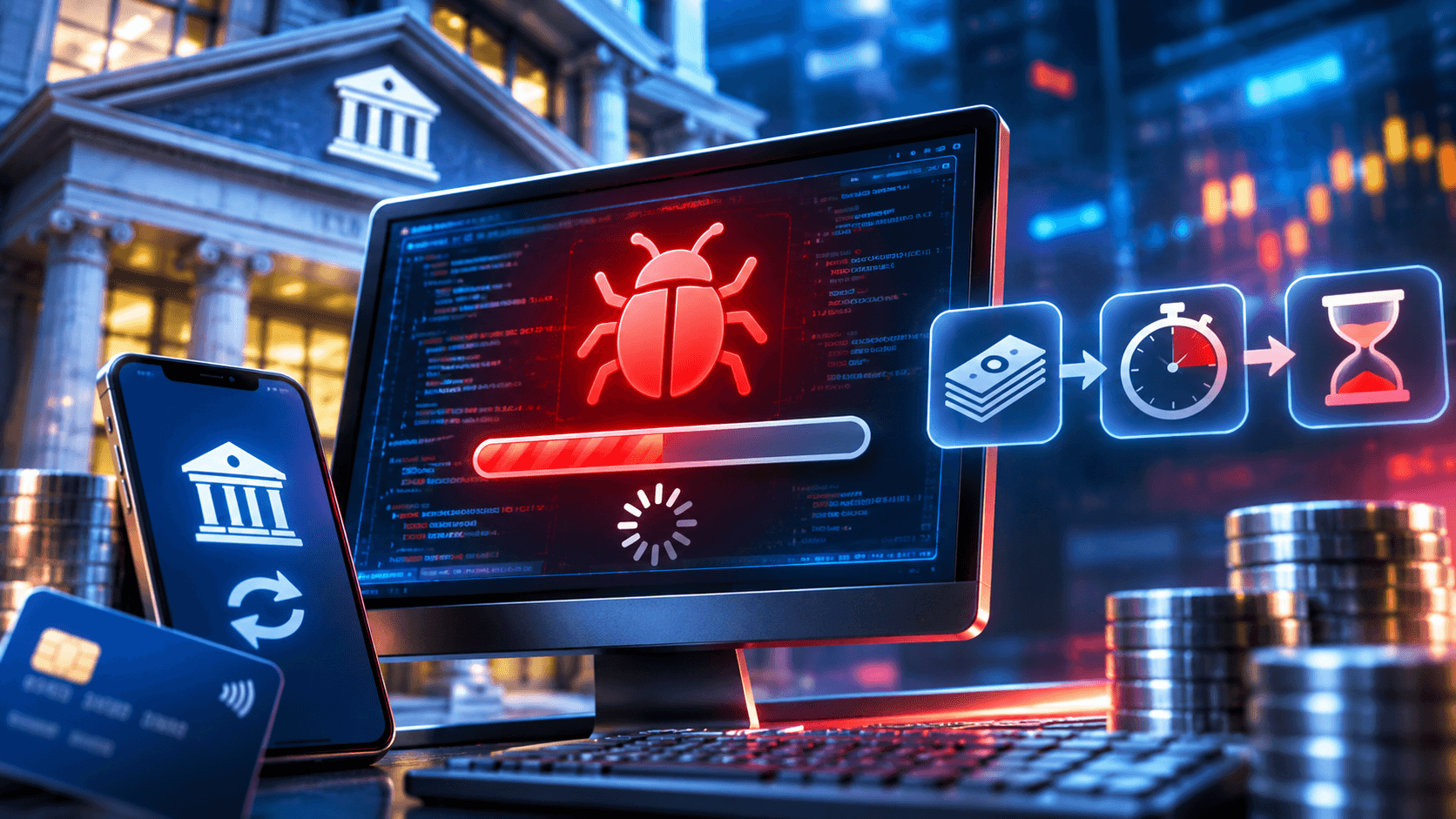
According to JPMorgan, the disruption was caused by a software bug that affected the company's internal hardware systems. Those systems use on-premises, meaning computing equipment managed directly by the bank.
When software encounters an error, certain processes may be disrupted even while other services continue running. JPMorgan did not disclose which specific components or programs were affected. Therefore, there is no basis for concluding that the disruption resulted from a particular server failure or a faulty system update.
How Can a Software Bug Slow Down Bank Transactions?
Every banking transaction must pass through several stages, from data verification to recording and payment settlement. If the software handling one of these processes malfunctions, a transaction can remain on hold longer than usual.
This does not necessarily mean the banking app becomes completely inaccessible. Customers may still be able to view their accounts, while certain payments remain incomplete.
That is why the effects of a disruption can vary from one user to another.
Which Banks Were Affected by the Outage?
Besides JPMorgan Chase, users of several other major U.S. banks also reported service problems. Frequently mentioned institutions included Bank of America, Wells Fargo, U.S. Bank, Capital One, and Truist.
However, it is important to distinguish customer reports from system outages actually confirmed by the banks.
Downdetector relies on reports submitted by users. A spike in complaints can signal a problem, but it does not establish the cause.
Therefore, the fact that many banks appeared in news reports does not automatically mean they all experienced software failures at the same time.
Also read: What Is JPM Coin? JPMorgan's Deposit Token on Ethereum
Why Could the JPMorgan Chase Outage Affect Other Banks?
One notable aspect of this incident is that its impact was not limited to Chase customers. Interbank money transfers involve processing by both the sending and receiving institutions.
For example, a U.S. Bank customer might send money to a Chase account. Even if U.S. Bank's systems are functioning normally, Chase must still process the payment for the transaction to be completed.
When processing at Chase slows down, customers of the sending bank may also experience delays. The same can happen when Chase customers send payments to other financial institutions.
As a result, a problem at one major bank can generate complaints across multiple services without causing failures in those other banks' internal systems.
This interconnectedness is what makes a payment-processing disruption different from an ordinary banking app issue.
Also read: Bitcoin Price Falls to $62,000: An Effect of AI Stocks?
Was Zelle Also Down During the U.S. Bank Outage?
Zelle also drew attention after some users reported that money transfers had not reached their intended recipients. The service allows customers to send and receive money through banks and financial institutions that participate in the Zelle network.
Despite the rise in user complaints, Zelle's operator, Early Warning Services, said its payment network remained operational.
This means the issues experienced by some users did not stem from a network-wide Zelle outage. Delays can occur when a bank responsible for processing a payment is experiencing technical problems.
Why Can Zelle Transfers Remain Pending?
Payments made through Zelle still involve the financial institutions holding the sender's and recipient's accounts. If either bank is slow to process a transaction, the money may not arrive even though the payment request has been sent.
A pending status means the transaction has not been completed, but it does not automatically mean the payment failed or the funds were lost. Users should therefore check their transaction history in their banking app before attempting to send the money again.
Also read: Digital Crime Task Force Launched: A New Way to Track Illegal USDT Transactions
Was the U.S. Bank Outage Caused by a Cyberattack?
Amid the numerous outage reports, questions arose about whether the U.S. banking system was under cyberattack. JPMorgan Chase said it had found no evidence linking the problem to hacking activity.
Instead, the bank identified a software error as the source of the transaction-processing disruption. This distinction matters because technical problems do not necessarily involve data breaches or unauthorized access to customer accounts.
Software bugs can result from errors in how a program operates, without any outside attack. Based on the available information, the JPMorgan incident cannot be described as a cyberattack or as evidence of a widespread failure of the U.S. financial system.
Were Customers' Money and Accounts Still Safe?
One of the biggest concerns during a banking disruption is the safety of funds held in customer accounts. JPMorgan said customers retained access to their accounts and money, even though some transactions were delayed.
However, that statement does not mean every digital banking feature was working without issues. Some users still reported difficulties accessing certain services during the disruption.
The key distinction is between a delayed transaction and lost funds. When a payment has not yet finished processing, customers should not immediately assume their money is gone or repeatedly try to send the same amount.
Previously delayed transactions may still be completed once the bank's processing systems resume normal operations.
Also read: Beware! OJK Shuts Down 16 Illegal Investment Entities, Including AI and Crypto Schemes
What Should You Do If a Bank Transfer Is Delayed?
Banking disruptions can be worrying, especially when a payment needs to be made urgently.
However, repeating a transaction without knowing the status of the first attempt can create additional problems.
Here are the steps you can take:
- Check the transaction status. See whether the payment is marked as successful, pending, or failed in your banking app.
- Do not immediately resend the payment. Make sure the first transaction has actually failed to avoid making a duplicate payment.
- Check official updates. Use the bank's official website, app, or customer service accounts.
- Keep proof of the transaction. Record the payment time, amount, reference number, and recipient account.
- Contact your bank. If the transaction status remains unclear, request an investigation through official customer support channels.
Customers should also be alert to scams that exploit service disruptions. Never share a PIN, password, or one-time password (OTP) with anyone claiming they can speed up account recovery.
When Would JPMorgan Chase Services Return to Normal?
JPMorgan said it was working to resolve the disruption and aimed to fix it by the end of November 16, 2026, U.S. time.
By the afternoon, the number of complaints submitted to Downdetector had begun to decline. The decrease showed that fewer users were filing reports, but it did not prove that all delayed transactions had been completed.
The available information did not specify exactly when all services and payments had fully recovered. Customers still experiencing issues were advised to check announcements from their respective banks, as payment resolution times may vary.
Also read: MSTR Excluded from MSCI: Are Strategy's Bitcoin Purchases at Risk?
What Was the Impact on Digital Payment Systems?
The JPMorgan Chase disruption illustrated how closely connected banks are within modern payment systems. A single major institution can process transactions involving many other organizations. When that processing is disrupted, the effects can reach users who do not even hold an account with the affected bank.
The incident is a reminder that payment system reliability depends on more than the apps customers use. Processing infrastructure, backup systems, and the ability to restore services also play important roles in keeping transactions running smoothly.
For the banking industry, incidents like this highlight the importance of operational resilience in preventing technical disruptions from escalating into wider problems.
As financial technology advances, understanding how digital transactions work and the risks they carry is increasingly important, including in crypto trading. You can sign up for Bittime to stay informed about developments in the digital asset industry while expanding your understanding of transaction security and asset management.
Conclusion
The U.S. bank outage on November 16, 2026, occurred when a software bug at JPMorgan Chase slowed the processing of some transactions.
Customers of other banks were also affected because interbank payments are interconnected. Nevertheless, not every institution experienced a system failure, and Zelle said its payment network continued operating.
JPMorgan also found no indication of a cyberattack in this incident.
For customers facing similar disruptions, the most important steps are to verify payment status, avoid duplicate transactions, and follow official bank updates until services return to normal.

Bittime is a licensed Digital Financial Asset Trading Platform (PAKD) supervised by Indonesia's Financial Services Authority (OJK) — where you can buy Bitcoin in Indonesia and hundreds of other crypto assets starting from IDR 10,000. Registration is fast and secure, and you can get started today.
Track the conversion rate of USDT to IDR and real-time price movements of your favorite crypto assets. Everything is available in one crypto investment app that you can download for free from the Play Store.
Ready to get started? Sign up for Bittime now and put your investment strategy into action on a platform trusted by millions of users in Indonesia.
FAQ
What caused the U.S. bank outage on November 16, 2026?
JPMorgan Chase confirmed a software bug in its internal systems that slowed the processing of some transactions. The issue also affected payments involving other banks.
Did JPMorgan Chase cause outages at other banks?
Processing disruptions at JPMorgan can delay interbank transactions. However, this does not mean that every bank receiving customer complaints experienced a failure in its own internal systems.
Which banks experienced service issues?
Users reported problems at JPMorgan Chase, Bank of America, Wells Fargo, U.S. Bank, Capital One, and Truist. Conditions differed across institutions, so outage reports are not necessarily evidence of system failures at those banks.
Was Zelle down, and were customers' funds still safe?
Zelle said its payment network remained operational, although some transfers were delayed. JPMorgan also said customers could still access their accounts and funds.
When would Chase Bank services return to normal?
JPMorgan aimed to resolve the disruption by the end of November 16, 2026, local time. However, the available information did not confirm when all services would be fully restored, so customers were advised to check official updates from Chase.
Disclaimer: The views expressed belong exclusively to the author and do not reflect the views of this platform. This platform and its affiliates disclaim any responsibility for the accuracy or suitability of the information provided. It is for informational purposes only and not intended as financial or investment advice.

.png)