Foreign Banks Are Starting to Withdraw Liquidity from Indonesia – What Is Happening?
2026-06-30
In recent weeks, market participants have focused on reports that several foreign banks have begun sending more of their profits to headquarters abroad.
This phenomenon has raised questions about Indonesia’s liquidity conditions, global investor confidence, and the outlook for the national economy.
Data shows that Citigroup, HSBC, and Standard Chartered’s units in Indonesia have repatriated around Rp11.5 trillion (US$640 million) since 2024, slightly exceeding the total profit they generated during that period.
This situation has raised concerns about increasing capital outflows from Indonesia and their impact on the domestic financial market.
However, this phenomenon needs to be understood in full context. Sending profits to headquarters does not mean these banks are leaving Indonesia, but rather signals a change in business strategy and capital management.
Key Takeaways
- Foreign banks are increasing profit remittances to headquarters as part of capital management strategy and risk adjustment.
- This phenomenon signals that some global investors are becoming more cautious about investment prospects in Indonesia.
- The main impact is felt more on market sentiment, the rupiah exchange rate, and capital flows rather than directly on banking conditions.
Register at Bittime now and start trading crypto with a fast, secure, and easy process in the app.
Why Are Foreign Banks Starting to Pull Liquidity from Indonesia?
It should first be understood that the term “pulling liquidity” in this context does not mean withdrawing customer funds. What is happening is profit repatriation — profits earned in Indonesia are being sent back to parent companies abroad.
This step is actually a common practice among multinational companies. However, what is drawing attention is the large proportion of profits being sent out compared to previous periods.
Before 2024, most global banks still left a portion of their profits in Indonesia to strengthen capital and support business expansion. Now, almost all profits — and even some retained earnings — are being sent back to headquarters.
For market participants, this change in pattern is often seen as an indicator that companies are becoming more selective in allocating capital in Indonesia.
Read Also: Diversification When the Rupiah Weakens: Gold, Dollar, or Crypto?
Factors Driving International Banks’ Strategy Changes
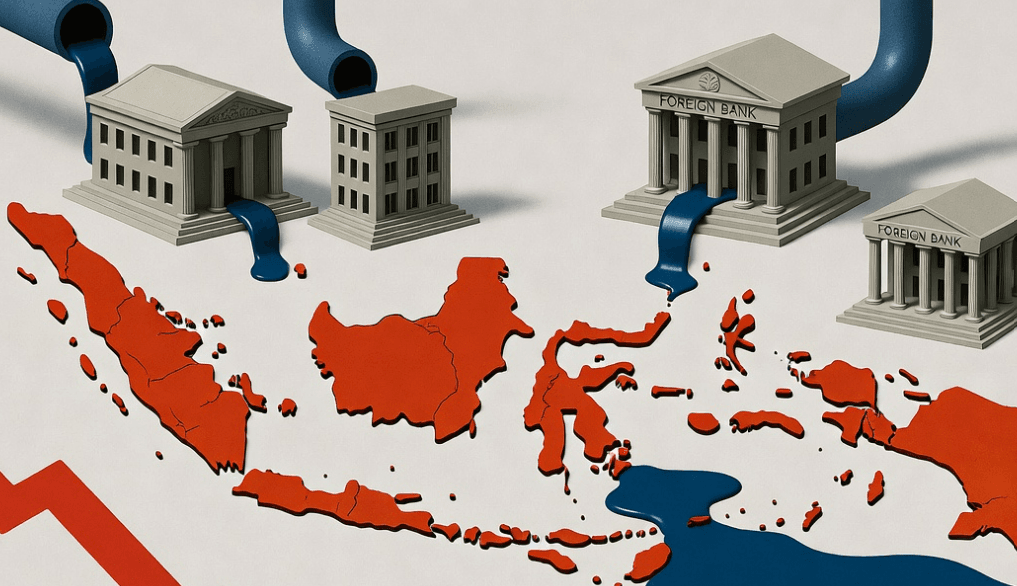
Source: AI-generated image
Several factors are suspected to be behind the increase in capital outflows from Indonesia’s foreign banking sector.
1. Changes in Economic Policy Direction
Since the new government took office, it has pushed for a larger state role through various strategic programs, including strengthening Danantara as a sovereign wealth fund.
Some industry players view this policy shift as increasing uncertainty regarding the role of the private sector and banking in financing national programs.
2. Concerns Over Financing Policies
Bloomberg reported discussions about the possibility of banks being involved in supporting certain government programs.
Although OJK has emphasized that lending decisions remain based on each bank’s business considerations, the issue remains a concern for foreign investors due to long-term risk management implications.
3. Rupiah Weakening
The weakening rupiah exchange rate also influences global companies’ decisions.
If the rupiah is expected to remain under pressure, holding profits in the local currency becomes less attractive than sending them to headquarters in US dollars.
Just starting to invest in crypto? Bitcoin (BTC) and Ethereum (ETH) can be popular starting choices to watch and trade on Bittime.
Does This Mean There Is Large-Scale Capital Outflow?
Not entirely.
What is happening is not a massive withdrawal of investor funds, but rather the remittance of corporate profits abroad.
The amount of around US$640 million is actually relatively small compared to the size of Indonesia’s economy. However, the market is paying more attention to the message behind the decision — namely, a more cautious stance from international banks toward Indonesia’s investment prospects.
Additionally, it should be noted that some foreign banks have already reduced their retail banking businesses in Indonesia for several years, long before the current government change.
Citigroup sold its consumer banking business to UOB in 2022, Standard Chartered divested part of its retail loan portfolio in 2023, while HSBC is also completing the divestment of its retail and wealth management businesses.
This means the trend is a continuation of global restructuring, not solely due to current Indonesian economic conditions.
Read Also: Rupiah Breaks Rp18,000: Foreign Outflow, Weakening IHSG, and Threat of Dollar at Rp20,000
Impact on the Rupiah and Financial Markets
Although it does not directly disrupt the banking system, the increase in foreign funds leaving Indonesia can still affect market sentiment.
Several impacts to watch include:
- The rupiah could face pressure if capital outflows continue to increase.
- Foreign investors are becoming more selective in placing capital in Indonesia’s stock and bond markets.
- Government funding costs may rise if investors demand higher bond yields.
In such conditions, market volatility usually increases as global investors tend to reduce exposure to risky assets.
Convert 1 BTC to IDR - Bitcoin to Rupiah Exchange Rate
What Does This Mean for Investors?
For retail investors, this development does not mean they should panic.
What is more important is understanding that foreign banks’ decisions reflect corporate strategy and capital management more than the direct fundamental condition of Indonesia’s banking sector.
Nevertheless, if negative sentiment continues to develop, several assets may come under pressure, such as:
- banking stocks,
- government bonds,
- and the rupiah exchange rate.
On the other hand, such conditions often prompt investors to consider diversification into global assets and digital assets that have different characteristics from the domestic market.
In the crypto market, for example, Bitcoin is often monitored as an alternative asset during global economic uncertainty. However, Bitcoin remains a highly volatile asset, so investment decisions must align with each investor’s risk profile.
Read also: Indonesia’s 2026 Economic Growth and Its Impact on Crypto
What Should Be Watched Next?
Several key indicators worth monitoring in the coming months include:
- developments in the rupiah exchange rate,
- foreign capital flows into stocks and bonds,
- Bank Indonesia’s policies,
- decisions by international rating agencies,
- and the clarity of the government’s economic policy direction.
If macroeconomic stability is maintained and investor confidence returns, opportunities for foreign capital inflows into Indonesia remain wide open.
Conclusion
News about global banks pulling funds from Indonesia deserves attention, but it should not be overreacted to.
The current phenomenon is more accurately described as an increase in profit repatriation — sending profits to headquarters — rather than customer fund withdrawals or foreign banks exiting Indonesia.
Nevertheless, the decision remains a signal that some global investors are reassessing their exposure to Indonesia amid economic policy changes, rupiah weakening, and rising market uncertainty.
For investors, the main focus should not be on a single piece of news, but on overall economic indicator developments. Portfolio diversification and disciplined risk management remain the most relevant strategies in facing market dynamics.

Let’s start trading crypto from the largest assets like BTC/IDR and ETH/IDR directly in the Bittime app.
Bittime is a licensed and supervised Digital Financial Asset Trader (PAKD) platform by the Financial Services Authority — where you can buy Bitcoin in Indonesia and hundreds of other crypto assets starting from Rp10,000. The registration process is fast, secure, and can be started today.
Monitor USDT to IDR conversion and the movement of your favorite crypto assets in real-time. All available in one crypto investment app that can be downloaded for free on the Play Store.
Ready to start? Register now at Bittime and execute your investment strategy with a platform trusted by millions of users in Indonesia.
FAQ
What does it mean when foreign banks pull liquidity from Indonesia?
This term refers to the increase in profit remittances (profit repatriation) to headquarters abroad, not the withdrawal of customer funds or the cessation of bank operations in Indonesia.
Is Indonesia’s capital outflow increasing?
Capital outflows are indeed a market concern, but this case is more related to corporate capital management strategy rather than broad capital outflow.
Why can the rupiah weaken due to foreign funds leaving?
When rupiah funds are converted into US dollars to be sent abroad, demand for dollars increases, which can put pressure on the rupiah exchange rate.
Will foreign banks leave Indonesia?
There is no such indication yet. Some banks are adjusting their businesses, but they are still operating and continue to generate profits in Indonesia.
What should investors do?
Investors should continue to monitor macroeconomic conditions, diversify their portfolios, and avoid making decisions based solely on one market sentiment.
Disclaimer: The views expressed belong exclusively to the author and do not reflect the views of this platform. This platform and its affiliates disclaim any responsibility for the accuracy or suitability of the information provided. It is for informational purposes only and not intended as financial or investment advice.

.png)