What is Re Protocol (RE)? Onchain Reinsurance with APYs up to 12%
2026-06-19
In the ever-evolving world of DeFi, various projects are emerging that aim to bridge traditional finance with blockchain technology. One that is currently gaining attention is Re Protocol (RE), a protocol that brings the concept of on-chain reinsurance into the crypto ecosystem.
Re Protocol allows users to earn yields from real-world insurance premiums through stablecoin products such as reUSD and reUSDe.
With an APY of 7% for reUSD and up to 12% for reUSDe, this project offers a yield alternative backed by real-world risk, rather than mere on-chain speculation.
Key Takeaways
- Re Protocol is an onchain reinsurance protocol which connects stablecoin capital with real insurance risks that are regulated and fully collateralized.
- reUSD offers a yield of around 7%and reUSDe up to 12% APY derived from real-world insurance premiums, with low correlation to traditional crypto assets.
- RE is a governance token with a maximum supply of 1 billion, it is currently trading around $0.44 with the market capped at around $70 million, and is used for voting and the protocol's security mechanisms.
Register at Bittime now and start trading crypto with a fast, safe, and easy process in the app.
What is Re Protocol?
Re Protocol is a DeFi protocol that builds an on-chain capital market for insurance risk, specifically reinsurance. Reinsurance is a mechanism through which insurance companies transfer a portion of the risk they bear to another party in exchange for a premium.
What sets Re Protocol apart is its on-chain approach. The protocol connects capital from stablecoins (such as USDC or similar assets) to regulated and fully collateralized reinsurance contracts.
In other words, users can gain exposure to real insurance premiums transparently through the blockchain.

According to the official re.xyz website, Re Protocol provides “on-chain access to regulated reinsurance” with a focus on verifiable solvency, attestations, audits, and a rigorous custody architecture.
Currently, the protocol manages an insurance portfolio worth hundreds of millions of dollars with a risk profile characterized by relatively low volatility.
The project was founded by Karn Saroya and is supported by the Resilience Foundation. RE Protocol operates on Ethereum as an ERC-20 token with a maximum total supply of 1 billion RE.
Read also: What Is Realvirm (RVM)? The RWA Token That Turns Physical Assets Into dNFTs
How Does Re Protocol Work?
Re Protocol works by connecting two sides:
- Parties requiring risk protection(through reinsurance treaties that already exist in the real world).
- The party provides the capital(DeFi users who deposit stablecoins).
The deposited capital will be used as collateral to support the reinsurance contract. In return, users receive a yield derived from the insurance premium by the party who needs protection.
dominant position the main points are:
- Fully collateralized— 100% capital is backed by real assets.
- Regulated— Using an insurance structure that already has a license and regulations.
- Verifiable— All premium and claim flows can be verified through attestations and audits.
- Low correlation— Yields from insurance premiums tend not to be highly correlated with Bitcoin price movements.in or Ethereum.
The underwriting portfolio currently includes various business lines such as homeowners insurance, commercial auto, small business commercial, and workers compensation with significant total exposure.
Read also:What Is GovTech AI Indonesia? Here's How It Works and Its Benefits for the Community
reUSD and reUSDe: Onchain Yield Products
OfThe main products offered by Re Protocol are:
- reUSD: Yield-bearing stablecoin that provides an APY of around7%. This yield comes from real insurance premiums.
- reUSDe: Variants with higher yield potential, reaching12% APY(based on the latest data available)steward).
These two products are designed to provide a more stable yield alternative to many other DeFi protocols that rely on inflationary tokenomics or unsustainable farming.
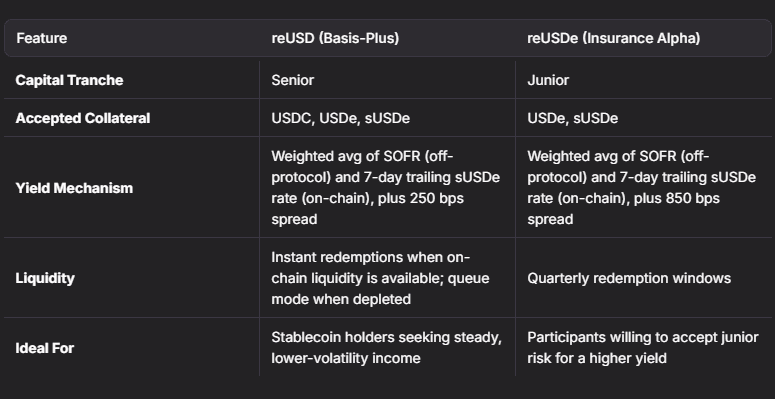
According to the official website, the potential annual yield is in the range of 8-16%, although actual figures may fluctuate depending on the performance of the underwriting portfolio. Its main advantages are:real yieldsupported by real economic cash flow, not just speculation.
Read also: What Is Gram (GRAM)? A Complete Guide to Toncoin's Rebranding and the MTONGA Roadmap
RE Token: Governance and Utility
REis the native token of Re Protocol with the role of:
- Governance token— RE holders can vote in protocol decisions.
- Coordination & Security token— Used in staking or bonding mechanisms to maintain security and accountability.
- Fixed supply— Maximum total supply of 1 billion tokens, without continuous inflation.
Currently the RE price is in the range$0,44with a market cap of around$70 millionand a fully diluted valuation of approximately $442 million. The circulating supply is approximately 159.6 million tokens.
This token has real utility in the ecosystem, not just a token.It's a speculative token. However, like most DeFi governance tokens, its value depends heavily on the growth of adoption and future protocol activity.
Read also: What Is Zignaly? A Review of the ZIG Token and Zignaly's Z-Indexes
Re Protocol Opportunities and Risks
Opportunity
- Access to the giant reinsurance market— The global reinsurance market is worth more than$800 billion. Even if Re Protocol only takes a small portion, the potential scale is enormous.
- Real yield from the real economy— Unlike many DeFi protocols, yields can disappear when a bull run ends.
- Portfolio diversification— Yields with low correlation to traditional crypto assets.
- Onchain transparency— All cash flow and risks are easier to verify than traditional insurance.
Keep tracking other stock tokens such as AMZON, AMDON, and NFLXON as well as MSFTON, then you can start trading on the trusted exchange, only on Bittime.
Risk
- Risiko underwriting— If a large claim occurs in an insurance portfolio, it could impact yield or even capital.
- Regulatory risks— Despite using a regulated structure, DeFi + insurance regulations are still evolving.
- Risiko smart contract— Like other DeFi protocols.
- Liquidity and volatility of RE tokens— Price RE can fluctuate sharply.
Conclusion
Re Protocol (RE) is one of the most exciting DeFi projects today due to its unique approach: connecting on-chain capital with regulated, real-world insurance risks.
With products like reUSD (approximately 7% APY) and reUSDe (up to 12% APY), users can earn real yields from insurance premiums, not just from token inflation.
RE, as a governance token with a limited supply of 1 billion, also has clear utility. However, like any other DeFi investment, this project still carries risks, particularly underwriting and regulatory risks.
For investors seeking yield diversification with exposure to the real economy, Re Protocol is worth exploring further. Always conduct your own research (DYOR), read the official documentation at re.xyz, and consider your risk profile before participating.

Interested in investing in global stocks? Check out tokenized stocks like AAPLX and NVDAX on the Bittime market.
Bittime is a licensed and regulated Digital Financial Asset Trader (PAKD) supervised by Indonesia’s Financial Services Authority (OJK) — where you can buy Bitcoin in Indonesia and hundreds of other crypto assets starting from just Rp10,000. The registration process is fast, secure, and you can get started today.
Track USDT to IDR conversions and monitor your favorite crypto assets in real time. Everything is available in one crypto investment app that you can download for free on the Play Store
Ready to start? Register now on Bittime and execute your investment strategy with a platform trusted by millions of users in Indonesia.
FAQ
What is Re Protocol?
Re Protocol is an onchain protocol that connects stablecoin capital with regulated and fully collateralized reinsurance risk. Users can earn yield from real insurance premiums through products like reUSD and reUSDe.
What is the APY offered by reUSD and reUSDe?
Currently, reUSD offers a yield of around 7%, while reUSDe can reach up to 12% APY. These figures are derived from real-world insurance premiums and can fluctuate depending on portfolio performance.
What is the function of the RE token?
RE is the governance token of the Re Protocol. Token holders can participate in voting on protocol decisions, staking, and security mechanisms. The total maximum supply is 1 billion tokens.
Is Re Protocol safe?
Re Protocol uses a regulated and fully collateralized structure and has an insurance portfolio with a low-volatility risk profile. However, underwriting, smart contract, and regulatory risks remain, as with other DeFi projects.
Where can I buy RE tokens or deposit to reUSD/reUSDe?
You can access the protocol through the official website at re.xyz or app.re.xyz. The RE token is also listed on various centralized and decentralized exchanges. Always verify the official link before making a transaction.
Disclaimer: The views expressed belong exclusively to the author and do not reflect the views of this platform. This platform and its affiliates disclaim any responsibility for the accuracy or suitability of the information provided. It is for informational purposes only and not intended as financial or investment advice.

.png)