What Is QCOMB? Getting to Know Qualcomm's Tokenized Stock in the bStocks Ecosystem
2026-11-20
What is QCOMB? Qualcomm Tokenized bStocks (QCOMB) is a digital asset that allows investors to gain exposure to price movements in Qualcomm Incorporated (NASDAQ: QCOM) shares through blockchain technology. Its introduction expands the range of investment instruments connecting traditional stock markets with the crypto industry.
As the company behind Snapdragon chipsets and 5G technology, Qualcomm plays an important role in the development of the semiconductor and artificial intelligence (AI) industries. However, holding QCOMB is not the same as buying Qualcomm shares directly, particularly when it comes to ownership, dividends, and investor rights.
Key Takeaways
- QCOMB is a tokenized stock that uses Qualcomm shares as its underlying asset within the bStocks ecosystem.
- QCOMB holders can benefit economically from share-price movements and dividend reinvestment without receiving voting rights in Qualcomm.
- Company performance, market liquidity, and the tokenization structure are important factors when evaluating QCOMB.
What Is QCOMB, or Qualcomm Tokenized bStocks?
QCOMB is a tokenized security issued by BTech Holdings Limited to provide economic exposure to Qualcomm shares. The token is issued under the BEP-20 standard on BNB Smart Chain.
Unlike Bitcoin, which has its own characteristics as a digital asset, QCOMB derives its value from shares in a company listed on Nasdaq. This concept falls under the category of Real World Assets (RWA), which refers to the representation of real-world assets through blockchain technology.
QCOMB was introduced on July 7, 2026, alongside several other tokens linked to shares of U.S. companies in the bStocks ecosystem.
Here is a brief overview of QCOMB:
The issuance of bStocks operates within the regulatory framework of the Financial Services Regulatory Authority (FSRA) at Abu Dhabi Global Market (ADGM).
Although commonly referred to as QCOMB crypto or QCOMB coin, this product is fundamentally a tokenized financial instrument, not a cryptocurrency with its own blockchain ecosystem.
Read also: What Is MUUB? Understanding the Tokenized ETF with 2x Exposure to Micron Stock
Understanding Qualcomm and Its Semiconductor Business
Founded in 1985, Qualcomm Incorporated has grown into a major technology company in the wireless communications industry. Its technology is used in a wide range of devices, from smartphones and laptops to smart vehicles.
Qualcomm generates revenue from two main business segments.
1. Qualcomm CDMA Technologies (QCT)
QCT is the division that develops and sells semiconductors and software systems. One of its flagship products is Snapdragon, a chipset platform widely used in smartphones.
In recent years, Qualcomm has expanded the use of this technology into computers, vehicles, and Internet of Things (IoT) devices.
The development of edge AI has also become an important part of its business. This technology enables devices to perform various AI functions directly without constantly relying on cloud services.
2. Qualcomm Technology Licensing (QTL)
In addition to selling chipsets, Qualcomm earns revenue from licensing its technology and intellectual property.
Device manufacturers that use certain communications technologies pay royalties under licensing agreements with Qualcomm. This gives the company a revenue stream beyond semiconductor product sales.
The combination of these two businesses gives Qualcomm a different profile from chipmakers such as Nvidia and AMD.

How Does QCOMB Work in the bStocks Ecosystem?
The concept of bStocks is fairly straightforward from an investor's perspective. Shares that were previously accessible only through capital-market infrastructure are now represented as digital tokens under a mechanism established by the issuer.
In general, QCOMB operates through the following steps:
- Qualcomm shares are held by an appointed custodian.
- The issuer makes tokens available through a 1:1 asset-backing mechanism.
- QCOMB is issued on BNB Smart Chain.
- The token's economic value tracks developments in Qualcomm shares, taking market conditions and product adjustments into account.
- Eligible token holders may use conversion facilities subject to the issuer's terms.
The entire process is governed by rules on share custody, token issuance, and user eligibility in each jurisdiction.
Is QCOMB Backed by Actual Qualcomm Shares?
bStocks uses an asset-backing structure with a 1:1 ratio to the underlying shares.
However, holding backed tokens does not mean that QCOMB investors are registered as Qualcomm shareholders. The shares are held in custody, while investors hold securities representing an economic interest in the underlying asset.
The number of tokens and their share exposure may also be adjusted when dividends are distributed or other corporate actions take place.
Does QCOMB Pay Dividends?
One notable aspect of QCOMB is its mechanism for providing economic benefits from Qualcomm stock dividends.
While conventional shareholders generally receive cash dividends, bStocks uses a reinvestment mechanism. Net dividends, after applicable taxes, fees, and deductions, are reinvested in the same underlying asset.
Eligible users may receive additional QCOMB, while on-chain token holders benefit through a multiplier adjustment.
For example, the September 2026 QCOMB dividend distribution used September 3, 2026, as the record date to determine eligible recipients.
This mechanism allows investment exposure to increase over time. However, dividend reinvestment does not guarantee profits, as the value of Qualcomm shares still depends on market conditions.
Read also: What Is INTWB Tokenized Stock? Price Potential and Leverage Risks
Latest QCOMB Price and Market Data
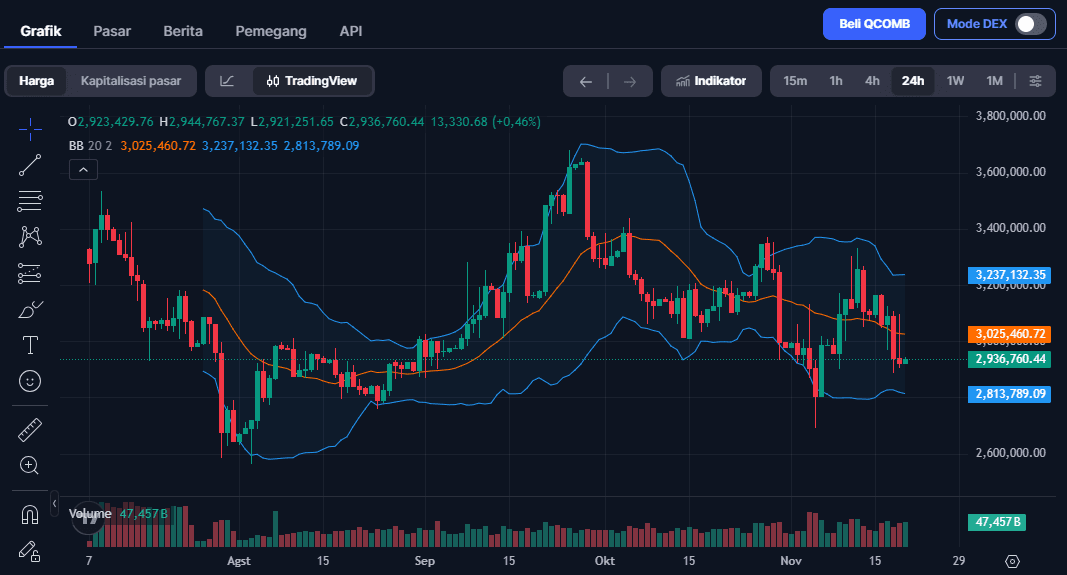
QCOMB price movements are closely linked to Qualcomm shares. However, because the two trade through different market infrastructures, their prices do not always match exactly.
Based on data as of November 20, 2026, here is an overview of the QCOMB market:
Converted into Indonesian rupiah, QCOMB was trading at approximately Rp2.92 million per token based on the market data available at the time of review.
Meanwhile, Qualcomm shares closed at US$162.01 on November 19, 2026, up 1.38% from the previous session.
The difference between the token price and the underlying share price may result from trading hours, spreads, market demand, and data-update timing.
To see how the market is responding to developments at other semiconductor companies, you can also track NVIDIA Tokenized Stock (NVDAX) price and AMD Tokenized Stock (AMDON) on Bittime.
Differences Between QCOMB and Qualcomm Shares (QCOM)
Although they are linked to the same company, QCOMB and QCOM shares offer different investment experiences and ownership rights.
Here is a comparison:
For investors accustomed to digital assets, transaction flexibility is one of the attractions of tokenized stocks.
However, if your goal is to obtain rights as a company shareholder, the two instruments are not equivalent.
Read also: What Is QNTB? Quantinuum Stock Token and How It Works
5 Factors That Influence the Price of QCOMB
Evaluating QCOMB requires an understanding of Qualcomm's business performance and the token's own trading conditions. Here are five factors worth watching.
1. Qualcomm's Financial Performance
Qualcomm released its fourth-quarter fiscal 2026 financial results on November 4, 2026, for the period ending September 27.
The report highlighted challenges in the smartphone business alongside relatively strong growth in the automotive segment.
For the full 2026 fiscal year, Qualcomm reported GAAP revenue of US$43.12 billion, down from US$44.28 billion the previous year.
These figures show that growth in newer businesses has not yet fully offset declining revenue in the company's core segment.
2. Developments in AI and the Semiconductor Industry
Although discussions of AI stocks often focus on companies such as Nvidia, Qualcomm has opportunities through a different approach.
The company focuses on developing processors that enable smartphones, computers, and vehicles to run various AI functions directly.
If consumer adoption of on-device AI continues to expand, demand for chipsets with strong computing performance and low power consumption could increase.
3. Smartphone Demand and 5G Technology
Smartphone chipset sales remain one of the largest contributors to Qualcomm's revenue.
Changes in consumer purchasing habits, device pricing competition, and manufacturers' decisions to use in-house chipsets can affect the performance of this business.
On the other hand, a new generation of AI-powered smartphones may give consumers an additional reason to upgrade their devices.
4. Expansion into Automotive and Data Centers
Qualcomm is working to expand its business to reduce its dependence on the mobile-device market.
In September 2026, the company disclosed a strategic collaboration with Amazon involving server chips, technology, and manufacturing services.
Management also set a target of US$5 billion in data-center revenue for fiscal 2027. The target highlights the company's focus on diversification, although achieving it remains to be seen.
5. QCOMB Trading Liquidity
Qualcomm's fundamentals are not the only consideration when buying or selling QCOMB. Conditions in the token market also determine how easily trades can be executed.
For example, when buyers or sellers are scarce, a large transaction may execute at a price different from the initial estimate.
Investors should therefore consider market depth and spreads rather than relying solely on daily trading volume.
Read also: SNXXB vs. SNDKB: Understanding Their Differences, Risks, and Potential
What Is the Outlook for QCOMB Amid AI and 5G Growth?
Qualcomm's biggest challenge today is building new sources of growth as its smartphone business comes under pressure.
An 89% year-over-year increase in automotive revenue illustrates the company's diversification potential. If its smart-vehicle and data-center businesses grow as targeted, Qualcomm could develop a more diversified revenue mix.
However, this process requires substantial investment in research, product development, and competition for new customers.
Qualcomm must also contend with device manufacturers that are increasingly developing their own chips. This shift could affect the company's market share and revenue over the long term.
For QCOMB investors, these developments should be viewed as fundamental indicators, not as a guarantee that the token's price will rise.
If you want to compare exposure to semiconductor companies with different business models, you can look at the trading pairs NVDAX/IDR and AMDON/IDR available on Bittime.
Benefits and Risks of Investing in QCOMB
Tokenization provides a different way to access stock-linked instruments. Although it offers flexibility, it is important to understand the characteristics of products such as QCOMB before allocating funds.
Potential Benefits of QCOMB
- Exposure to Qualcomm shares: Follow developments at the semiconductor company through a digital asset.
- Fractional purchases: Invest amounts supported by the platform.
- Trading flexibility: Use blockchain infrastructure with potential access to trading outside regular stock-market hours.
- Dividend reinvestment: Receive economic benefits from dividend distributions under the issuer's terms.
- Portfolio diversification: Add exposure to the technology sector beyond conventional cryptocurrencies.
Risks of Investing in QCOMB
A 1:1 share-backing mechanism does not mean that investors' funds are guaranteed or protected against price declines. In addition to evaluating the company's fundamentals, you should understand the product terms and available legal protections.
Read also: What Is CRDOB? Understanding the Credo Technology Stock Token
How Can You Buy QCOMB in Indonesia?
QCOMB was introduced through the QCOMB/USDT trading pair in the Binance bStocks ecosystem. However, not all users can access the product because restrictions apply in certain countries and regions.
Indonesia is among the jurisdictions restricted from accessing bStocks services. As of November 20, 2026, there has been no official confirmation of a QCOMB listing on Bittime.
Before considering Qualcomm stock tokens, there are several things you should check:
- Product availability through licensed platforms in Indonesia.
- Whether the ticker and contract address match the issuer's information.
- Terms governing dividends, ownership, and token redemption.
- Transaction fees and liquidity conditions.
- Jurisdiction-based restrictions on product access.
Waiting until the product becomes available through regulatory-compliant channels is more prudent than disregarding applicable access restrictions.
Tokenized Stock Options Available on Bittime
Although QCOMB's availability has not been confirmed, several tokenized stocks linked to U.S. technology companies can already be explored through Bittime.
Through Bittime's tokenized stock services, you can access various assets linked to U.S. shares starting from Rp10,000, subject to applicable trading terms.
Each token has a different underlying company, product structure, and risk profile. They should therefore not be regarded as direct substitutes for Qualcomm shares.
Conclusion
Understanding QCOMB offers insight into how blockchain technology is expanding access to stock-linked instruments. In Qualcomm's case, the appeal lies in its semiconductor business and its diversification opportunities amid growth in the AI industry.
However, promising prospects for a company do not necessarily make every tokenized product linked to it suitable for all investors. Ownership rights, liquidity, and product availability remain important considerations when making investment decisions.
If you are interested in exploring U.S. stock-linked investments through digital assets, sign up for Bittime to explore various tokenized stock options according to your investment goals and risk profile.
FAQ
What is QCOMB?
QCOMB is Qualcomm Tokenized bStocks, a tokenized security designed to provide economic exposure to Qualcomm shares. It is issued on BNB Smart Chain within the bStocks ecosystem.
What is the difference between QCOMB and Qualcomm shares?
Qualcomm shares provide ownership in the company and associated shareholder rights under applicable rules. QCOMB, by contrast, represents an economic interest in the underlying shares without granting direct voting rights in Qualcomm.
Does QCOMB pay dividends?
QCOMB uses a net dividend reinvestment mechanism after applicable taxes and fees. The benefits may be reflected through additional token exposure or a multiplier adjustment, according to the issuer's terms.
What affects the price of QCOMB?
QCOMB's price is influenced by Qualcomm's financial performance, semiconductor demand, advances in AI technology, and stock-market sentiment. Token liquidity and trading spreads may also cause its price to differ from that of QCOM shares.
Is QCOMB available on Bittime?
As of November 20, 2026, there has been no official confirmation of a QCOMB listing on Bittime. However, other tokenized stocks linked to semiconductor companies, including NVDAX, AMDON, and AVGOON, are already available.
Disclaimer: The views expressed belong exclusively to the author and do not reflect the views of this platform. This platform and its affiliates disclaim any responsibility for the accuracy or suitability of the information provided. It is for informational purposes only and not intended as financial or investment advice.

.png)