What Is Float? How It Works, Rewards, and Tokenized Stocks
2026-10-29
What is Float? Float introduces itself as a memecoin launchpad on Solana that pairs coins with tokenized stocks, also known as tokenized stocks. According to the project's explanation, users continue to transact using SOL, while the platform automatically handles the conversion into the paired asset.
Its appeal lies in distributing trading fees among traders, holders, creators, and the FLOAT token. However, buying a memecoin on Float does not mean owning shares in the company associated with that coin, and the rewards offered still depend on trading activity.
Key Takeaways
- Float offers memecoins paired with tokenized stocks, while users can transact using SOL.
- The project describes allocating 35% of the fees received by Float to trader airdrops and 15% to holder rewards.
- FLOAT has a buyback and burn mechanism announced by the project, but this does not guarantee a price increase.
What Is Float, and How Is It Different from the FLOAT Token?
Float is a platform for launching and trading memecoins. FLOAT is the project's flagship token, which was associated with a token buyback and burn mechanism in its launch announcement.
There are four components to distinguish:
- Float: the launchpad platform.
- FLOAT: the project's flagship token.
- Memecoins on Float: tokens launched by creators through the platform.
- Tokenized stocks: paired assets that are also used for holder rewards under the project's mechanism.
This distinction matters because the benefits and risks of each component are not the same. Rewards for holders of a particular memecoin do not automatically mean that all FLOAT holders receive stock rewards under identical terms.
The initial materials stated that the flagship token had yet to launch. A subsequent announcement included in the source states that FLOAT is already live, so this article's explanation of the token's status follows that announcement.
Read also: What Is SOXLB? Learn How It Works, Its Risks, and How It Differs from SOXL
How Does the Float Launchpad Work?
Launching at a Higher Initial Valuation
According to the project, coins launch at a market capitalization of approximately US$20,000 through a model with deeper initial liquidity. Float compares this with launches at valuations of around US$4,000 discussed in its materials.
The goal is to make acquiring a large portion of the supply require more capital. However, market capitalization is not the same as liquidity funds, so the US$20,000 figure should not be interpreted as the value of assets available in the pool.
This approach is intended to make bundling more difficult. Bundling refers to coordinated purchases intended to acquire a large share of the supply from the outset. Float acknowledges that its mechanism does not eliminate bundling and that creators can still make the first purchase.
Migration to a Raydium Pool
The project states that a coin reaches the graduation stage at a market capitalization of approximately US$150,000. After that, liquidity is moved to a Raydium pool and is claimed to be permanently locked through Burn & Earn.
Liquidity locking should be distinguished from locking tokens held by individual holders. This mechanism does not prevent large holders from selling their tokens or guarantee that the price will hold.
Reusing an Existing Ticker Incurs a Fee
Float states that a ticker can be used for the first time without a special repeat-ticker fee. Subsequent launches using a ticker that already exists on the platform incur a fee of 1 SOL for the treasury.
According to the project, this rule is enforced through a smart contract rather than just the website interface. Its purpose is to limit the creation of imitation tokens that fragment community attention and liquidity.
This rule applies only on Float. Similar tickers can still appear on other platforms, so the token address remains an important identifier to verify.
Read also: Is DIOR Coin Legit? Check the Evidence Behind Its Oil Backing
What Is Float's Connection to Tokenized Stocks?
Float says that memecoins on its platform are paired with tokenized stocks, including assets linked to NVIDIA, Tesla, and McDonald's. The project's materials also mention support for more than 130 other stocks.
As a conceptual example, a creator could launch an AI-themed memecoin paired with a tokenized NVIDIA stock. Users pay with SOL, and the platform handles the conversion required for trading.
A trading pair is different from stock ownership. The memecoin is not NVIDIA stock and is not automatically affiliated with the company.
The rights attached to a tokenized stock also depend on its issuer and the product's terms. Do not assume that it always provides the same voting rights, dividends, or redemption rights as ordinary shares.
Stock pairings can broaden the theme of a memecoin. However, using a particular paired asset does not guarantee that the memecoin's price will follow that stock's movements.
How Are Float's Fees and Rewards Distributed?
Creators can reportedly choose trading fees of 1%, 2%, or 2.5%. After Raydium's share is deducted, the fees received by Float are distributed as follows:
- 35%: USDC airdrops for top traders.
- 35%: FLOAT token buybacks and burns.
- 15%: holder rewards in the paired tokenized stock.
- 5%: creator share.
- 10%: treasury.
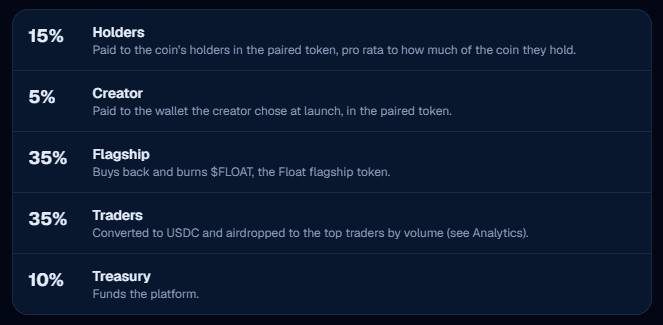
These percentages are calculated from the fees received by Float, according to the project's explanation, rather than from the total transaction value. For example, if the fee pool being distributed is US$100, the trader allocation would be US$35 and the holder allocation US$15.
This example is for illustrative purposes only. The amount received by each wallet still depends on the distribution rules and the activity that qualifies for rewards.
Airdrops for the Top 100 Traders
Float explains that the top 100 wallets ranked by seven-day trading volume share a USDC pool in proportion to their respective volumes. The stated regular schedule is every Monday, with rankings displayed on a leaderboard.
However, one image caption in the initial materials mentions the first distribution taking place the following Wednesday. Because the regular schedule and the first distribution date differ, the date of the initial airdrop should be confirmed through the latest announcement.
Pursuing trading volume also incurs transaction costs and trading risks. Airdrops do not guarantee that all user expenses or losses will be covered.
Holder Rewards in Tokenized Stocks
According to the project, the holder allocation is distributed based on the amount of memecoin held, subject to the applicable requirements. Payments are made in the paired tokenized stock and are said to occur automatically every few minutes.
Recipients need to have a token account for the stock asset. Float states that purchasing through the platform sets up this account, but the implementation should be checked when using the service.
These rewards come from trading fees, not company profit distributions. Therefore, describing them as Tesla or NVIDIA dividends would be misleading.
Read also: What Is the PREDICT Token? An Introduction to Predict.fun and Its Use Cases
What Is the Purpose of the FLOAT Coin?
The project's announcement links FLOAT to an allocation of 35% of fees for automatic on-chain buybacks and burns. A buyback means repurchasing tokens, while a burn reduces the token supply through a token-burning mechanism.
The level of support provided by this mechanism depends on the fees collected and how the mechanism is implemented. If trading activity declines, the funds available for buybacks may also decrease.
This mechanism does not establish a minimum price or guarantee profits for holders. Information about the supply, distribution, and token management authority should still be reviewed separately.
The token address listed in the announcement is:
Bv1a7cEj5aRnJQhMw4kRQqAFesMSd5LwcDnUzq52BMmr
The referenced market page displays the FLOAT/SOL pair on Raydium. This also highlights the importance of distinguishing the flagship FLOAT token from the stock-paired memecoins described in the launchpad concept.
Read also: What Is GenLayer (GEN)? Understanding Its TGE, Tokenomics, and Use Cases
Risks to Understand Before Using Float
The project materials state that its program had not been audited when the explanation was published. Claims about reward distribution, liquidity locking, and automatic buybacks should therefore be distinguished from the results of an audit or independent testing.
Other risks to consider include:
- Memecoin volatility: price declines may exceed the rewards received.
- Liquidity and slippage: transaction size can affect the execution price.
- Tokenized stock issuer: access conditions and user rights depend on third parties.
- Dependence on trading volume: fee distributions may shrink when activity declines.
- Supply concentration: higher bundling costs do not eliminate the dominance of large wallets.
Before connecting a wallet, verify the domain and token address through the project's verified channels. Also review the transactions you are asked to sign, the reward terms, and evidence that the promised mechanisms are being implemented.
If you want to explore other crypto assets, you can sign up for Bittime and review the available assets. Always understand the fees and risks before trading.
Conclusion
Understanding what Float is means looking at how the platform combines memecoin launches, tokenized stock pairs, and fee distribution. This concept offers incentives to several groups of users, with its success depending on activity levels and how the mechanisms are implemented.
FLOAT, memecoins on the platform, and tokenized stocks remain distinct assets. Review updated documentation and on-chain evidence before relying on reward claims when making investment decisions.
Bittime is a licensed Digital Financial Asset Trader (PAKD) platform authorized and supervised by Indonesia's Financial Services Authority (OJK) — where you can buy Bitcoin in Indonesia and hundreds of other crypto assets starting from IDR 10,000. Registration is quick and secure, and you can get started today.
Track the USDT to IDR conversion and the real-time price movements of your favorite crypto assets. Everything is available in one crypto investment app that you can download for free from the Play Store.
Ready to get started? Sign up for Bittime now and put your investment strategy into action with a platform trusted by millions of users in Indonesia.
FAQ
What Is Float (FLOAT)?
Float is a memecoin launchpad on Solana that offers tokenized stock pairs. FLOAT is the project's flagship token, which is associated with buybacks and burns.
Does Buying FLOAT Mean Owning Stocks?
Not automatically. The FLOAT token is different from a tokenized stock, while rights associated with tokenized stock assets depend on the issuer's terms.
How Can You Get a Float Airdrop?
According to the project, the USDC pool is distributed among the top 100 wallets ranked by seven-day trading volume. Check the latest schedule and requirements, as the initial materials contain conflicting information about the first distribution.
Do Memecoin Holders Receive Stock Dividends?
The rewards described come from trading fees and are paid in the paired tokenized stock. This mechanism differs from dividends paid by a company to its shareholders.
Has Float Been Audited?
The provided materials state that the program had not been audited at the time of publication. Its current audit status should be verified through an accessible audit report.
Disclaimer: The views expressed belong exclusively to the author and do not reflect the views of this platform. This platform and its affiliates disclaim any responsibility for the accuracy or suitability of the information provided. It is for informational purposes only and not intended as financial or investment advice.
.png)