What Is DAC Chain (DACT)? A Quantum-Secure Blockchain and Its Functions
2026-11-10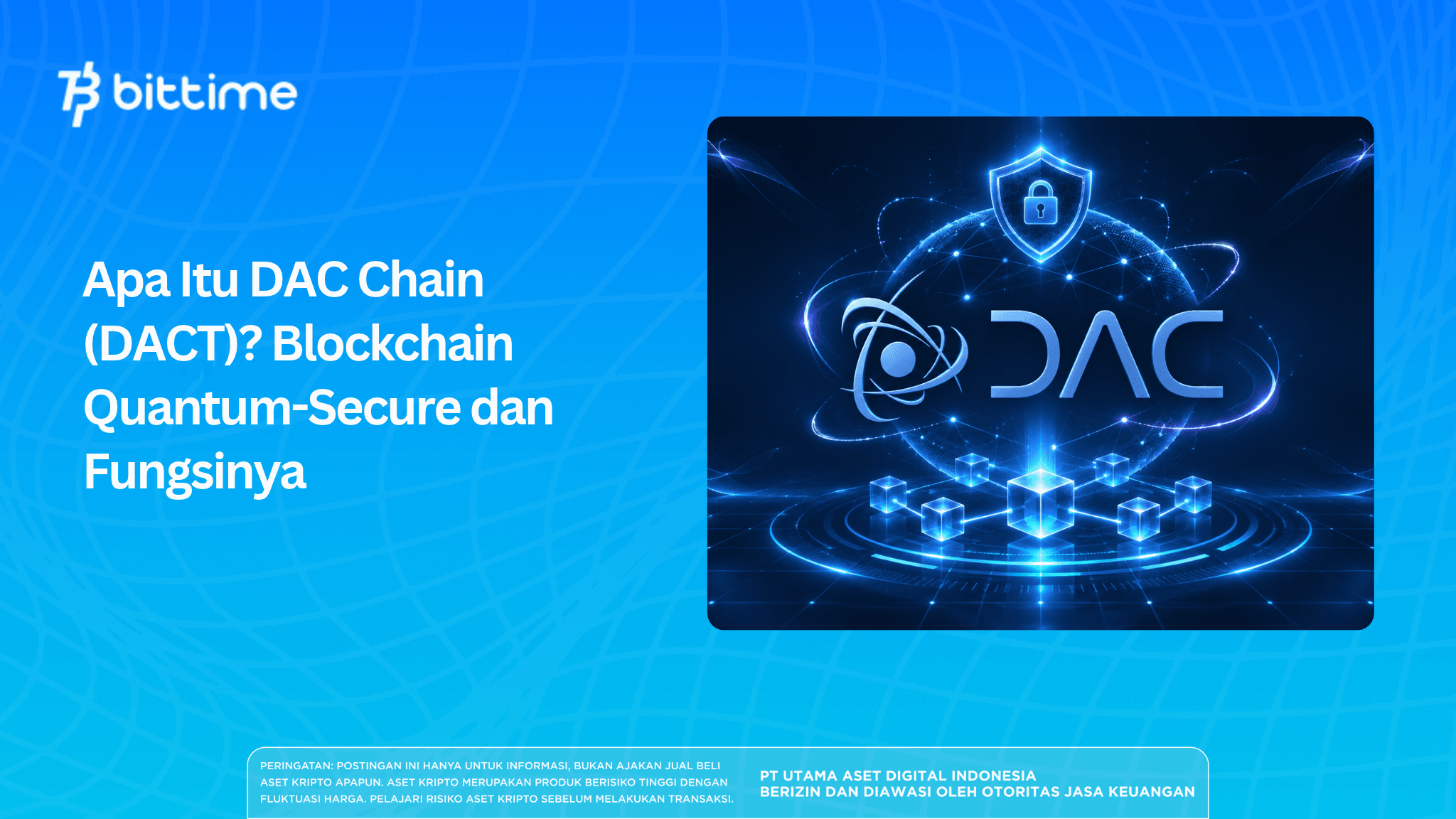
What is DAC Chain? DAC Chain, also known as DAC Quantum Chain, is a Layer 1 blockchain project developing security systems to address potential threats from quantum computers. Through Proof of Quantum Work (PoQW) and Quantum Entropy technologies, the network is designed to be better prepared for advances in computing that could affect the security of blockchain in the future.
Beyond its approach to security, DAC Chain uses a dual-asset system comprising DACT and DACC, each serving a different purpose. The project is also drawing attention ahead of the planned DACT Token Generation Event (TGE) on November 22, 2026. So how does DAC Chain work, what are its tokens used for, and what should investors consider before evaluating DACT as an investment?
Key Takeaways
- DAC Chain is a Layer 1 blockchain project developing quantum-secure technology through Proof of Quantum Work and Quantum Entropy.
- DACT is an ERC-20 token used within the ecosystem, while DACC is the native coin used for network operations.
- DACT has a total supply of 1 billion tokens, with 85.5% allocated through vesting contracts. Its TGE is targeted for November 22, 2026.
What Is DAC Chain (DACT)?
DAC Chain is a Layer 1 blockchain designed to support digital transactions, smart contracts, and decentralized applications, with a particular focus on long-term security.
One of its core objectives is to prepare blockchain infrastructure for advances in quantum computing. Such technology could eventually challenge the cryptographic methods currently used to protect many digital systems.
DAC Chain aims to address this challenge through a quantum-oriented consensus and security architecture while building a network that can support business applications and blockchain-based services.
The network also aims to be compatible with the Ethereum Virtual Machine (EVM). This approach is intended to make it easier for developers to build applications using smart contract technology already familiar within the Ethereum ecosystem.
To support network activity, DAC Chain introduces two digital assets with distinct roles. DACT serves as the ecosystem token, while DACC is used for transactions and the blockchain's operational requirements.
Read also: What Is United Dividend Trust Fund (UDTF)? Understanding This Solana Token
How Does DAC Quantum Chain Work?
As a Layer 1 blockchain, DAC Quantum Chain is designed to operate its own network and transaction-processing mechanisms.
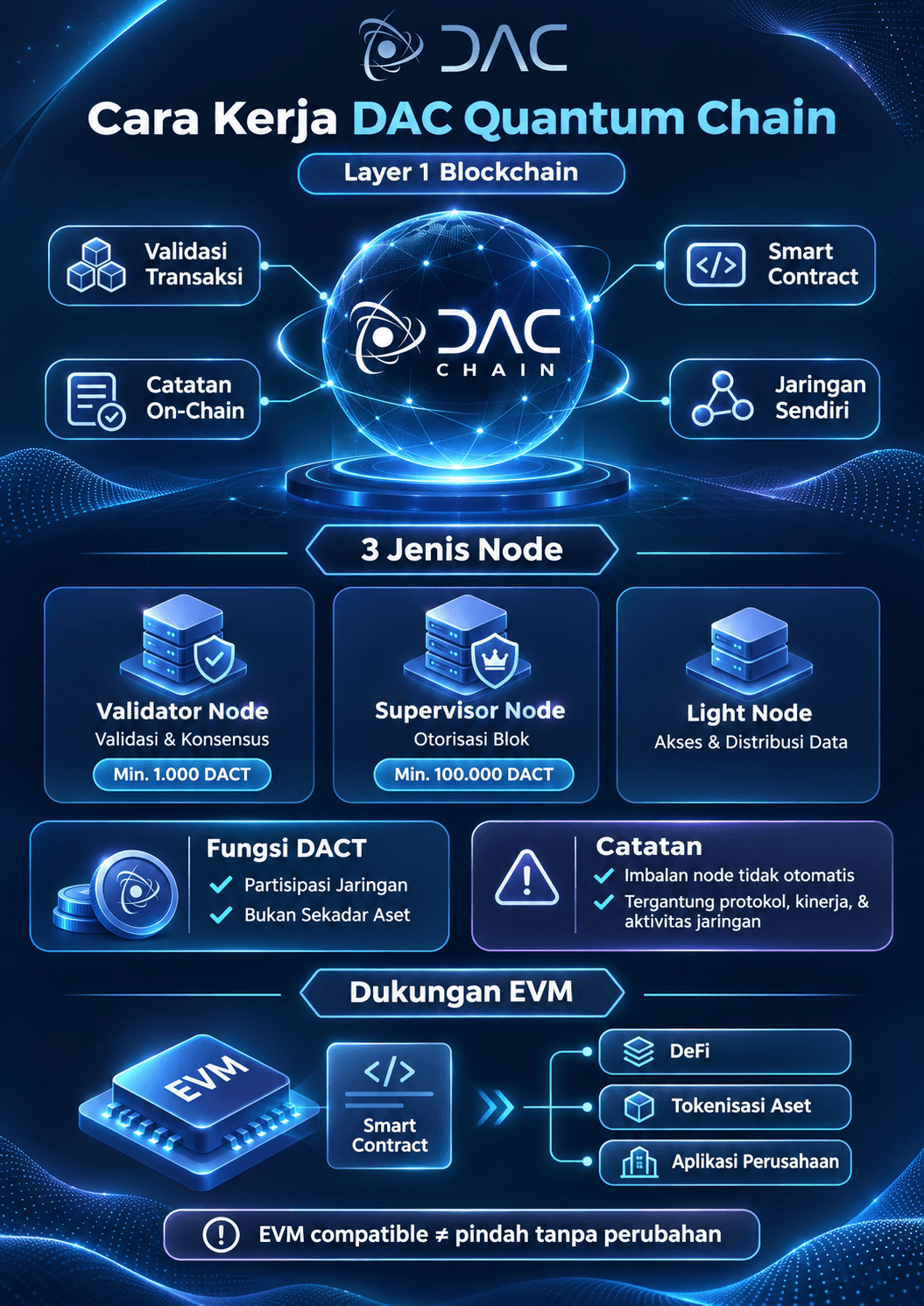
This means DAC Chain is not merely an application running on another blockchain. Its infrastructure is being developed to validate transactions, execute smart contracts, and record activity directly on its own network.
To perform these functions, DAC Chain relies on several types of nodes with different responsibilities.
The Roles of Validator and Supervisor Nodes
DAC Chain's architecture includes three main categories of nodes:
- Validator Node: Participates in transaction validation and the blockchain consensus process.
- Supervisor Node: Supports transaction management and block authorization according to the network's mechanisms.
- Light Node: Helps users access and distribute blockchain information without performing full validation functions.
To activate a Validator Node, users must hold at least 1,000 DACT. The holding requirement for a Supervisor Node is 100,000 DACT.
These requirements give DACT a role in network participation beyond simply being a tradable asset.
However, holding tokens does not automatically guarantee earnings from running a node. Rewards still depend on protocol rules, node performance, and network activity.
Smart Contract and EVM Support
EVM compatibility is one of the features DAC Chain aims to offer developers.
With this support, smart contract applications could be developed or adapted to run on DAC Chain. Potential use cases include DeFi services, asset tokenization, and enterprise blockchain applications.
Nevertheless, successful integration depends on infrastructure readiness and each application's technical requirements. EVM compatibility does not mean every Ethereum application can be migrated without modification.
Understanding DAC Chain's Quantum-Secure Technology
Security is one reason DAC Chain places quantum technology at the center of its development efforts.
Many blockchains currently rely on cryptographic methods to secure transactions and asset ownership. However, as quantum computers become more capable, they could alter the security of certain cryptographic algorithms.
To prepare for this possibility, DAC Chain is developing two technological approaches: Proof of Quantum Work and Quantum Entropy.
Proof of Quantum Work (PoQW)
Proof of Quantum Work is a consensus mechanism being developed as part of DAC Chain's architecture.
The approach is intended to help the network address security challenges that may emerge as quantum computing capabilities advance. PoQW is one of the technologies that distinguish DAC Chain's proposed architecture from blockchains using more established consensus mechanisms.
However, its effectiveness still needs to be assessed through implementation and technical testing.
Unlike Proof of Work or Proof of Stake, which have seen widespread adoption, PoQW does not yet have a comparable track record of real-world use and independent testing.
Claims about its security advantages should therefore be understood as part of an ongoing technology development effort, not as proof that the system is already fully resistant to quantum attacks.
Quantum Entropy
In addition to PoQW, DAC Chain is developing an approach based on Quantum Entropy.
Put simply, Quantum Entropy involves using quantum physical processes to generate randomness that is difficult to predict. Random numbers play an important role in digital security, particularly in generating cryptographic keys and certain authentication processes.
The quality of a randomness source can affect system security. However, Quantum Entropy alone cannot guarantee comprehensive protection against quantum-computer attacks.
Blockchain security also depends on the algorithms used, their implementation, and the network's ability to withstand different types of attacks.
Accordingly, the term quantum-secure is best understood, in DAC Chain's context, as a technology goal currently under development. Its resilience still needs to be demonstrated through testing and independent security assessments.
Read also: What Is USAR? Solana Token, Contract, and Risks
What Is the Purpose of the DACT Token in the DAC Chain Ecosystem?
DACT, or DAC Token, is an Ethereum-based token that follows the ERC-20 standard. It has a fixed total supply of 1 billion tokens.
Its functions relate to user participation and access to services across the DAC Chain ecosystem.
The project's documentation describes several potential uses for DACT, including:
- Node activation: Serves as one of the requirements for operating Validator and Supervisor Nodes.
- Ecosystem participation: Supports user involvement in network activities and development.
- Service access: Is designed for use in specific services, such as notarization, private servers, and API integrations.
- Incentive mechanisms: Relates to participation requirements for the DACC-based reward system.
- Governance: Supports the planned framework for user participation in ecosystem governance.
These roles link DACT's utility to the ecosystem's operational and development needs.
However, token utility does not necessarily translate into strong market demand. Its economic value will also depend on user numbers, network activity, and how widely DAC Chain's services are actually adopted.
Read also: What Is SMHB? VanEck Semiconductor ETF Token and Its Risks
Differences Between DACT Token and DACC Coin
One important feature of DAC Chain is its use of two digital assets within a single ecosystem.
DACT and DACC are both associated with DAC Chain, but they serve different purposes.
DACT supports participation and specific activities within the ecosystem. DACC, by contrast, is used to pay transaction fees, execute smart contracts, and support the node reward system.
This separation is part of DAC Chain's dual-token economy design.
The aim is to distinguish everyday blockchain usage from the ecosystem token's functions, which follow a separate distribution mechanism.
With this system, DAC Chain aims to build a more flexible network economy. Its benefits, however, must still be demonstrated through actual transaction activity, DACC usage, and ecosystem growth.
Read also: What Is STXB? Seagate Stock Token, Price, and Risks
DACT Tokenomics: Total Supply and Token Distribution
Tokenomics is an important consideration for anyone looking to understand DACT crypto, particularly ahead of its planned public launch.
DACT's total supply is capped at 1,000,000,000 tokens. Of this amount, 855 million DACT, or 85.5%, is held in vesting contracts that govern the gradual release of tokens.
The remaining 145 million DACT falls outside these seven vesting contract allocations.
DACT Allocation Breakdown
The following distribution is based on the project's vesting documentation:
The largest allocation is the Reserve category at 20.5% of the total supply. Team and Institutional each receive 15%.
This breakdown shows that most tokens are subject to different distribution terms depending on the recipient category.
For investors, this information is important for understanding how the available supply of DACT could change over time.
What Is the DACT Vesting Schedule?
Vesting is a mechanism that determines when tokens from an allocation can be released.
In practice, allocation recipients do not necessarily receive all their tokens at once. Some tokens only become available after a waiting period or according to a specified schedule.
DAC Chain uses a combination of cliff and linear vesting. A cliff is the waiting period before tokens start becoming available, while linear vesting releases tokens gradually over a defined period.
Some of DACT's vesting schedules include:
- Team: A 12-month cliff with a total vesting period of 36 months.
- Marketing: A 2-month cliff with 36 months of vesting.
- Enterprise: A 12-month cliff with 48 months of vesting.
- Institutional: A 3-month cliff with 36 months of vesting.
- Grant / Airdrop: No cliff, with vesting over 24 months.
For the Grant/Airdrop allocation, vesting is calculated using October 22, 2026, as the reference date.
This means the token release schedule encoded in the contracts does not fully align with the public TGE currently planned for November.
It is also important to understand that tokens unlocked through vesting do not automatically enter the market. They may remain in recipients' wallets without being traded.
Why Should Investors Pay Attention to Token Unlocks?
Token unlock schedules affect the amount of supply that could become available.
When large quantities of tokens become transferable, selling pressure could increase if allocation holders decide to sell. The impact, however, will still depend on market demand and liquidity conditions at the time.
Therefore, total supply alone is not enough to assess DACT's tokenomics.
Investors should also examine unlock schedules, actual circulating supply, and ownership distribution to gain a more complete picture.
Read also: What Is Lia (LIA)? Token Utility, Tokenomics, and the LIA Airdrop
When Is the DACT TGE Scheduled?
A Token Generation Event (TGE) is an important milestone in the launch of a crypto asset. It typically involves creating tokens, distributing the initial allocation, or making tokens available under the project's specified mechanisms.
DACT's TGE was initially planned for October 22, 2026. However, the public launch date was subsequently moved to November 22, 2026, at 00:00 UTC.
This change in date does not automatically alter every vesting schedule already recorded in the contracts.
Project documentation indicates that the vesting contracts use October 22, 2026, as their reference date. As a result, some vesting processes may begin before the public TGE takes place.
As of November 10, 2026, the November 22 date remains a target and may change based on announcements from the developers.
The TGE date is also not necessarily the same as an exchange listing date. DACT trading availability must be confirmed through official announcements from the relevant platforms.
DAC Chain's Advantages and Risks
DAC Chain presents several concepts worth following, particularly for those interested in Layer 1 blockchains and digital security.
However, its technological potential should be considered alongside the challenges the project still faces.
Potential Advantages of DAC Chain
1. A Security Approach Focused on Quantum Technology
DAC Chain is developing PoQW and Quantum Entropy to address long-term security challenges. This focus is one of the project's defining features as interest in quantum computing continues to grow.
2. A Dual-Asset System with Distinct Roles
Using DACT and DACC enables the project to separate ecosystem participation from network transaction fees. This approach is designed to prevent day-to-day operations from relying entirely on a single asset.
3. EVM-Based Development Support
EVM compatibility could make development easier for teams already familiar with Ethereum technology. It may also help expand the range of applications if the network infrastructure performs as planned.
4. A Focus on Enterprise Use Cases and Asset Tokenization
DAC Chain also targets enterprise blockchain services, DeFi applications, and Real World Assets (RWA). However, the success of these initiatives still depends on actual adoption by businesses and users.
What Are the Risks?
Several factors deserve attention when assessing DAC Chain and DACT's potential:
- Technology risk: Some features still require further development, testing, and real-world validation.
- Security risk: Quantum-secure claims need to be supported by technical validation and independent audits.
- Token distribution risk: Unlocking vested allocations could affect the available token supply.
- Liquidity risk: Limited trading activity could lead to price volatility and wide bid-ask spreads.
- Adoption risk: Project growth depends on network activity, developers, and users adopting its services.
Given these factors, DAC Chain should not be assessed solely on the technology it promises or the excitement surrounding its TGE.
Technical documentation, roadmap progress, transparent token distribution, and actual network usage are more relevant indicators to monitor.
Read also: What Is UODF Coin? Understanding the Solana Token and Its Dividend Claims
What Is the Outlook for DAC Chain and DACT Crypto?
DAC Chain's outlook will largely depend on whether the project can turn its technological plans into infrastructure that people actually use.
The concept of quantum-secure blockchain has long-term relevance. However, technological appeal alone is insufficient without reliable network performance, tested security, and applications with real users.
DAC Chain has introduced a testnet environment and is developing its Interstellar network as part of this process.
This testing stage can help the project evaluate its technology before broader deployment. Even so, success on a testnet does not necessarily indicate the level of adoption the network will achieve at scale.
Developments worth monitoring include validator activity, the number of applications, smart contract usage, security audit results, and the deployment of DAC Chain-based services.
For DACT, the price outlook will also be affected by liquidity, market demand, and the token distribution schedule.
In other words, ecosystem growth and an increase in DACT's price will not necessarily happen together.
If you want to follow the latest blockchain projects and crypto assets, you can register with Bittime to explore market information and digital asset news. For DACT specifically, first verify whether trading is available by checking the platform's official asset listings.
Conclusion
Understanding DAC Chain means getting to know a Layer 1 blockchain project that aims to prepare network security for advances in quantum computing. Through Proof of Quantum Work and Quantum Entropy, DAC Chain is developing a technological approach that differs from those used by many conventional blockchains.
Within the ecosystem, DACT and DACC serve separate functions. DACT is used for network participation and services, while DACC supports transactions and blockchain operations.
Ahead of the planned TGE on November 22, 2026, DACT's tokenomics are important to examine, particularly its total supply, distribution, and vesting schedules.
Despite its promising concepts, DAC Chain still needs to demonstrate success through technology development, security testing, and user adoption. For anyone interested in the project, understanding its risks and monitoring official updates is more important than focusing solely on potential token price increases.
Bittime is a Digital Financial Asset Trader (PAKD) licensed and supervised by Indonesia's Financial Services Authority (OJK) — where you can buy Bitcoin in Indonesia and hundreds of other crypto assets starting from IDR 10,000. Registration is quick and secure, and you can get started today.
Track the USDT to IDR conversion rate and the prices of your favorite crypto assets in real time. Everything is available in one crypto investment app that you can download for free from the Play Store.
Ready to get started? Sign up for Bittime now and put your investment strategy into action on a platform trusted by millions of users in Indonesia.
FAQ
What is DAC Chain, and how does it work?
DAC Chain is a Layer 1 blockchain project developing infrastructure with a quantum-secure approach. The network is designed to process transactions and execute smart contracts through mechanisms that include Proof of Quantum Work and Quantum Entropy.
Is DAC Chain a Layer 1 blockchain?
Yes. DAC Chain is being developed as a Layer 1 blockchain with its own infrastructure and consensus mechanism. The project also aims to offer EVM compatibility to support the development of smart contract applications.
What is the difference between the DACT token and the DACC coin?
DACT is an ERC-20 token on Ethereum used for network participation and ecosystem services. DACC is DAC Chain's native coin, used for transaction fees, smart contract execution, and node rewards.
Is DAC Chain truly resistant to quantum-computer attacks?
DAC Chain is developing Proof of Quantum Work and Quantum Entropy as part of its quantum-secure architecture. However, these technologies still require proof and independent assessment before they can be considered to provide comprehensive protection against quantum-computing threats.
What is DACT's total supply, and when is its TGE scheduled?
DACT's total supply is capped at 1 billion tokens, with 85.5% allocated through vesting contracts. The public TGE is targeted for November 22, 2026, while the vesting contracts use October 22, 2026, as their reference date.
Disclaimer: The views expressed belong exclusively to the author and do not reflect the views of this platform. This platform and its affiliates disclaim any responsibility for the accuracy or suitability of the information provided. It is for informational purposes only and not intended as financial or investment advice.

.png)