What Is BrCA? Brazil's Carbon Token Backed by CPR Verde on Solana
2026-07-28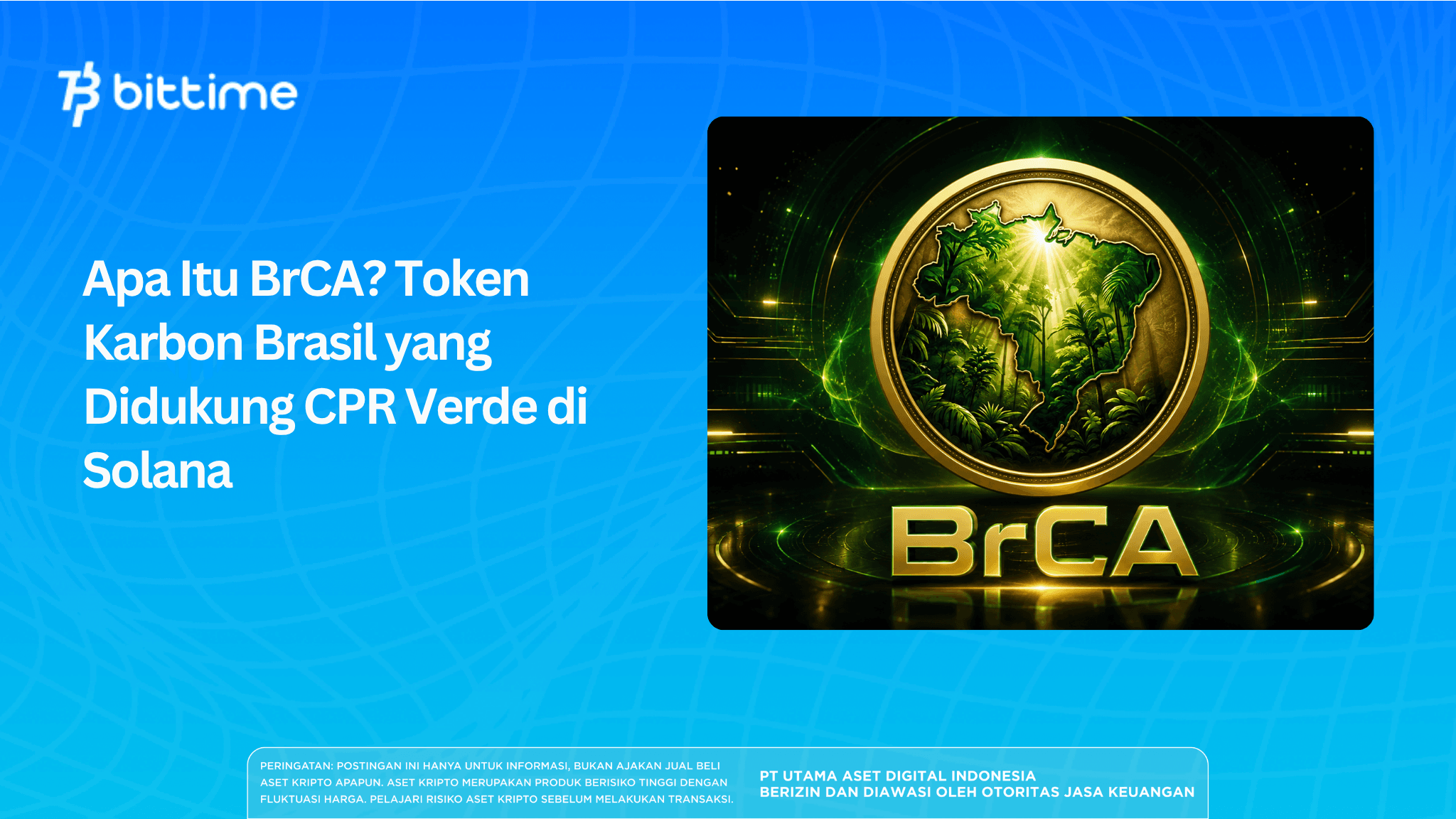
What is BrCA? Brazil Carbon Asset, or BrCA, is a token Real World Asset on the Solana network, which was developed to connect Brazilian environmental assets with blockchain markets.
According to the project description, each BrCA is designed to represent one metric ton of carbon dioxide equivalent (CO₂e) attributed to CPR Verde.
Key Takeaways
- BrCA is marketed as an RWA token on Solana that represents one metric ton of CO₂e from Brazilian environmental assets.
- CPR Verde is an agribusiness credit instrument for conservation financing, not an automatic carbon credit that can be used in all offset schemes.
- BrCA's relationship with B3 must be proven through a CPR registration number and backup documentation; the presence of B3 infrastructure does not necessarily mean the token has B3 endorsement.
What is BrCA?
BrCA stands for Brazil Carbon Asset, a crypto token that embodies the concept of environmental asset tokenization, or green RWA.
This token was issued on Solana network and can be traded via the BrCA/SOL pair on decentralized exchanges.
The project description states that each token represents one ton of CO₂e conserved within the Brazilian biome.
This real-world value is said to come from the CPR Verde, or Cédula de Produto Rural Verde. Blockchain is then used as a digital layer to record ownership and movement of tokens.
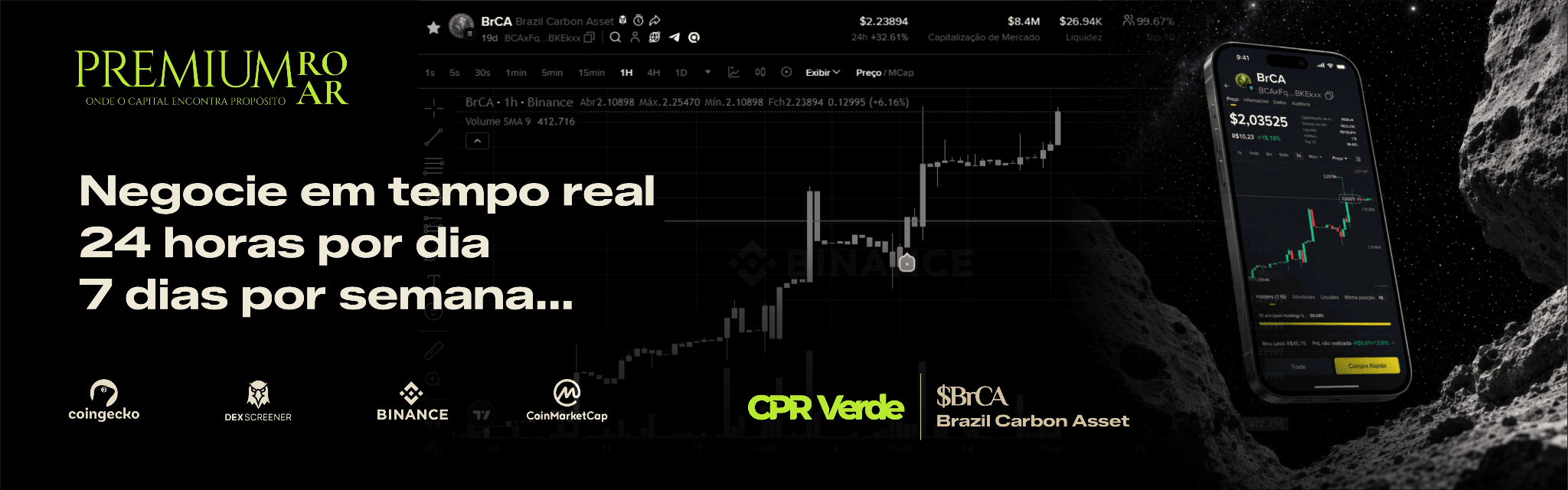
The BrCA mint address on the Solana network displayed on the blockchain explorer is:
BCAxFqs3VJGTmVsBsyYxWL2zZG6xR1kAynCKkhBKEkxx
This address needs to be verified every time a user purchases BrCA. The token name and ticker are not proprietary, so others can create counterfeit tokens with the same symbol.
BrCA should not be judged solely on the carbon narrative or RWA terms. Its economic value depends on several layers:
- The validity of the CPR Verde which is used as the underlying asset.
- Quality of CO₂e measurement methodology.
- Credibility of CPR auditors and issuers.
- Matching the number of tokens to the reserve assets.
- The ability of token holders to acquire or redeem environmental benefits.
- Trading liquidity in the secondary market.
- Legal compliance in Brazil and the user's country.
A failure in any of these layers could cause the token price to diverge significantly from the value of the environmental assets it claims to support.
Read also:What Is Catecoin (CATE)? Solana's Cat Meme Coin
What is CPR Verde?
CPR Verde is a special form of the Cédula de Produto Rural, Brazil's agribusiness credit instrument. It is used to support the conservation and restoration of native forests and biomes.
The issuer can be a rural producer, an association, or a cooperative. The issuer makes a commitment to produce or maintain specific environmental benefits as part of the obligations under the instrument.
The issuance of a CPR Verde must be accompanied by certification from an external auditor or third party explaining the underlying environmental product or service.
Environmental benefits that can be associated with CPR Verde include:
- Conservation of native vegetation.
- Forest area restoration.
- Reduction of greenhouse gas emissions.
- Carbon sequestration or storage.
- Biodiversity protection.
- Conservation of soil and water resources.
- Conservation of protected areas.
This instrument provides producers with the opportunity to obtain financing in exchange for conservation activities. Companies or other buyers can gain exposure to the environmental outcomes promised in the CPR.
For those of you who want to monitor the development of RWA and other crypto assets, register at Bittime to explore the available asset options. Also, read technology, blockchain, and tokenization updates on the Bittime Blog before making a decision.
Is CPR Verde the Same as Carbon Credits?
Not always.
Carbon credits generally represent one ton of CO₂e emissions that have been reduced, avoided, or absorbed based on a specific methodology. These credits typically go through a process of measurement, reporting, verification, issuance, and retirement to prevent multiple claims.
A CPR Verde is a legal instrument containing a promise to deliver a product or environmental benefit. This instrument can be related to carbon, but the existence of a CPR Verde does not automatically prove that the asset meets all the standards of a carbon credit program.
Before calling BrCA a carbon credit ready to be used for offsets, investors need to find answers to several questions:
- What carbon methodology is used?
- Who calculates and verifies CO₂e?
- Have emission reductions occurred or are they still a commitment?
- Has the asset been published on a specific carbon registry?
- How are the risks of fire, deforestation, or carbon sequestration addressed?
- Can one environmental asset be sold through more than one instrument?
- What is the retirement process after the token is used?
Without that information, BrCA is safer understood as a token claimed to be backed by CPR Verde-based environmental assets, rather than being directly equated with all types of carbon credits.
Read also: What Is SLVR.fun? An Introduction to the Ethereum-Based Grid Mining Protocol
How Does BrCA Work?
Conceptually, the BrCA mechanism can be divided into two layers: the real-world layer and the blockchain layer.
1. CPR Verde Publication
Manufacturers or qualified parties issue a Verde CPR based on environmental conservation or restoration activities. The document must describe the obligations, location, validity period, environmental product, and the certifying party.
2. Instrument Registration
CPRs are instruments that must be registered with an authorized central registration agency or depository. Registration aims to clarify the instrument's existence, issuer, characteristics, changes in ownership, and any legal obligations that may be attached.
3. Verification of Environmental Benefits
An independent party should verify the land, vegetation, methodology, carbon content, and conservation period. Verification can involve geospatial data, satellite imagery, field surveys, and documentation of land ownership or management.
4. Asset Tokenization
The project then issued BrCA on Solana. According to the published design, one token represents one metric ton of CO₂e from CPR Verde, which supports the ecosystem.
5. Trading in the Secondary Market
Token holders can transfer or trade BrCA through wallets and decentralized exchanges that support Solana. On-chain transactions are publicly visible, including wallet addresses, transfer amounts, and liquidity pool activity.
6. Redemption or Retirement
This layer is crucial, but needs to be explained in more detail by the project. Investors need to know whether the token can:
- Exchanged for rights to CPR Verde.
- Used to claim a ton of carbon benefits.
- Burned when environmental benefits are used.
- Redeemed into certain payments.
- Used only as a trading asset.
Without a clear redemption or retirement mechanism, tokens can change hands on the blockchain without ensuring that their carbon benefits are used only once.
Read also:What Is XSolut AI (XST)? An Infrastructure Project for America's AI Future
What Network Does BrCA Operate On?
BrCA operates on the Solana network. The token uses the Solana token standard and is traded against SOL through the liquidity pool on Raydium.
The choice of Solana provides several characteristics:
- Transactions can be completed quickly.
- Network costs are usually relatively small.
- The token easily integrates with Solana wallets.
- Token activity can be traced using a blockchain explorer.
- BrCA can be used in DeFi applications that support it.
- Liquidity pools enable trading without a conventional order book.
However, blockchain only verifies digital activity. Solana can show the number of tokens, transactions, wallets, and contracts, but it cannot independently prove that a forest is still protected or that CPR Verde is legitimate.
This is the main risk of RWA: the blockchain can be transparent, while the underlying assets still depend on off-chain processes.
Read also:What is o1.exchange? A Meta DEX Aggregator Backed by Coinbase Ventures and a16z
What are the advantages of BrCA as an environmental asset?
Opening Access to Environmental Assets
Tokenization allows assets previously only available through institutional transactions to be divided into digital units. Users can gain exposure without having to purchase entire CPR Verde units.
Traceable Transactions
BrCA transfers can be monitored on the blockchain. This transparency is superior to ownership records, which are entirely managed through closed databases.
Global Liquidity Potential
Solana tokens can be traded by users from any region as long as they have a wallet and access to a platform that supports it.
However, global tradability doesn't necessarily mean a token is always liquid. Actual liquidity depends on the amount of assets available in the pool and the activity of buyers and sellers.
Connecting Conservation and Finance
If the legal structure works as designed, BrCA could help connect environmentally conscious producers with buyers seeking exposure to carbon and conservation assets.
Easier to Understand Units
Representing one token for one metric ton of CO₂e can simplify reporting and record-keeping. However, this simplicity is only valuable if each token is truly backed by a verified environmental unit.
Read also:What is Allora Coin (ALLO)? How it Works and Tokenomics
How is BrCA related to B3?
B3 is Brazil's financial market infrastructure that provides a system for the centralized registration and storage of CPRs, including the Verde CPR. The system was developed to fulfill listing obligations and facilitate trading of instruments in the over-the-counter market.
The first Verde CPR recorded through the infrastructure was registered in 2022. This event demonstrated that Verde CPRs can be recorded and administered through existing financial market systems.
However, this relationship needs to be understood carefully.
BrCA is not a traded stock on B3, and there is no evidence from reviewed public materials that B3 directly endorses the BrCA token. B3 provides the registration infrastructure for CPR Verde in general. This is different from stating that B3 guarantees the BrCA token or its price.
In order for the specific relationship of BrCA to B3 to be verified, projects should ideally publish:
- Registration number of each CPR Verde.
- Name of CPR issuer.
- Issue and maturity date.
- Registrar or depository institution.
- Certification company identity.
- Area and coordinates of environmental assets.
- The number of tonnes of CO₂e reserved.
- Proof that the CPR was not pledged or sold twice.
- One-to-one relationship between CPR and BrCA supply.
- Periodically provide audit recommendations.
Without a registration number to match, the presence of the CPR Verde facility at B3 is not sufficient to prove that the entire BrCA supply has underlying assets recorded there.
A more accurate conclusion is that B3 could be part of the off-chain infrastructure for recording Verde's CPR, while Solana would be the on-chain infrastructure for BrCA. The specific relationship between the two still requires documentary evidence from the projects.
Read also: What Is Jimothy the Raccoon (JIMOTHY)? The Rising Solana Meme Coin
Who is behind the BrCA project?
BrCA was developed within the ROAR Premium ecosystem. Public information links the project to Rogério Araújo, who is said to be the company's founder and the initiator of the environmental asset tokenization initiative.
Project materials describe BrCA as an effort to build financial infrastructure for carbon assets by combining:
- CPR Verde.
- Brazil's environmental assets.
- RWA tokenization.
- Solana Network.
- Digital asset trading.
- Tracking environmental benefits.
Investors need more than just knowing the company name or founder. The RWA team also needs to possess competencies in:
- Brazilian agribusiness law.
- Forest conservation.
- Carbon measurement.
- Environmental audit.
- Smart contract.
- Reserve management.
- Digital asset compliance.
- Risk management.
Read also:What Is RobinVista? Getting to Know the Fixed-Fee DEX on Robinhood Chain
BrCA Market Data and Liquidity
BrCA is traded through the BrCA/SOL pair. At the time of data review, one pool displayed a capitalization, or fully diluted valuation, of approximately $11.7 million, but liquidity of only around $2,900.
Six-hour activity on the pool was recorded at around $7,200, with a very limited number of traders. These figures are subject to change rapidly.
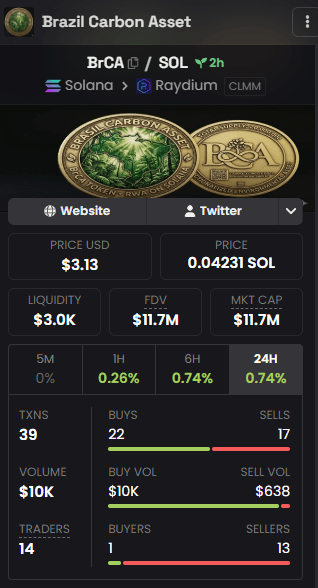
It's important to note the significant difference between token valuation and pool liquidity. Market capitalization is the product of the last price multiplied by the number of tokens, while liquidity indicates the assets actually available to facilitate transactions.
A thin pool can cause:
- High slippage.
- Prices are subject to change due to small transactions.
- Difficulty selling large positions.
- Price differences between platforms.
- Price manipulation.
- Valuations that look large without market depth.
- Losses when liquidity providers withdraw assets.
The automated audit label on the aggregator should not be interpreted as a comprehensive audit of smart contracts or their underlying assets. The platform also warns that automated audits can be inaccurate.
Read also:What Are Hood Stocks ($HSTOCKS)? How They Work and the Risks
What are the risks of investing in BrCA?
1. Risk of Proof of Reserves
Investors need to ensure that the amount of CPR Verde and tons of CO₂e is exactly equal to or greater than the tokens in circulation. Without proof of reserves, it can be difficult to align the token amount with environmental assets.
2. Legal Risks
Token ownership does not necessarily confer direct legal rights to the Verde CPR. Documents should clarify whether BrCA holders are creditors, beneficiaries, owners of environmental claims, or simply owners of digital tokens.
3. Greenwashing Risk
The terms carbon, forests, and ESG can be used to create a positive image. Investors should examine methodologies, auditors, project locations, and actual conservation outcomes.
4. Double Counting Risk
The same environmental benefit cannot be sold or claimed multiple times. Projects need a mechanism to prevent a single ton of CO₂e from being used by multiple tokens or buyers.
5. Risk of Permanence
Carbon stored in forests can be released again due to fires, logging, land-use changes, or disasters. Buffers or offsetting mechanisms must be in place to address these reversals.
6. Liquidity Risk
Low pool liquidity can lead users to buy at high prices and sell at much lower prices. The values displayed on the chart do not guarantee execution prices.
7. Smart Contract Risk
Contract errors, administrator access, mint authority, or wallet management can affect token security.
8. Custodial Risk
The CPR documents and legal rights to the underlying assets reside outside the blockchain. If the custodian or management company experiences problems, the tokens can remain in circulation even if the underlying assets are not functioning properly.
9. Carbon Price Risk
Carbon pricing varies based on methodology, location, project quality, credit life, and target market. Not all tons of CO₂e have the same economic value.
10. Regulatory Risk
The status of RWA tokens may vary by country. Changes in regulations regarding digital assets, securities, carbon markets, or cross-border investments may impact user access.
11. Publisher's Risks
CPRs inherently contain obligations from their issuers. If the issuer fails to fulfill its commitments, token holders may face complex legal proceedings.
12. Token Value Risk Is Not the Same as Asset
The price of BrCA on DEXs is determined by demand and liquidity. This price can be above or below the ton value of CO₂e claimed on the underlying asset.
Read also:What Is Pon (PONS)? The Robinhood Coin Meme That's Going Viral
Checklist Due Diligence BrCA
Before considering a purchase, check:
- Correct token mint address.
- Total dan circulating supply BrCA.
- Status mint authority dan freeze authority.
- Token distribution to large wallets.
- Liquidity and liquidity provider status.
- CPR Verde registration number.
- Identity of the issuer of each CPR.
- Identity of the auditor or certification company.
- Carbon accounting methodology.
- Coordinates and legal status of land.
- Monitoring reports via satellite or field inspection.
- One-to-one tokenization mechanism.
- Redemption and retirement policies.
- Proof of reserves terbaru.
- Legal rights received by token holders.
- Risks when CPR is due or fails to be fulfilled.
The more information that is not available, the more investors will rely on trust in the issuer.
How to Buy BrCA?
BrCA can be obtained through decentralized exchanges on the Solana network. The process requires a non-custodial wallet and SOL.
1. Prepare a Solana Wallet
Use a wallet that supports the Solana token. Store your seed phrase offline and never share it on websites, private messages, or forms.
2. Have SOL
SOL is needed as a payment asset in trading pairs as well as to pay network fees.
3. Verify Token Address
Make sure the mint address entered is:
BCAxFqs3VJGTmVsBsyYxWL2zZG6xR1kAynCKkhBKEkxx
Verify the address using blockchain explorer and the project's official channels.
4. Connect Wallet to DEX
Open a trading platform that offers the BrCA/SOL pair, then connect your wallet. Ensure the site domain is correct to avoid phishing.
5. Check Liquidity and Price Impact
Don't just look at the price per token. Check:
- Total liquidity value.
- Estimated tokens received.
- Price impact.
- Slippage.
- Trading volume.
- Comparison of purchase value and estimated selling value.
On thin pool assets, even small transactions can result in large price changes.
6. Perform a Trial Transaction
Consider small transactions first. This step helps ensure tokens can be purchased, received by wallets, and resold.
7. Transaction Confirmation
Check the number of BrCAs, network fees, and minimum received before granting approval.
8. Save Notes
Record the entry price, fees, token amount, transaction address, and reason for purchase. Determine your risk limit before the price moves.
BrCA's availability on centralized exchanges is subject to change. Check the asset listings on the platforms directly and don't assume a token is available just because it appears in an article.
Please ensure BrCA availability is checked directly as this article does not state that the token has been listed on Bittime.
Start trading SOL/IDR with Bittime here!
Conclusion: Is BrCA Worth Caring About?
BrCA is noteworthy as an experiment that attempts to connect Brazilian environmental conservation, CPR Verde, and the Solana blockchain. The idea is relevant to the growth of the RWA sector and the need for transparency in environmental asset markets.
BrCA is better suited to be monitored as an early stage RWA asset rather than being directly considered as a replacement for institutional carbon credits.
Use capital that you are willing to bear the loss of and wait for clearer evidence of reserves, audits, and redemption mechanisms before making a large commitment.
Let’s start trading crypto with the largest assets, such as BTC/IDR and ETH/IDR, right in the Bittime app.
Bittime is a licensed and regulated Digital Financial Asset Trader (PAKD) supervised by Indonesia’s Financial Services Authority (OJK) — where you can buy Bitcoin in Indonesia and hundreds of other crypto assets starting from just Rp10,000. The registration process is fast, secure, and you can get started today.
Track USDT to IDR conversions and monitor your favorite crypto assets in real time. Everything is available in one crypto investment app that you can download for free on the Play Store
Ready to start? Register now on Bittime and execute your investment strategy with a platform trusted by millions of users in Indonesia.
FAQ
What is BrCA?
BrCA is an RWA token on the Solana network that claims to represent one metric ton of CO₂e from the CPR Verde-based environmental asset. The token can be transferred and traded on-chain.
What is CPR Verde?
CPR Verde is a Brazilian agribusiness credit instrument linked to forest conservation or restoration and environmental benefits. Its issuance must be supported by certification from an external auditor or third party.
Is BrCA officially traded on B3?
There is no evidence in the public materials reviewed that BrCA is traded or directly endorsed by B3. B3 provides the CPR Verde registration system, not the BrCA token trading marketplace.
Where can BrCA be purchased?
BrCA is traded through the BrCA/SOL pair on decentralized exchanges on the Solana network. Users must verify the mint address, liquidity, slippage, and security of the site before making a swap.
Is BrCA safe for investment?
BrCA carries high risks, including liquidity, legality of claims, proof of reserves, smart contracts, and the quality of the carbon asset. The technical security of the token does not automatically prove the legitimacy of the environmental asset that supports it.
Disclaimer: The views expressed belong exclusively to the author and do not reflect the views of this platform. This platform and its affiliates disclaim any responsibility for the accuracy or suitability of the information provided. It is for informational purposes only and not intended as financial or investment advice.

.png)