AI vs. AGI: What’s the Difference, and Why Is AGI the Future of AI?
2026-09-07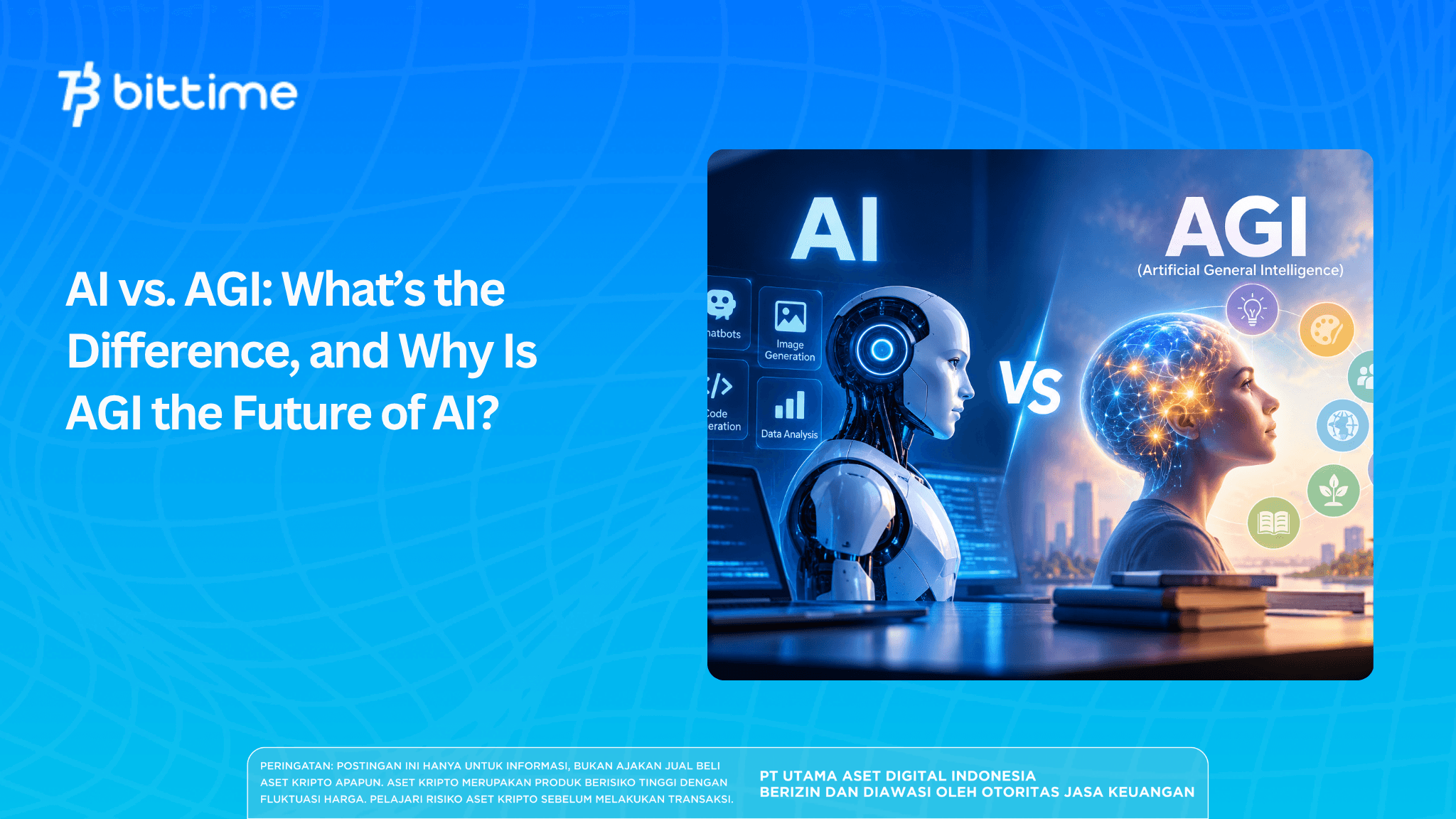
Advances in artificial intelligence are making computers increasingly capable of performing tasks that previously required human abilities.
From generating text and images, analyzing data, and translating languages to assisting with programming tasks, AI technology is now being used across an increasing number of fields.
Meanwhile, artificial general intelligence (AGI) has a much broader goal: creating machines capable of learning, reasoning, adapting, and independently solving a wide range of new problems.
This difference makes the AI vs AGI discussion increasingly relevant. Amid the rapid development of AI technology, AGI has become one of the long-term goals that could transform how humans work and interact with machines.
Key Takeaways
- Current AI generally has specific capabilities, while AGI is designed to generalize knowledge across different types of tasks.
- Artificial general intelligence has not yet been realized as a widely recognized technology; the capabilities of modern AI do not automatically make it AGI.
- If successfully developed, AGI could expand the use of AI into research, robotics, education, healthcare, and many other sectors.
AI vs AGI: What Is the Main Difference?
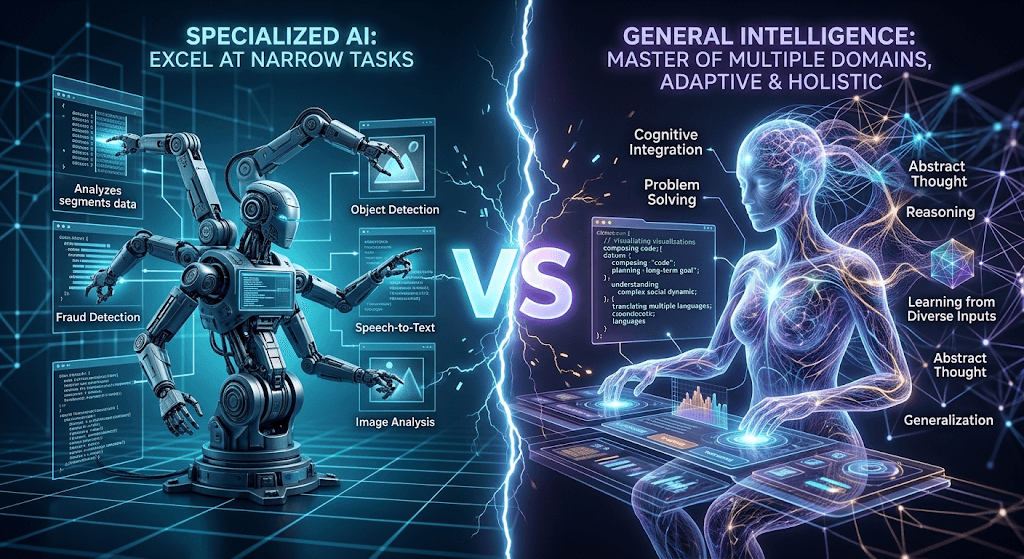
Simply put, AI is a broad term for technologies that enable computers to perform tasks requiring capabilities such as pattern recognition, prediction, language processing, or decision-making.
Examples can be found in product recommendations, chatbots, facial recognition systems, autonomous vehicles, data analysis, and generative AI that produces text, images, and videos.
In contrast, AGI describes a form of AI that theoretically possesses general intellectual capabilities.
Such a system would not only perform tasks it has learned, but also understand new problems and apply knowledge from one field to solve problems in another.
Therefore, the main difference between AI and AGI lies in the scope and flexibility of their capabilities.
AI can be highly effective at one task without being capable of performing another. AGI is expected to be able to move between tasks with a level of adaptability approaching that of humans.
Read Also: 10+ Best AI Coins 2026: Here Is the List of Artificial Intelligence-Themed Crypto!
Why Is AGI Considered the Next Stage?
The progress of AI today shows that machines can achieve remarkable performance in specific fields. However, these capabilities often still depend on the architecture, data, instructions, and environment designed for the system.
AGI aims to overcome these limitations.
Imagine a system that can help a student understand mathematics, then switch to analyzing scientific data, developing business strategies, and learning new skills without requiring a separate model to be created for each task.
Such capabilities would make AI more than just a tool for completing tasks; it would become a system capable of adapting to problems it has never encountered before.
This is why AGI has become one of the main focuses of future technology.
Be productive with AI, invest smarter. Register on Bittime and start building your portfolio today.
Are ChatGPT and Generative AI Already AGI?
Not necessarily. Generative AI is an important development in AI because it can generate content based on patterns learned from data.
However, the ability to convincingly generate text or images does not by itself prove that a system possesses general intelligence.
Modern AI systems can still struggle to understand certain contexts, handle genuinely new situations, or flexibly transfer capabilities from one domain to another.
Therefore, increasingly advanced generative AI capabilities should be viewed as part of the development of artificial intelligence, rather than definitive proof that AGI has been achieved.
Read Also: 11 Best AI Humanizers 2026: Make AI Text More Natural and Human-Like
What Are Some Examples of AGI?
Because AGI remains theoretical, there is no example of AGI that is universally agreed upon as true AGI.
However, a simple illustration could be a system capable of performing various activities with a level of flexibility similar to that of a human worker.
For example, a single system could understand instructions, find the information it needs, learn new methods, solve problems, communicate with humans, and then use that experience to handle different tasks.
If such a system were also connected to robots, these capabilities could be extended into the physical world. In theory, intelligent robots could understand their environment, plan actions, handle unexpected conditions, and independently adjust their movements.
This concept illustrates the relationship between AGI and the future of intelligent robots.
Don't miss updates on AI coin prices such as Bittensor (TAO), Venice Token (VVV), NEAR Protocol (NEAR), and Internet Computer (ICP) on Bittime.
What Still Needs to Be Developed to Achieve AGI?
The gap between current AI and AGI still involves a number of technical challenges. Future systems need stronger reasoning capabilities, a deeper understanding of context, and the ability to recognize and solve problems they have never encountered before.
For robots, the challenges become even more complex. Machines need better visual and audio perception, an understanding of three-dimensional space, autonomous navigation, and precise movement.
Social capabilities are another challenge. Humans do not only understand words, but also interpret context, expressions, emotions, and social situations.
Therefore, achieving AGI is not simply about making models larger or adding more data. Progress is needed across multiple fields, including machine learning, computer vision, natural language processing, deep learning, robotics, and agent systems capable of taking actions autonomously.
Read Also: 11 Best AI Detector Tools
Why Is the Technology World Pursuing AGI?
The reason is not simply to create smarter machines. AGI has the potential to increase productivity and help humans address problems that are too complex or require large amounts of analysis.
In scientific research, for example, systems with generalization capabilities could help combine knowledge from different disciplines. In healthcare, more adaptive AI could potentially assist with analysis and the development of new solutions.
Meanwhile, in manufacturing and robotics, systems capable of understanding environmental conditions could make automation far more flexible.
However, this potential also comes with risks. Increasingly autonomous systems require security mechanisms, human oversight, data protection, and regulations capable of keeping pace with technological development.
What Is the Future of AI and AGI?
There is no certainty about when AGI will actually be achieved. Estimates vary widely, and some researchers even question whether the definition of AGI can be practically achieved.
What is clearer is that AI development continues to move toward systems increasingly capable of understanding different types of input, using tools, performing multi-step tasks, and adapting to user needs.
Therefore, the AI vs AGI debate is not simply about whether machines can think like humans.
The more important question is how far machines can understand the world, learn from experience, and act safely in situations that their creators have not fully predicted.
Read Also: What Is RapidAI? A Medical AI Platform for Stroke Detection and Modern Imaging Analysis
Conclusion
AI and AGI represent two different levels of concepts. Current AI technology is already capable of handling many complex tasks, but it generally remains limited in terms of context and task scope.
Meanwhile, artificial general intelligence describes systems with broader learning and reasoning capabilities, including the ability to handle new problems without being specifically designed for every task.
If AGI is successfully realized, its impact on work, research, robotics, and the economy could be significant. However, the greater a system's capabilities, the more important security, ethics, and human oversight become.

AI projects continue to develop rapidly. Track the price movements of NEAR Protocol (NEAR), Internet Computer (ICP), and Injective (INJ) directly on Bittime.
Bittime is a licensed Digital Financial Asset Trader (PAKD) platform supervised by the Financial Services Authority (OJK) — where you can buy Bitcoin in Indonesia and hundreds of other crypto assets starting from Rp10,000. Registration is fast, secure, and you can get started today.
Track the USDT to IDR conversion and the real-time price movements of your favorite crypto assets. Everything is available in a single crypto investment app that can be downloaded for free from the Play Store.
Ready to get started? Sign up on Bittime now and execute your investment strategy with a platform trusted by millions of users in Indonesia.
FAQ
What is the difference between AI and AGI?
AI is generally designed to perform specific tasks or groups of tasks, while AGI is theoretically capable of learning and completing various types of tasks with broader generalization capabilities.
Does AGI already exist?
There is no system universally recognized as AGI yet. AGI remains a concept or research goal in the development of artificial intelligence.
Is ChatGPT AGI?
Not automatically. ChatGPT is a generative AI system with broad language capabilities, but those capabilities do not by themselves fulfill all the characteristics of AGI.
What are some potential uses of AGI in the future?
AGI could theoretically be used in scientific research, education, healthcare, software development, manufacturing, autonomous vehicles, and intelligent robots capable of adapting to their environment.
Why are technology companies pursuing AGI?
AGI could make AI systems more flexible in handling various tasks, increase productivity, and help solve complex problems that require capabilities across multiple fields.
Disclaimer: The views expressed belong exclusively to the author and do not reflect the views of this platform. This platform and its affiliates disclaim any responsibility for the accuracy or suitability of the information provided. It is for informational purposes only and not intended as financial or investment advice.

.png)