Get to Know What Amortization is, Learn How It Works!
2024-08-05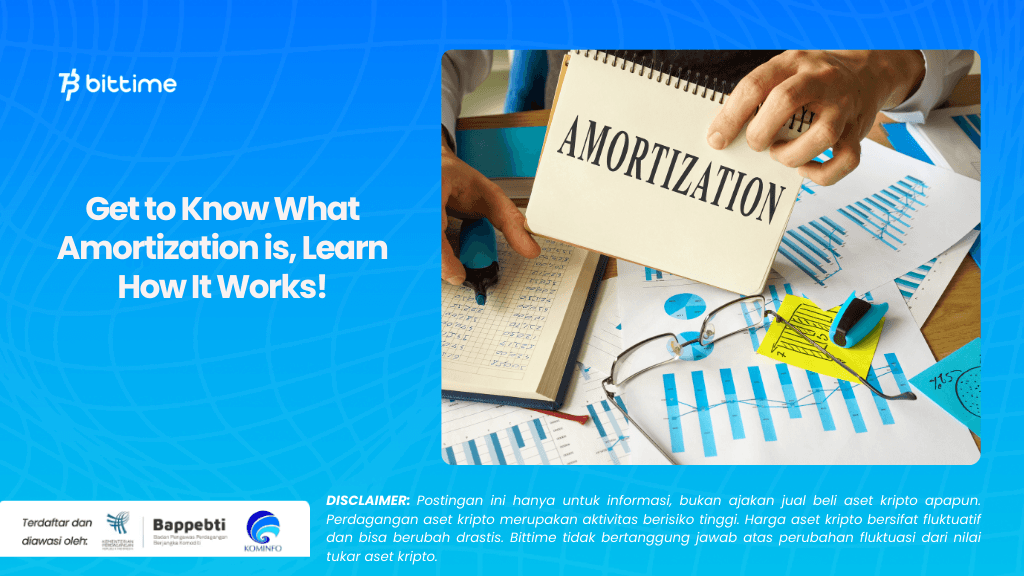
Bittime - In the world of finance, accurately depicting a company's financial health is critical. Amortization plays an important role in achieving this goal by systematically spreading the cost of intangible assets over their useful lives.
This article will take an in-depth look at amortization, its purpose, mechanisms, benefits, and its various forms.

What is Amortization?
Amortization is an accounting process that involves the gradual depreciation of the value of intangible assets over a certain period. In contrast to depreciation applied to tangible assets, amortization is used for assets such as patents, copyrights, trademarks, and licenses.
The main purpose of amortization is to match the cost of an asset with the income generated over its useful life.
Why is Amortization Important?
Amortization has an important role in company financial management:
- Accurate Profit Determination: By allocating the cost of intangible assets in stages, companies can calculate more accurate net income.
- Tax Compliance: Amortization affects taxable income, so proper calculation is critical.
- Decision Making: Information about amortization costs helps management in making investment decisions and the use of intangible assets.
- Transparent Financial Reporting: Amortization provides a more realistic financial picture by reflecting the gradual decline in the value of intangible assets.
How Does Amortization Works?
The amortization process involves the following steps:
- Asset Cost Determination: Determine the initial costs of acquiring or developing the intangible asset.
- Estimated Useful Life: Estimate the time period over which the asset will provide economic benefits.
- Determination of Residual Value: Determine the residual value of the asset at the end of its useful life.
- Calculation of Annual Amortization Cost: Calculate the annual amortization amount by subtracting the residual value from the initial cost and dividing it by the useful life.
- Amortization Recording: Record amortization costs as an expense in the income statement and reduce the value of intangible assets on the balance sheet.
Amortization Methods
There are several methods for calculating amortization:
Straight-Line Method
The straight line method is the simplest method for calculating amortization. The cost of an asset is spread evenly over its useful life. For example, if a patent has a useful life of 10 years with an initial cost of IDR 100,000,000, then the annual amortization is IDR 10,000,000.
The advantage of this method is that it is easy to calculate and understand. Meanwhile, the drawback is that it does not take into account the rapid decline in asset value at the beginning of the useful life.
Declining Balance Method
The declining balance method allocates greater amortization expense at the beginning of the useful life and less at the end of the useful life. The amortization percentage is applied to the asset's book balance each year.
This method reflects a more realistic decline in asset value. However, on the other hand, this method is more complex in calculations.
Units-of-Production Method
The units of production method relates amortization costs to the level of asset utilization. The cost is divided by the total units the asset is expected to produce, and amortization is calculated based on the units actually produced.
This method reflects the actual use of the asset. However, the weakness lies in the difficulty of estimating total production units accurately.
Sum-of-the-Years' Digits Method
This method uses the number of digits of the useful life years to determine the amortization factor. The amortization percentage is higher at the beginning of the useful life and decreases gradually.
The advantage of this method is that it reflects a more rapid decline in asset value at the outset. Although this method is considered more complex.
Factors Influencing Method Selection
The choice of amortization method depends on several factors:
- Nature of assets: Assets with rapid decline in value may be better suited to using the declining balance method.
- Asset usage patterns: If asset usage is inconsistent, the units of production method may be more appropriate.
- Company accounting policies: Some companies have accounting policies that determine the amortization method that should be used.
- Financial reporting objectives: The method chosen must be in accordance with the company's financial reporting objectives.
Amortization vs Depreciation
Amortization and depreciation are two accounting terms that are often used interchangeably, but they have important differences. Both terms refer to the process of allocating the cost of an asset over its useful life, but the difference lies in the type of asset involved.
Although similar, amortization and depreciation have differences:
- Asset Type: Amortization is used for intangible assets, while depreciation is used for tangible assets.
- Reasons for Decreased Value: Amortization reflects a decrease in an asset's value due to the expiration of its useful life, while depreciation reflects a decrease in value due to use, wear, or other factors.
- Calculation Method: Although there are several methods for both, the methods used usually differ due to the different nature of the assets.
Amortization Gain
Amortization provides benefits such as:
- Revenue and Expense Matching: Helps match asset costs with income.
- Better Decision Making: Helps in making investment decisions.
- Tax Benefits: Reduces taxable income.
- Accurate Financial Presentation: Shows a more realistic financial picture.
Amortization Type
In addition to amortization of intangible assets, there is also:
- Loan Amortization: Loan repayment in installments, including interest and principal.
- Mortgage Amortization: The monthly payment for a mortgage, including principal and interest.
Understanding amortization is important for managing intangible assets and making sound financial decisions.
How to Buy Crypto on Bittime
You can buy and sell crypto assets easily and safely via Bittime. Bittime is one of the best crypto applications in Indonesia which is officially registered with Bappebti.
To be able to buy crypto assets on Bittime, make sure you have registered and completed identity verification. Apart from that, also ensure you have sufficient balance by depositing some funds into your wallet. For your information, the minimum purchase of assets on Bittime is IDR 10,000. After that, you can purchase crypto assets in the application. Study Complete Guide How to Buy Crypto on Bittime.
Monitor graphic movement of Bitcoin (BTC) price, Ethereum (ETH), Solana (SOL), and other cryptos to find out today's crypto market trends in real-time on Bittime.
Disclaimer: The views expressed belong exclusively to the author and do not reflect the views of this platform. This platform and its affiliates disclaim any responsibility for the accuracy or suitability of the information provided. It is for informational purposes only and not intended as financial or investment advice.

.png)